google-site-verification: googledf360471e5e08135.html

Category: Professional

  • Introducing Professional Wisdom Hub – Banking, Finance & Legal Learning SeriesLearning from Experience, Sharing with Purpose.

    Introducing Professional Wisdom Hub – Banking, Finance & Legal Learning SeriesLearning from Experience, Sharing with Purpose.

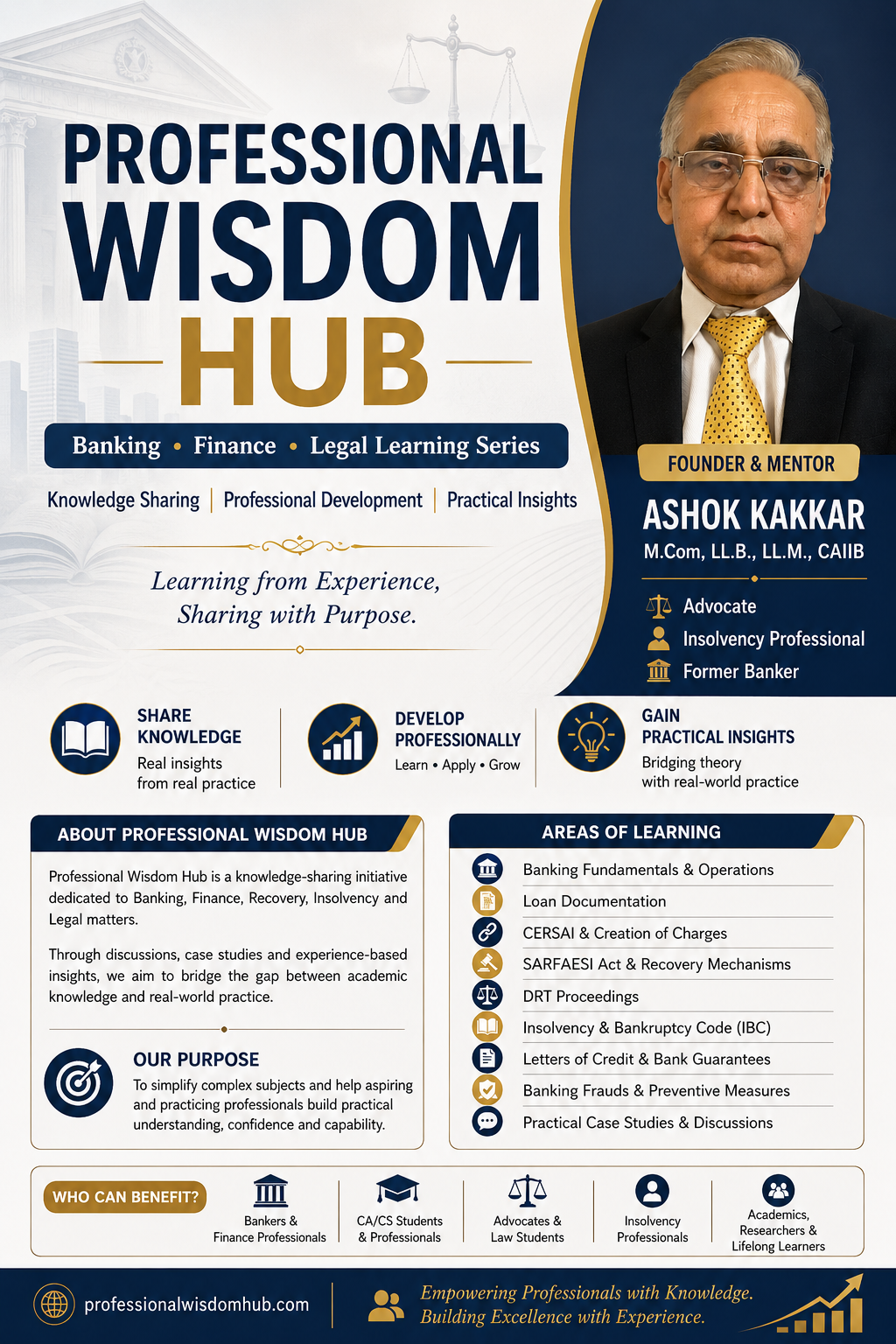
    After more than four decades of experience in banking, recovery, legal practice and insolvency matters, I am pleased to introduce Professional Wisdom Hub – Banking • Finance • Legal Learning Series.

    The objective of this initiative is to share practical knowledge, real-life experiences, case studies and professional insights with bankers, finance professionals, advocates, students and aspiring practitioners. Through discussions and experience-based learning, I hope to contribute towards bridging the gap between academic knowledge and practical application.

    I welcome suggestions, participation and collaboration from all those interested in continuous learning and professional growth.

    Learning from Experience, Sharing with Purpose.

    Ashok Kakkar
    M.Com, LL.B., LL.M., CAIIB
    Advocate | Insolvency Professional | Former Banker

    ProfessionalWisdomHub #BankingEducation #FinanceProfessionals #LegalLearning #IBCIndia #KnowledgeSharing

  • DRT vs SARFAESI: Understanding India’s Banking Recovery Framework

    DRT vs SARFAESI: Understanding India’s Banking Recovery Framework

    A Practical Perspective for Bankers, Borrowers, Students, and Financial Professionals

    The recovery of bank dues is a critical component of a healthy financial system. Banks and financial institutions primarily operate with public deposits and therefore have a responsibility to ensure that funds lent to borrowers are recovered through lawful and effective mechanisms. When borrowers fail to repay loans and accounts become Non-Performing Assets (NPAs), banks are compelled to initiate recovery proceedings under the legal remedies available to them.

    In India, two major recovery mechanisms are commonly used by banks and financial institutions: proceedings before the Debt Recovery Tribunal (DRT) and enforcement actions under the SARFAESI Act, 2002. In recent years, the Insolvency and Bankruptcy Code, 2016 (IBC) has also emerged as an important recovery and resolution framework. Understanding these mechanisms is important not only for bankers and legal professionals but also for borrowers, business owners, students, and financial practitioners.

    Background of Banking Recovery Laws

    Prior to the introduction of specialized recovery laws, banks relied mainly upon ordinary civil courts for recovery of their dues. Recovery suits often took several years due to procedural formalities, repeated adjournments, recording of evidence, and multiple appellate remedies. As credit expansion increased and NPAs began to rise, delays in recovery adversely affected the liquidity and profitability of banks.

    To address these challenges, the Government of India introduced specialized legal frameworks aimed at providing quicker and more effective recovery mechanisms. The establishment of Debt Recovery Tribunals in 1993 and the enactment of the SARFAESI Act in 2002 represented significant reforms in the banking recovery landscape.

    Debt Recovery Tribunal (DRT)

    The Debt Recovery Tribunal system was established under the Recovery of Debts Due to Banks and Financial Institutions Act, 1993, which was later renamed as the Recovery of Debts and Bankruptcy Act.

    The principal objective of DRTs was to provide a specialized judicial forum for adjudication of claims relating to bank dues and financial disputes. Instead of approaching ordinary civil courts, banks could file Original Applications before the Tribunal for recovery of their outstanding dues.

    In DRT proceedings, the Tribunal examines loan documents, statements of account, security documents, evidence produced by the bank, and objections raised by the borrower. If the Tribunal is satisfied that the claim is established, it issues a Recovery Certificate, which can then be executed by the Recovery Officer through attachment and sale of assets.

    The DRT framework provides a structured and legally supervised recovery process. It is particularly useful in matters involving disputed claims, guarantor liability, insufficient security, or complex legal issues requiring adjudication.

    However, despite its intended objective of speedy recovery, DRT proceedings often face practical challenges such as heavy case pendency, procedural delays, adjournments, and prolonged litigation. As a result, recovery through DRT alone may sometimes be time-consuming.

    Introduction of SARFAESI Act

    Recognizing the need for a stronger enforcement mechanism, the Government enacted the Securitisation and Reconstruction of Financial Assets and Enforcement of Security Interest Act, 2002, popularly known as the SARFAESI Act.

    The SARFAESI Act significantly transformed banking recovery practices by empowering secured creditors to enforce security interests without initially approaching a court or tribunal. This reduced dependence on lengthy judicial procedures and enabled banks to take quicker recovery action against defaulting borrowers.

    The Act primarily applies to secured loans where valid security interests such as mortgages, hypothecation, or charges have been created in favour of the lender.

    Key Features of SARFAESI

    Once a loan account is classified as an NPA, the secured creditor may issue a demand notice under Section 13(2) of the Act, requiring the borrower to discharge the outstanding liability within sixty days.

    If the borrower fails to comply with the notice, the bank may take measures under Section 13(4), including:

    • Taking possession of secured assets
    • Taking over management of the secured business in certain situations
    • Appointing a manager
    • Selling or otherwise realizing secured assets for recovery of dues

    Where physical possession of secured assets is resisted, banks may seek assistance from the District Magistrate under Section 14 of the Act.

    Importantly, borrowers retain the right to challenge SARFAESI actions before the Debt Recovery Tribunal under Section 17.

    DRT and SARFAESI: Understanding the Difference

    Although both mechanisms are designed to facilitate recovery of bank dues, their nature and approach are fundamentally different.

    The DRT functions as a judicial adjudicatory forum. Recovery proceedings commence with filing of an application, followed by hearings, examination of evidence, and adjudication by the Tribunal.

    The SARFAESI Act, on the other hand, functions primarily as an enforcement mechanism. It enables secured creditors to take direct action against secured assets without first obtaining a decree or recovery certificate from a court or tribunal.

    Consequently, DRT proceedings are generally tribunal-driven, whereas SARFAESI proceedings are creditor-driven. In many secured asset cases, SARFAESI provides a faster and more efficient recovery route compared to traditional litigation.

    Why Banks Often Prefer SARFAESI

    From a practical banking perspective, SARFAESI offers several advantages:

    • Reduced dependence on lengthy court procedures
    • Faster possession and realization of secured assets
    • Greater control over the recovery process
    • Improved recovery prospects
    • Enhanced pressure for settlement by defaulting borrowers

    These factors often make SARFAESI the preferred recovery route where adequate and enforceable security exists.

    However, SARFAESI is not a universal remedy. It generally does not apply to unsecured loans and certain exempt categories, including specific agricultural lands. Moreover, legal disputes arising from SARFAESI actions frequently return to DRT for adjudication.

    Emergence of the Insolvency and Bankruptcy Code, 2016

    The introduction of the Insolvency and Bankruptcy Code, 2016 brought another important dimension to the recovery and resolution framework in India.

    Unlike DRT and SARFAESI, which primarily focus on recovery and enforcement, the IBC seeks to achieve resolution of stressed entities as a going concern. The objective is not merely to recover dues but also to preserve enterprise value and maximize returns for stakeholders.

    In appropriate corporate insolvency cases, banks and financial creditors may find the IBC route more beneficial than pursuing individual recovery actions under DRT or SARFAESI. The collective insolvency process under the supervision of the National Company Law Tribunal (NCLT) often provides an opportunity for restructuring, revival, or resolution of distressed businesses.

    Accordingly, modern recovery strategies frequently involve evaluating all available options—DRT, SARFAESI, and IBC—before determining the most suitable course of action.

    Conclusion

    The DRT system, the SARFAESI Act, and the Insolvency and Bankruptcy Code together form the backbone of India’s banking recovery and resolution framework. Each mechanism serves a distinct purpose.

    DRT provides a structured judicial forum for adjudication of recovery disputes. SARFAESI empowers secured creditors with direct enforcement rights over secured assets. The IBC offers a comprehensive insolvency resolution framework aimed at preserving value and resolving financial distress.

    The choice among these remedies depends upon factors such as the nature of security, complexity of disputes, borrower profile, recovery prospects, and commercial considerations. Together, these legal mechanisms strengthen financial discipline, safeguard public deposits, improve recovery efficiency, and contribute to the stability of the banking system.

    Disclaimer

    This article is intended solely for educational, academic, and informational purposes. It does not constitute legal advice, banking advice, financial recommendation, or professional opinion for any specific transaction, dispute, or proceeding. Readers should refer to applicable laws, judicial pronouncements, RBI guidelines, and qualified professionals before taking any action relating to DRT proceedings, SARFAESI actions, IBC matters, or banking recovery issues.

    Ashok Kakkar

    Advocate & Insolvency Professional, Former Banker

    Ashok Kakkar is a seasoned banking and legal professional with extensive experience in corporate lending, recovery, insolvency resolution, and financial regulations. Through his writings, he aims to simplify complex banking and legal concepts for students, professionals, borrowers, and businesspersons.

    #DRT #SARFAES I#BankingLaw #DebtRecovery #NPARecovery #IndianBanking #BankRecovery #FinancialLaw #LoanRecovery #LegalAwareness
  • Traditional Litigation Will Always Remain Important — but Young Professionals Should Also Prepare for Emerging Legal Fields

    Traditional Litigation Will Always Remain Important — but Young Professionals Should Also Prepare for Emerging Legal Fields

    Traditional Litigation Will Always Remain Important — but Young Professionals Should Also Prepare for Emerging Legal Fields

    Introduction

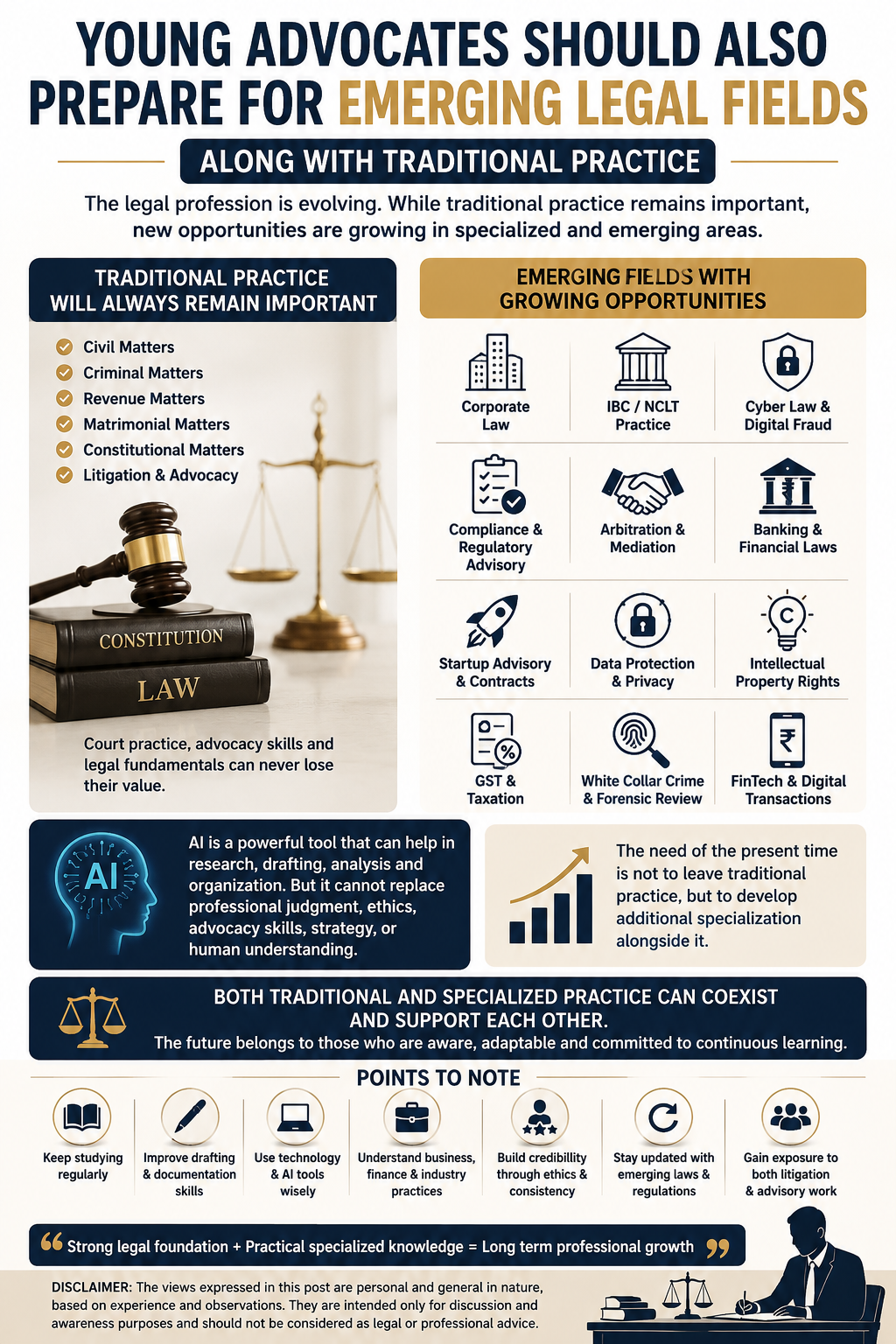
    The legal profession in India is gradually undergoing a major transformation. Traditional litigation practice relating to civil, criminal, revenue, matrimonial, labour, taxation, and constitutional matters continues to remain the backbone of our justice delivery system. Courtroom advocacy, drafting, legal reasoning, and practical litigation experience will always retain their importance and dignity.

    However, alongside traditional practice, rapid developments in business, technology, finance, digital transactions, startups, regulatory systems, and corporate governance have created entirely new opportunities for legal and financial professionals.

    Today, businesses, startups, NBFCs, banks, fintech companies, and technology platforms increasingly require professionals who understand not only legal provisions but also practical commercial realities, compliance structures, financial systems, risk management, and regulatory frameworks.

    As a result, several specialized legal and compliance-related fields are expanding rapidly and creating meaningful professional opportunities for advocates, chartered accountants, company secretaries, insolvency professionals, and young legal practitioners.

    Emerging Areas Creating Professional Opportunities

    In the present environment, the following areas are witnessing substantial growth:

    1. Insolvency & Bankruptcy (IBC/NCLT)

    IBC practice has emerged as one of the fastest-growing professional areas in India. Matters relating to corporate insolvency resolution, liquidation, creditor rights, restructuring, claims verification, and proceedings before NCLT/NCLAT have significantly increased.

    This field requires coordination between advocates, chartered accountants, insolvency professionals, bankers, and corporate advisors.

    2. Corporate Law & Compliance

    With increasing corporate regulation and business expansion, companies now require continuous support in areas such as:

    • Corporate governance
    • Regulatory filings
    • Shareholder agreements
    • Board compliance
    • Corporate restructuring
    • Due diligence
    • Contract management

    Professionals having both legal and financial understanding are increasingly valued.

    3. Banking & Financial Laws

    Banking and finance-related legal work continues to offer long-term opportunities, particularly in:

    • SARFAESI matters
    • DRT proceedings
    • Loan documentation
    • Recovery proceedings
    • Financial frauds
    • Regulatory compliance
    • Negotiable Instruments Act matters

    India’s expanding financial ecosystem continues to generate substantial professional work in these sectors.

    4. Cyber Law & Digital Fraud Matters

    The rapid increase in digital banking, online transactions, fintech platforms, and social media usage has also increased cyber-related disputes and digital fraud cases.

    Legal and financial professionals are increasingly required for:

    • Cyber fraud advisory
    • Digital evidence handling
    • Data protection compliance
    • Online financial fraud disputes
    • IT Act matters
    • Digital transaction-related litigation

    5. Arbitration & Commercial Dispute Resolution

    Commercial entities now increasingly prefer arbitration and mediation for quicker dispute resolution instead of prolonged litigation.

    This has created opportunities in:

    • Domestic arbitration
    • Commercial mediation
    • Infrastructure disputes
    • Contractual disputes
    • Corporate settlements

    6. Startup Advisory & Documentation

    India’s startup ecosystem is expanding rapidly. Startups require support in:

    • Founder agreements
    • Investment documentation
    • ESOP structuring
    • Commercial contracts
    • Regulatory compliance
    • Data privacy frameworks

    Young professionals with strong drafting and documentation skills can build specialized expertise in this area.

    Role of AI & Technology in Professional Practice

    We are now living in an AI-driven and technology-oriented environment. Artificial Intelligence tools are gradually becoming part of professional practice across sectors including law, finance, compliance, and taxation.

    AI can certainly assist in:

    • Legal research
    • Drafting
    • Data organization
    • Compliance review
    • Document analysis
    • Preliminary due diligence

    However, AI cannot replace:

    • Professional judgment
    • Ethics
    • Strategic thinking
    • Practical experience
    • Human understanding
    • Advocacy skills
    • Negotiation ability

    Technology should therefore be treated as a supporting professional tool and not as a substitute for genuine competence and continuous learning.

    Importance of Continuous Learning

    One of the most important realities of the present professional environment is that continuous learning has become essential.

    Professionals today may benefit by:

    • Regular reading and updating
    • Understanding emerging regulations
    • Learning practical drafting
    • Developing technology awareness
    • Understanding financial and commercial systems
    • Building interdisciplinary knowledge

    The future may increasingly favour professionals who combine:

    • legal understanding,
    • financial awareness,
    • commercial practicality,
    • and technological adaptability.

    Traditional Practice Will Continue to Remain Important

    While discussing emerging opportunities, it is equally important to understand that traditional litigation practice will never lose its significance.

    Civil courts, criminal courts, revenue authorities, taxation forums, tribunals, and constitutional courts will continue to remain central to the legal system.

    The need of the present time may therefore not be to abandon traditional practice, but to strengthen oneself with additional specialization and practical knowledge alongside it.

    Both traditional litigation and specialized advisory practice can coexist and complement each other effectively.

    Conclusion

    The professional environment in India is changing steadily due to technological advancement, digital transactions, regulatory expansion, and evolving business systems.

    Young advocates and professionals who remain proactive, disciplined, and continuously updated may find significant opportunities in emerging fields such as:

    • IBC/NCLT
    • Corporate Law
    • Banking & Financial Laws
    • Cyber Law
    • Compliance
    • Arbitration
    • Startup Advisory
    • Data Protection
    • Digital Fraud Matters

    At the same time, traditional litigation skills, ethics, drafting ability, and practical understanding will continue to remain foundational to the legal profession.

    The future may belong to professionals who successfully combine strong fundamentals with continuous learning, practical exposure, and adaptability.

    Disclaimer

    The views expressed in this article are personal, general, and experience-based reflections shared purely for educational and awareness purposes. The article does not constitute legal, financial, career, or professional advice. Readers are advised to exercise their own independent judgment and professional discretion.

    Ashok Kakkar
    Advocate | Insolvency Professional | Former Banker
    Chandigarh

    Ashok Kakkar is an Advocate, Insolvency Professional, and Former Banker with over 40 years of combined experience in banking, finance, recovery, insolvency, and legal practice. He regularly writes and shares practical insights on emerging legal fields, banking laws, IBC/NCLT practice, and professional development for young advocates and professionals.

    #Corporate Law, #IBC, NCLT, #Cyber Law, #Banking Laws, #Arbitration, #Compliance, #Young Advocates, #Legal Profession, #AI, #Professional Development

  • Kakkar Wisdom Hub is Now on YouTube

    Kakkar Wisdom Hub is Now on YouTube

    I am pleased to share that Kakkar Wisdom Hub has expanded its knowledge-sharing initiative through a dedicated YouTube channel.

    The channel aims to provide practical insights and simplified discussions on Banking, Finance, Recovery, Insolvency, and Legal Awareness based on professional experience accumulated over several decades in banking and legal practice.

    The objective is to make complex subjects easier to understand for students, young professionals, bankers, advocates, entrepreneurs, and individuals interested in these fields.

    I invite readers and learners to explore the channel and share their valuable suggestions for future topics and discussions.

    YouTube Channel:
    https://youtube.com/@kakkarwisdomhub

    Learning from Experience, Sharing with Purpose.

    Ashok Kakkar
    Advocate | Insolvency Professional | Former Banker

  • Banking & Legal Wisdom Series- By Ashok Kakkar

    Banking & Legal Wisdom Series

    Experience-Based Knowledge for Structured Financial Understanding

    The Banking & Legal Wisdom Series is a collection of practical, experience-driven books authored by Ashok Kakkar, Advocate, Insolvency Professional, and Senior Banking Professional with over four decades of professional experience.

    This series is built on a simple premise:

    Financial clarity prevents legal complications.

    The books are designed to bridge the gap between theoretical concepts and real-world banking practice. They aim to simplify complex financial structures, documentation processes, credit mechanisms, and risk indicators for professionals, borrowers, students, and informed readers.

    The Foundation of the Series

    The series draws upon:

    • Extensive experience in corporate credit and banking operations
    • Practical exposure to loan documentation and security structuring
    • Risk monitoring and early warning signal identification
    • Insolvency and resolution processes under structured legal frameworks
    • Observations from professional decision-making environments

    Each publication reflects structured analysis rather than academic abstraction.

    Purpose of the Series

    The objectives of the Banking & Legal Wisdom Series are:

    • To promote financial discipline and documentation awareness
    • To clarify practical distinctions in banking operations
    • To enhance understanding of credit risk and compliance
    • To provide accessible knowledge for non-technical readers
    • To encourage responsible financial conduct

    The series is written in simple, precise language while maintaining professional integrity.

    Who Should Read This Series?

    These books are particularly relevant for:

    • Banking professionals
    • Credit officers and risk managers
    • Chartered Accountants
    • Insolvency professionals
    • Law students
    • Entrepreneurs and borrowers
    • Individuals seeking structured financial understanding

    Practical Approach

    Unlike purely academic publications, this series emphasizes:

    • Real-world examples
    • Risk-based thinking
    • Documentation clarity
    • Preventive financial vigilance
    • Ethical professional conduct

    The focus is not only on understanding banking structures but also on understanding their consequences.

    Independent Authorship & Transparency

    While language refinement tools may assist in structuring certain content, all professional insights, interpretations, and subject-matter perspectives are independently developed and reviewed by the author.

    The series reflects cumulative professional experience and structured reflection.

    A Continuing Knowledge Initiative

    The Banking & Legal Wisdom Series is an evolving body of work. Future publications will continue to address:

    • Practical banking frameworks
    • Legal-financial intersections
    • Risk awareness
    • Documentation discipline
    • Professional ethics

    The intention is not promotion, but structured contribution.

    Ashok Kakkar

    Knowledge, when structured through experience, becomes wisdom.

    Books Available on Amazon KDP

    Banking & Legal Wisdom Series – by Ashok Kakkar

    The following titles are currently available through Amazon Kindle Direct Publishing (KDP):

    1. Understanding CIBIL Score and Credit Health in India

    A Practical Guide for Borrowers and Bankers
    Book in Banking & Legal Wisdom Series – by Ashok Kakkar

    2. Fund-Based and Non-Fund-Based Credit Facilities Explained

    A Practical Guide on Working Capital, Letters of Credit, and Bank Guarantees
    Book in Banking & Legal Wisdom Series – by Ashok Kakkar

    3. Early Warning Signals in Bank Accounts

    A Practical Guide for Bankers and Borrowers
    Book in Banking & Legal Wisdom Series – by Ashok Kakkar

    4. Charge on Property by Banks and Financial Institutions

    Legal and Practical Perspective
    Book in Banking & Legal Wisdom Series – by Ashok Kakkar
    5. A Lesson Learned Late

    Clarity, Balance, and Purpose in the Later Stage of Professional Life
    Book in Banking & Legal Wisdom Series – by Ashok Kakkar

    Series Note

    These books are based on structured professional experience and are written in accessible language to support bankers, borrowers, students, professionals, and informed readers seeking clarity in financial and legal matters.

  • Welcome to Professional Wisdom Hub

    Welcome to Professional Wisdom Hub

    Welcome to Professional Wisdom Hub

    Banking • Finance • Legal Learning Series

    Turning Experience into Learning Opportunities for Future Professionals

    In every profession, knowledge is acquired through education, training, observation, and experience. While academic learning provides a strong foundation, practical understanding develops through years of professional engagement, decision-making, problem-solving, and interaction with real-life situations. The lessons learned through experience often extend beyond what can be found in textbooks and classrooms.

    With this belief and objective, I am pleased to introduce Professional Wisdom Hub, a knowledge-sharing initiative dedicated to practical learning and professional development in the fields of Banking, Finance, Recovery, Insolvency, and Law.

    Having spent more than four decades in the banking sector and subsequently practicing as an Advocate and Insolvency Professional, I have had the opportunity to work across diverse areas including banking operations, credit management, loan documentation, recovery proceedings, legal compliance, SARFAESI matters, Debt Recovery Tribunal (DRT) proceedings, creation and enforcement of security interests, CERSAI registrations, insolvency resolution processes, and related legal and financial issues.

    Throughout this professional journey, one observation has remained constant: there exists a significant gap between theoretical knowledge and practical application. Students and young professionals often possess strong academic qualifications but seek practical insights that can help them understand how principles operate in real-world situations. At the same time, many experienced professionals carry valuable knowledge and practical wisdom that deserves to be documented, shared, and passed on to future generations.

    Professional Wisdom Hub has been conceived as a platform to bridge this gap.

    The initiative aims to create an environment where practical experiences, professional insights, case studies, regulatory developments, and real-world perspectives can be shared in a simple, understandable, and meaningful manner. The focus is not merely on explaining legal provisions or banking concepts but on understanding their practical implications and applications.

    The platform is intended for:

    • Banking professionals and banking aspirants
    • Finance professionals and students
    • Chartered Accountants, Company Secretaries, and management students
    • Advocates and law students
    • Insolvency professionals and insolvency enthusiasts
    • Entrepreneurs and business owners
    • Individuals interested in banking, finance, legal, and insolvency matters

    The proposed areas of discussion and learning include:

    • Banking Operations and Practices
    • Credit Management and Loan Documentation
    • Creation and Enforcement of Security Interests
    • Mortgages, Hypothecation, and Guarantees
    • SARFAESI Act and Recovery Mechanisms
    • Debt Recovery Tribunal (DRT) Proceedings
    • CERSAI Registration and Compliance
    • Insolvency and Bankruptcy Code (IBC)
    • Banking Frauds and Preventive Measures
    • Letters of Credit and Bank Guarantees
    • Regulatory and Legal Developments
    • Practical Case Studies and Professional Experiences

    Professional Wisdom Hub is envisioned not merely as a training programme but as a community of learning. Through articles, discussions, webinars, videos, interactive sessions, and knowledge-sharing initiatives, the endeavour seeks to encourage continuous learning and professional growth.

    The objective is simple: to transform professional experience into meaningful learning opportunities for those preparing to enter or advance within their chosen professions. Equally important is the opportunity to learn from the perspectives and experiences of others, thereby creating a mutually beneficial environment for knowledge exchange.

    I believe that professional wisdom acquires its true value when it is shared. Every experience, whether successful or challenging, carries lessons that may help others avoid mistakes, make informed decisions, and grow with confidence.

    I warmly invite professionals, students, practitioners, educators, and lifelong learners to join this journey of knowledge sharing and professional development. Your participation, suggestions, experiences, and perspectives will contribute to making this initiative meaningful and beneficial for all.

    Together, let us build a platform where experience becomes knowledge, knowledge becomes understanding, and understanding contributes to professional excellence.

    Professional Wisdom Hub

    Banking • Finance • Legal Learning Series

    Learning from Experience, Sharing with Purpose

    Ashok Kakkar
    M.Com, LL.B., LL.M., CAIIB
    Advocate | Insolvency Professional | Former Banker

     kakkarwisdomhub@gmail.com
    https://legalwisdomhub.in

    #Banking & Finance ,#Legal Education,# Insolvency & Bankruptcy ,#Career Guidance,# Knowledge Sharing