google-site-verification: googledf360471e5e08135.html

Category: SARFAESI

  • Understanding Early Warning Signals (EWS) in Bank Accounts

    Understanding Early Warning Signals (EWS) in Bank Accounts

    Understanding Early Warning Signals (EWS) in Bank Accounts

    A Practical Banking Perspective

    Introduction: Why Problems in Loan Accounts Rarely Come Suddenly

    In banking practice, loan accounts do not become Non-Performing Assets (NPAs) overnight. Almost every stressed account shows warning signs much before it crosses the critical 90-day overdue mark. These signs, commonly referred to as Early Warning Signals (EWS), appear quietly in account operations, financial discipline, stock management, borrower behaviour, and compliance with bank requirements.

    Unfortunately, such signals are often ignored or treated as routine irregularities—either due to work pressure, over-reliance on system reports, or the belief that temporary issues will resolve on their own. By the time serious action is taken, the account has already slipped into Special Mention Account (SMA) or NPA, leaving very limited scope for correction.

    This article explains EWS from a banker’s practical perspective, while also guiding borrowers on what to avoid, how issues can be corrected early, and why discipline and transparency matter.

    1. What Are Early Warning Signals?

    Early Warning Signals are indicators of stress suggesting that a borrower’s conduct, business operations, or financial position is deviating from sanctioned terms and sound banking norms.

    They are not defaults by themselves. The real concern is:

    • Frequency of irregularities
    • Repetition over time
    • Borrower’s attitude towards rectification

    An isolated delay may be manageable; a recurring pattern reflects deeper stress.

    2. Transactional Red Flags in Bank Accounts

    Account operations provide the earliest and most reliable signals, as they reflect real-time cash flows.

    Common EWS

    1. Frequent overdrawing beyond sanctioned limits
    2. Temporary overdrafts becoming routine
    3. Clearing overdues at the eleventh hour to avoid NPA
    4. Sudden fall in turnover without explanation
    5. Routing business through other banks while limits are used here
    6. Irregular interest servicing

    How Banks Verify

    • Scrutiny of account statements and system alerts
    • Comparison with projected turnover and CMA data
    • Review of month-end and quarter-end adjustments

    Corrective Steps

    • Immediate discussion with the borrower
    • Restriction or freezing of further drawings
    • Insistence on routing full business through the financed account
    • Review or restructuring of limits, where justified

    Borrower’s Responsibility

    Avoid cosmetic adjustments merely to “save” the account. Genuine difficulties must be communicated early with a realistic correction plan.

    3. Stock Statements, Inventory and Drawing Power Issues

    Working capital accounts are particularly vulnerable to manipulation through stock statements.

    Common EWS

    1. Delay or non-submission of stock statements
    2. Identical stock figures month after month
    3. Inflated stock without matching sales
    4. Old, obsolete, or unusable stock lying in premises
    5. Debtors outstanding beyond 90 days or sanction terms
    6. Mismatch between stock value and insurance cover

    Verification by Bank

    • Regular and surprise inspections
    • Cross-check with GST returns and sales records
    • Age-wise debtor analysis
    • Verification of insurance policies

    Corrective Steps

    • Reassessment and reduction of Drawing Power (DP)
    • Exclusion of obsolete stock and old debtors
    • Tightening of margins and disbursement conditions

    Borrower’s Responsibility

    Maintain proper inventory records and submit accurate stock statements. No excuse is acceptable during verification—regular or otherwise.

    4. Financial Reporting, Balance Sheets and QIS Delays

    Common EWS

    1. Delay in submission of audited Balance Sheets
    2. Non-submission or casual submission of QIS and CMA data
    3. Delay in renewal of limits
    4. Adverse audit remarks not addressed
    5. Statutory dues (GST, PF, TDS) remaining unpaid

    Bank’s Verification

    • Monitoring renewal calendars
    • Review of audit reports and statutory compliance
    • Tracking borrower responses to reminders

    Corrective Steps

    • Freezing or restricting limits until compliance
    • Downgrading internal credit rating
    • Escalation to controlling office

    Borrower’s Responsibility

    Financial reporting is a contractual obligation, not a formality. Timely compliance protects ratings and future funding.

    5. Behavioural and Soft Signals (Often Ignored)

    Soft signals are not reflected in MIS but are often early indicators of trouble.

    Common Soft Signals

    1. Avoiding meetings, inspections, or bank communication
    2. Evasive or delayed replies to bank letters
    3. Negative market feedback
    4. Disputes among partners, directors, or family members
    5. Withdrawal or reluctance of guarantors
    6. Promoters prioritising luxury spending despite business stress

    Bank’s Approach

    • Field visits and personal interaction
    • Market intelligence from suppliers and buyers
    • Review of legal disputes and public records

    6. Security, Mortgage and Documentation Irregularities

    Common EWS

    1. Delay in creation or perfection of security
    2. Title defects in mortgaged property
    3. Non-registration of charge where required
    4. Insurance lapses or under-insurance

    Corrective Steps

    • Immediate rectification or additional collateral
    • Suspension of further disbursement

    7. From EWS to SMA and NPA – A Slippery Slope

    Repeated tolerance of:

    • Frequent overdrawing
    • Eleventh-hour adjustments
    • Temporary accommodations

    creates a false sense of comfort. Allowing accounts to hover near 90 days only postpones the problem and worsens recovery prospects.

    8. Impact on Borrowers: The Hidden Cost of Nominal Irregularities

    Ignoring EWS leads to:

    • Downgrade in internal bank rating
    • Higher interest rates and reduced limits
    • Adverse impact on CIBIL score
    • Classification as SMA-1 / SMA-2
    • Eventual NPA
    • Loss of business goodwill
    • Difficulty in meeting future funding needs

    What appears “minor” today can permanently impair creditworthiness.

    9. Joint Responsibility: Banker and Borrower Together

    Banker Must

    • Act on first signal, not first default
    • Avoid habitual ad-hoc adjustments
    • Enforce discipline consistently

    Borrower Must

    • Operate accounts transparently
    • Maintain proper records
    • Respond promptly to inspections and letters
    • Prioritise business stability over personal luxuries

    10. Final Checklist to Avoid Irregularities

    1. Maintain disciplined account operations
    2. Submit stock statements, financials, and QIS on time
    3. Route genuine turnover through the financed account
    4. Ensure proper creation and maintenance of security
    5. Keep inventory and debtor records updated
    6. Respond promptly to bank communications
    7. Resolve disputes among partners or guarantors early

    Conclusion: Prevention Is Better Than Recovery

    Early Warning Signals are protective mechanisms, not punitive tools. Timely recognition and correction preserve asset quality, protect business goodwill, and maintain healthy banker-borrower relationships.

    In banking, discipline today prevents distress tomorrow.

    A Final Message

    For bankers, EWS provide the opportunity to act early.
    For borrowers, they offer a chance to correct course before damage becomes irreversible.
    Ignoring them helps no one.

    Disclaimer

    This article is intended for educational and informational purposes only. It reflects practical experience and general banking principles. It does not constitute legal, financial, or professional advice. Readers are advised to consult applicable laws, regulatory guidelines, and professional advisors before taking any decision

    By-Ashok Kakkar .

    #SMA Accounts,# Loan Monitoring, #Risk Management in Banking, #Working Capital Finance, #Borrower Awareness, #Financial Discipline, #Credit Rating, #CIBIL Score,


  • Practical Banking Perspective: What Lenders Examine Before Sanctioning Loans

    Practical Banking Perspective: What Lenders Examine Before Sanctioning Loans

    Practical Banking Perspective: What Lenders Examine Before Sanctioning Loans

    Understanding Credit Assessment, Financial Discipline, Documentation, and Risk Evaluation in Modern Lending Practices

    Applicable To:

    Individuals • Professionals • Students • Home Buyers • Business Owners • First-Time Borrowers

    1. Introduction

    In today’s financial environment, loans have become an important part of economic and personal growth. Whether a person wishes to purchase a house, expand a business, pursue higher education, buy a vehicle, or manage temporary financial needs, borrowing has become a common financial tool.

    However, many borrowers still approach the loan process without fully understanding how banks and financial institutions actually evaluate loan applications. From a practical banking perspective, loan sanctioning is not merely about filling forms or submitting documents. It is a detailed process involving financial assessment, legal verification, credit evaluation, compliance checking, and risk management.

    Every lender — whether a bank, NBFC, housing finance company, or cooperative institution — must ensure that the proposed borrowing remains financially sustainable and legally secure.

    2. Core Objectives of Loan Evaluation

    Before approving any loan, lenders generally try to evaluate three major aspects:

    2.1 Repayment Capacity

    Whether the borrower has sufficient and stable income to repay the loan comfortably throughout the loan tenure.

    2.2 Genuineness of Purpose

    Whether the loan requirement appears genuine, reasonable, and properly disclosed by the borrower.

    2.3 Overall Credit Risk

    Whether the overall financial and legal risk involved in the proposal is acceptable according to the lender’s policy and regulatory framework.

    3. Identity Verification and KYC Compliance

    The first stage of loan processing usually involves identity verification and KYC compliance.

    Lenders commonly ask for:

    1. PAN Card
    2. Aadhaar Card
    3. Passport
    4. Voter ID
    5. Driving Licence
    6. Address Proof
    7. Recent Photographs

    This process helps financial institutions:

    1. Prevent fraud and impersonation
    2. Comply with RBI and anti-money laundering regulations
    3. Verify the borrower’s identity and address authenticity

    Even minor mismatches in documents may sometimes delay loan processing.

    4. Income Source and Financial Stability

    One of the most important aspects of loan assessment is repayment capability.

    Lenders generally evaluate:

    1. Salary income
    2. Business income
    3. Professional income
    4. Rental income
    5. Agricultural income (where acceptable)
    6. Other regular earnings

    4.1 Documents Commonly Required from Salaried Individuals

    1. Salary slips
    2. Form 16
    3. Bank statements
    4. Employment proof

    4.2 Documents Commonly Required from Self-Employed Borrowers

    1. Income Tax Returns (ITRs)
    2. GST returns
    3. Balance Sheet
    4. Profit & Loss Account
    5. Business registration documents

    The purpose is to assess whether income is stable and sustainable during the loan period.

    5. Existing Liabilities and Debt Burden

    Banks also assess the borrower’s current financial obligations before sanctioning fresh credit.

    These may include:

    1. Existing home loans
    2. Personal loans
    3. Vehicle loans
    4. Credit card dues
    5. Business liabilities
    6. Overdraft facilities
    7. Guarantee obligations

    Lenders calculate the borrower’s FOIR (Fixed Obligation to Income Ratio) to determine whether the borrower is already overburdened with debt.

    6. Credit Score and Financial Discipline

    Modern lending systems heavily depend upon credit history and repayment behaviour.

    Lenders generally review:

    1. CIBIL score
    2. Past repayment history
    3. Delayed EMI payments
    4. Loan defaults
    5. Settlement history
    6. Number of recent loan enquiries

    Generally, a higher credit score improves:

    1. Loan approval chances
    2. Interest rate negotiation
    3. Faster processing possibilities

    A healthy credit profile reflects financial discipline and responsible borrowing habits.

    7. Bank Account Conduct and Transaction Behaviour

    Bank statements often reveal important details about the borrower’s financial discipline.

    Lenders examine:

    1. Salary credits
    2. Average monthly balance
    3. Frequency of cheque returns
    4. ECS dishonours
    5. Irregular cash deposits
    6. Transaction patterns
    7. Overall account conduct

    Poor account management may create a negative impression even if income appears satisfactory.

    8. Purpose of the Loan

    Lenders always try to understand why the borrower requires the loan.

    Different loan purposes involve different risk levels.

    8.1 Home Loans

    Focus generally remains on:

    1. Property documents
    2. Approved plans
    3. Long-term repayment stability
    4. Property valuation

    8.2 Business Loans

    Lenders may focus more on:

    1. Business turnover
    2. Cash flow
    3. GST returns
    4. Financial statements

    8.3 Personal Loans

    Greater importance is usually given to:

    1. Salary stability
    2. Existing EMIs
    3. Credit score

    8.4 Education Loans

    Banks may evaluate:

    1. Institution reputation
    2. Course quality
    3. Employability prospects
    4. Parent or co-applicant profile

    9. Property and Security Evaluation

    In secured loans, lenders also examine the legality and value of the collateral offered.

    Commonly required documents include:

    1. Sale deed
    2. Title documents
    3. Mutation records
    4. Approved building plans
    5. No-Encumbrance Certificate (NEC)
    6. Property valuation reports
    7. Tax receipts

    Banks conduct both legal scrutiny and technical valuation before accepting property as security.

    10. Evaluation of Composite Loans

    Composite loans involve:

    1. Purchase of land
    2. Construction of house

    These loans are useful for borrowers wishing to build customized homes instead of purchasing ready-built flats or apartments.

    However, lenders treat such loans cautiously because the final security gets created gradually during construction.

    Banks usually evaluate:

    1. Clear land ownership
    2. Approved construction plans
    3. Architect estimates
    4. Construction cost projections
    5. Stage-wise disbursement requirements
    6. Site inspection reports
    7. End-use monitoring of funds

    Funds are often released in phases such as:

    1. Land purchase stage
    2. Foundation stage
    3. Plinth stage
    4. Structure completion stage
    5. Finishing stage

    11. Common Mistakes Borrowers Frequently Make

    Many borrowers unknowingly create financial difficulties for themselves.

    Some common mistakes include:

    1. Focusing only on EMI amount
    2. Ignoring total repayment burden
    3. Signing documents without reading them
    4. Concealing liabilities
    5. Ignoring mortgage conditions
    6. Applying simultaneously to multiple lenders
    7. Ignoring insurance obligations
    8. Depending entirely on agents without verification

    Financial decisions should always be taken carefully and after proper understanding.

    12. Practical Suggestions for Borrowers

    Before approaching any lender, borrowers should ideally:

    1. Organize all financial documents properly
    2. Maintain healthy banking habits
    3. Check credit score regularly
    4. Avoid unnecessary loan enquiries
    5. Understand total repayment obligations
    6. Read all loan terms carefully
    7. Avoid signing blank documents
    8. Verify property papers independently
    9. Maintain financial discipline consistently
    10. Seek professional guidance whenever necessary


    13. Conclusion

    Lenders’ questions and documentation requirements are not merely procedural formalities. They are intended to protect both the lender and the borrower from future financial stress and legal complications.

    A borrower who maintains financial discipline, transparency, organized records, and realistic repayment planning generally stands a much better chance of obtaining loan approval smoothly and on favorable terms.

    In practical financial life, informed borrowing is just as important as informed earning.

    14. Message to Readers

    Loans can become powerful financial tools when used responsibly and with proper planning. However, borrowing without understanding long-term obligations may create unnecessary financial pressure.

    Before taking any loan:

    1. Understand the total repayment burden — not merely the EMI
    2. Read sanction terms and mortgage conditions carefully
    3. Verify property documents legally
    4. Maintain transparency with the lender
    5. Borrow according to actual repayment capacity

    Financial literacy, documentation discipline, and responsible borrowing habits play a major role in achieving long-term financial stability and peace of mind.

    15. Disclaimer

    This write-up is prepared purely for general educational and informational purposes based on practical banking understanding and standard lending practices in India. Lending policies, documentation requirements, eligibility criteria, and regulatory guidelines may vary between institutions and may change over time.

    Readers are advised to consult qualified financial, legal, banking, or professional advisors before making any financial decision. The author shall not be responsible for any action taken solely on the basis of the information contained in this article.

    Ashok Kakkar

    Advocate & Insolvency Professional, Former Banker

    Ashok Kakkar is an independent writer and financial literacy enthusiast with a keen interest in banking practices, legal awareness, and public financial education. He regularly writes on practical issues relating to loans, banking systems, financial discipline, and consumer awareness in simple and reader-friendly language.

  • Introducing Professional Wisdom Hub – Banking, Finance & Legal Learning SeriesLearning from Experience, Sharing with Purpose.

    Introducing Professional Wisdom Hub – Banking, Finance & Legal Learning SeriesLearning from Experience, Sharing with Purpose.

    After more than four decades of experience in banking, recovery, legal practice and insolvency matters, I am pleased to introduce Professional Wisdom Hub – Banking • Finance • Legal Learning Series.

    The objective of this initiative is to share practical knowledge, real-life experiences, case studies and professional insights with bankers, finance professionals, advocates, students and aspiring practitioners. Through discussions and experience-based learning, I hope to contribute towards bridging the gap between academic knowledge and practical application.

    I welcome suggestions, participation and collaboration from all those interested in continuous learning and professional growth.

    Learning from Experience, Sharing with Purpose.

    Ashok Kakkar
    M.Com, LL.B., LL.M., CAIIB
    Advocate | Insolvency Professional | Former Banker

    ProfessionalWisdomHub #BankingEducation #FinanceProfessionals #LegalLearning #IBCIndia #KnowledgeSharing

  • DRT vs SARFAESI: Understanding India’s Banking Recovery Framework

    DRT vs SARFAESI: Understanding India’s Banking Recovery Framework

    A Practical Perspective for Bankers, Borrowers, Students, and Financial Professionals

    The recovery of bank dues is a critical component of a healthy financial system. Banks and financial institutions primarily operate with public deposits and therefore have a responsibility to ensure that funds lent to borrowers are recovered through lawful and effective mechanisms. When borrowers fail to repay loans and accounts become Non-Performing Assets (NPAs), banks are compelled to initiate recovery proceedings under the legal remedies available to them.

    In India, two major recovery mechanisms are commonly used by banks and financial institutions: proceedings before the Debt Recovery Tribunal (DRT) and enforcement actions under the SARFAESI Act, 2002. In recent years, the Insolvency and Bankruptcy Code, 2016 (IBC) has also emerged as an important recovery and resolution framework. Understanding these mechanisms is important not only for bankers and legal professionals but also for borrowers, business owners, students, and financial practitioners.

    Background of Banking Recovery Laws

    Prior to the introduction of specialized recovery laws, banks relied mainly upon ordinary civil courts for recovery of their dues. Recovery suits often took several years due to procedural formalities, repeated adjournments, recording of evidence, and multiple appellate remedies. As credit expansion increased and NPAs began to rise, delays in recovery adversely affected the liquidity and profitability of banks.

    To address these challenges, the Government of India introduced specialized legal frameworks aimed at providing quicker and more effective recovery mechanisms. The establishment of Debt Recovery Tribunals in 1993 and the enactment of the SARFAESI Act in 2002 represented significant reforms in the banking recovery landscape.

    Debt Recovery Tribunal (DRT)

    The Debt Recovery Tribunal system was established under the Recovery of Debts Due to Banks and Financial Institutions Act, 1993, which was later renamed as the Recovery of Debts and Bankruptcy Act.

    The principal objective of DRTs was to provide a specialized judicial forum for adjudication of claims relating to bank dues and financial disputes. Instead of approaching ordinary civil courts, banks could file Original Applications before the Tribunal for recovery of their outstanding dues.

    In DRT proceedings, the Tribunal examines loan documents, statements of account, security documents, evidence produced by the bank, and objections raised by the borrower. If the Tribunal is satisfied that the claim is established, it issues a Recovery Certificate, which can then be executed by the Recovery Officer through attachment and sale of assets.

    The DRT framework provides a structured and legally supervised recovery process. It is particularly useful in matters involving disputed claims, guarantor liability, insufficient security, or complex legal issues requiring adjudication.

    However, despite its intended objective of speedy recovery, DRT proceedings often face practical challenges such as heavy case pendency, procedural delays, adjournments, and prolonged litigation. As a result, recovery through DRT alone may sometimes be time-consuming.

    Introduction of SARFAESI Act

    Recognizing the need for a stronger enforcement mechanism, the Government enacted the Securitisation and Reconstruction of Financial Assets and Enforcement of Security Interest Act, 2002, popularly known as the SARFAESI Act.

    The SARFAESI Act significantly transformed banking recovery practices by empowering secured creditors to enforce security interests without initially approaching a court or tribunal. This reduced dependence on lengthy judicial procedures and enabled banks to take quicker recovery action against defaulting borrowers.

    The Act primarily applies to secured loans where valid security interests such as mortgages, hypothecation, or charges have been created in favour of the lender.

    Key Features of SARFAESI

    Once a loan account is classified as an NPA, the secured creditor may issue a demand notice under Section 13(2) of the Act, requiring the borrower to discharge the outstanding liability within sixty days.

    If the borrower fails to comply with the notice, the bank may take measures under Section 13(4), including:

    • Taking possession of secured assets
    • Taking over management of the secured business in certain situations
    • Appointing a manager
    • Selling or otherwise realizing secured assets for recovery of dues

    Where physical possession of secured assets is resisted, banks may seek assistance from the District Magistrate under Section 14 of the Act.

    Importantly, borrowers retain the right to challenge SARFAESI actions before the Debt Recovery Tribunal under Section 17.

    DRT and SARFAESI: Understanding the Difference

    Although both mechanisms are designed to facilitate recovery of bank dues, their nature and approach are fundamentally different.

    The DRT functions as a judicial adjudicatory forum. Recovery proceedings commence with filing of an application, followed by hearings, examination of evidence, and adjudication by the Tribunal.

    The SARFAESI Act, on the other hand, functions primarily as an enforcement mechanism. It enables secured creditors to take direct action against secured assets without first obtaining a decree or recovery certificate from a court or tribunal.

    Consequently, DRT proceedings are generally tribunal-driven, whereas SARFAESI proceedings are creditor-driven. In many secured asset cases, SARFAESI provides a faster and more efficient recovery route compared to traditional litigation.

    Why Banks Often Prefer SARFAESI

    From a practical banking perspective, SARFAESI offers several advantages:

    • Reduced dependence on lengthy court procedures
    • Faster possession and realization of secured assets
    • Greater control over the recovery process
    • Improved recovery prospects
    • Enhanced pressure for settlement by defaulting borrowers

    These factors often make SARFAESI the preferred recovery route where adequate and enforceable security exists.

    However, SARFAESI is not a universal remedy. It generally does not apply to unsecured loans and certain exempt categories, including specific agricultural lands. Moreover, legal disputes arising from SARFAESI actions frequently return to DRT for adjudication.

    Emergence of the Insolvency and Bankruptcy Code, 2016

    The introduction of the Insolvency and Bankruptcy Code, 2016 brought another important dimension to the recovery and resolution framework in India.

    Unlike DRT and SARFAESI, which primarily focus on recovery and enforcement, the IBC seeks to achieve resolution of stressed entities as a going concern. The objective is not merely to recover dues but also to preserve enterprise value and maximize returns for stakeholders.

    In appropriate corporate insolvency cases, banks and financial creditors may find the IBC route more beneficial than pursuing individual recovery actions under DRT or SARFAESI. The collective insolvency process under the supervision of the National Company Law Tribunal (NCLT) often provides an opportunity for restructuring, revival, or resolution of distressed businesses.

    Accordingly, modern recovery strategies frequently involve evaluating all available options—DRT, SARFAESI, and IBC—before determining the most suitable course of action.

    Conclusion

    The DRT system, the SARFAESI Act, and the Insolvency and Bankruptcy Code together form the backbone of India’s banking recovery and resolution framework. Each mechanism serves a distinct purpose.

    DRT provides a structured judicial forum for adjudication of recovery disputes. SARFAESI empowers secured creditors with direct enforcement rights over secured assets. The IBC offers a comprehensive insolvency resolution framework aimed at preserving value and resolving financial distress.

    The choice among these remedies depends upon factors such as the nature of security, complexity of disputes, borrower profile, recovery prospects, and commercial considerations. Together, these legal mechanisms strengthen financial discipline, safeguard public deposits, improve recovery efficiency, and contribute to the stability of the banking system.

    Disclaimer

    This article is intended solely for educational, academic, and informational purposes. It does not constitute legal advice, banking advice, financial recommendation, or professional opinion for any specific transaction, dispute, or proceeding. Readers should refer to applicable laws, judicial pronouncements, RBI guidelines, and qualified professionals before taking any action relating to DRT proceedings, SARFAESI actions, IBC matters, or banking recovery issues.

    Ashok Kakkar

    Advocate & Insolvency Professional, Former Banker

    Ashok Kakkar is a seasoned banking and legal professional with extensive experience in corporate lending, recovery, insolvency resolution, and financial regulations. Through his writings, he aims to simplify complex banking and legal concepts for students, professionals, borrowers, and businesspersons.

    #DRT #SARFAES I#BankingLaw #DebtRecovery #NPARecovery #IndianBanking #BankRecovery #FinancialLaw #LoanRecovery #LegalAwareness

  • Traditional Litigation Will Always Remain Important — but Young Professionals Should Also Prepare for Emerging Legal Fields

    Traditional Litigation Will Always Remain Important — but Young Professionals Should Also Prepare for Emerging Legal Fields

    Traditional Litigation Will Always Remain Important — but Young Professionals Should Also Prepare for Emerging Legal Fields

    Introduction

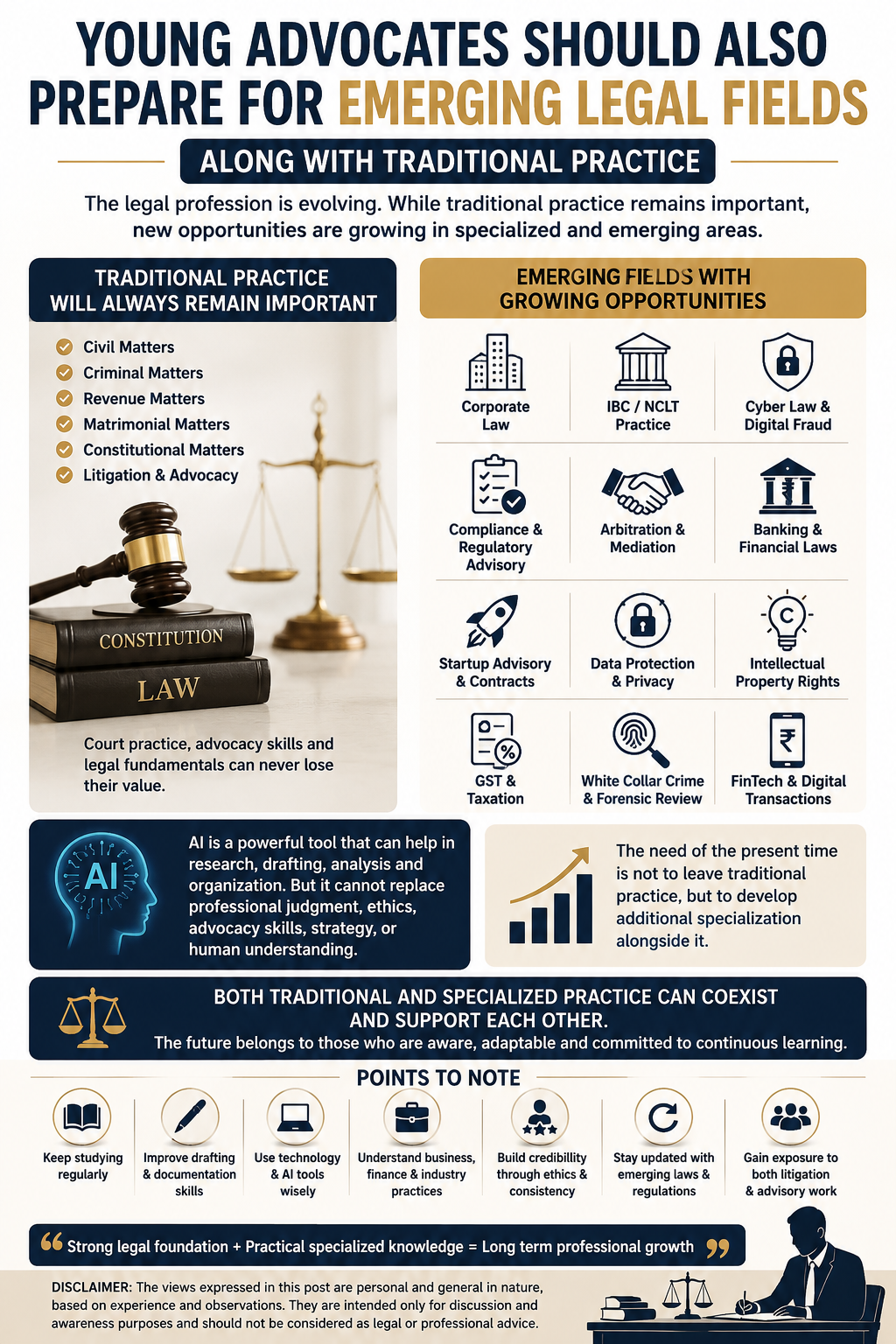
    The legal profession in India is gradually undergoing a major transformation. Traditional litigation practice relating to civil, criminal, revenue, matrimonial, labour, taxation, and constitutional matters continues to remain the backbone of our justice delivery system. Courtroom advocacy, drafting, legal reasoning, and practical litigation experience will always retain their importance and dignity.

    However, alongside traditional practice, rapid developments in business, technology, finance, digital transactions, startups, regulatory systems, and corporate governance have created entirely new opportunities for legal and financial professionals.

    Today, businesses, startups, NBFCs, banks, fintech companies, and technology platforms increasingly require professionals who understand not only legal provisions but also practical commercial realities, compliance structures, financial systems, risk management, and regulatory frameworks.

    As a result, several specialized legal and compliance-related fields are expanding rapidly and creating meaningful professional opportunities for advocates, chartered accountants, company secretaries, insolvency professionals, and young legal practitioners.

    Emerging Areas Creating Professional Opportunities

    In the present environment, the following areas are witnessing substantial growth:

    1. Insolvency & Bankruptcy (IBC/NCLT)

    IBC practice has emerged as one of the fastest-growing professional areas in India. Matters relating to corporate insolvency resolution, liquidation, creditor rights, restructuring, claims verification, and proceedings before NCLT/NCLAT have significantly increased.

    This field requires coordination between advocates, chartered accountants, insolvency professionals, bankers, and corporate advisors.

    2. Corporate Law & Compliance

    With increasing corporate regulation and business expansion, companies now require continuous support in areas such as:

    • Corporate governance
    • Regulatory filings
    • Shareholder agreements
    • Board compliance
    • Corporate restructuring
    • Due diligence
    • Contract management

    Professionals having both legal and financial understanding are increasingly valued.

    3. Banking & Financial Laws

    Banking and finance-related legal work continues to offer long-term opportunities, particularly in:

    • SARFAESI matters
    • DRT proceedings
    • Loan documentation
    • Recovery proceedings
    • Financial frauds
    • Regulatory compliance
    • Negotiable Instruments Act matters

    India’s expanding financial ecosystem continues to generate substantial professional work in these sectors.

    4. Cyber Law & Digital Fraud Matters

    The rapid increase in digital banking, online transactions, fintech platforms, and social media usage has also increased cyber-related disputes and digital fraud cases.

    Legal and financial professionals are increasingly required for:

    • Cyber fraud advisory
    • Digital evidence handling
    • Data protection compliance
    • Online financial fraud disputes
    • IT Act matters
    • Digital transaction-related litigation

    5. Arbitration & Commercial Dispute Resolution

    Commercial entities now increasingly prefer arbitration and mediation for quicker dispute resolution instead of prolonged litigation.

    This has created opportunities in:

    • Domestic arbitration
    • Commercial mediation
    • Infrastructure disputes
    • Contractual disputes
    • Corporate settlements

    6. Startup Advisory & Documentation

    India’s startup ecosystem is expanding rapidly. Startups require support in:

    • Founder agreements
    • Investment documentation
    • ESOP structuring
    • Commercial contracts
    • Regulatory compliance
    • Data privacy frameworks

    Young professionals with strong drafting and documentation skills can build specialized expertise in this area.

    Role of AI & Technology in Professional Practice

    We are now living in an AI-driven and technology-oriented environment. Artificial Intelligence tools are gradually becoming part of professional practice across sectors including law, finance, compliance, and taxation.

    AI can certainly assist in:

    • Legal research
    • Drafting
    • Data organization
    • Compliance review
    • Document analysis
    • Preliminary due diligence

    However, AI cannot replace:

    • Professional judgment
    • Ethics
    • Strategic thinking
    • Practical experience
    • Human understanding
    • Advocacy skills
    • Negotiation ability

    Technology should therefore be treated as a supporting professional tool and not as a substitute for genuine competence and continuous learning.

    Importance of Continuous Learning

    One of the most important realities of the present professional environment is that continuous learning has become essential.

    Professionals today may benefit by:

    • Regular reading and updating
    • Understanding emerging regulations
    • Learning practical drafting
    • Developing technology awareness
    • Understanding financial and commercial systems
    • Building interdisciplinary knowledge

    The future may increasingly favour professionals who combine:

    • legal understanding,
    • financial awareness,
    • commercial practicality,
    • and technological adaptability.

    Traditional Practice Will Continue to Remain Important

    While discussing emerging opportunities, it is equally important to understand that traditional litigation practice will never lose its significance.

    Civil courts, criminal courts, revenue authorities, taxation forums, tribunals, and constitutional courts will continue to remain central to the legal system.

    The need of the present time may therefore not be to abandon traditional practice, but to strengthen oneself with additional specialization and practical knowledge alongside it.

    Both traditional litigation and specialized advisory practice can coexist and complement each other effectively.

    Conclusion

    The professional environment in India is changing steadily due to technological advancement, digital transactions, regulatory expansion, and evolving business systems.

    Young advocates and professionals who remain proactive, disciplined, and continuously updated may find significant opportunities in emerging fields such as:

    • IBC/NCLT
    • Corporate Law
    • Banking & Financial Laws
    • Cyber Law
    • Compliance
    • Arbitration
    • Startup Advisory
    • Data Protection
    • Digital Fraud Matters

    At the same time, traditional litigation skills, ethics, drafting ability, and practical understanding will continue to remain foundational to the legal profession.

    The future may belong to professionals who successfully combine strong fundamentals with continuous learning, practical exposure, and adaptability.

    Disclaimer

    The views expressed in this article are personal, general, and experience-based reflections shared purely for educational and awareness purposes. The article does not constitute legal, financial, career, or professional advice. Readers are advised to exercise their own independent judgment and professional discretion.

    Ashok Kakkar
    Advocate | Insolvency Professional | Former Banker
    Chandigarh

    Ashok Kakkar is an Advocate, Insolvency Professional, and Former Banker with over 40 years of combined experience in banking, finance, recovery, insolvency, and legal practice. He regularly writes and shares practical insights on emerging legal fields, banking laws, IBC/NCLT practice, and professional development for young advocates and professionals.

    #Corporate Law, #IBC, NCLT, #Cyber Law, #Banking Laws, #Arbitration, #Compliance, #Young Advocates, #Legal Profession, #AI, #Professional Development

  • Strategic Recovery Pathways: How Banks Evaluate SARFAESI vs IBC in Stressed Asset Cases

    Strategic Recovery Pathways: How Banks Evaluate SARFAESI vs IBC in Stressed Asset Cases

    Strategic Recovery Pathways: How Banks Evaluate SARFAESI vs IBC in Stressed Asset Cases

    Understanding the Practical Decision-Making Process in Modern Recovery and Insolvency Matters

    Background

    In today’s evolving banking and insolvency environment, recovery of stressed assets has become one of the most complex and commercially sensitive areas for banks, financial institutions, insolvency professionals, chartered accountants, advocates, and other stakeholders.

    Whenever a borrower account turns into a Non-Performing Asset (NPA), lenders are often faced with an important practical question:

    Should recovery action be initiated under the SARFAESI Act, or should proceedings under the Insolvency and Bankruptcy Code (IBC) be considered?

    In practical situations, this decision is rarely based only on legal provisions or availability of collateral security. Instead, it usually involves a broader evaluation of financial exposure, operational viability, statutory compliance, governance issues, litigation risks, promoter conduct, stakeholder interests, and long-term recovery prospects.

    From a professional banking perspective, the objective is not merely enforcement of security but maximization of recovery while balancing timelines, economic feasibility, continuity of operations, and overall stakeholder value.

    This article attempts to discuss some of the key practical factors that are commonly evaluated by lenders while determining the appropriate recovery strategy.

    1. Understanding the Difference Between SARFAESI and IBC

    Before examining the practical considerations, it is important to understand the broad distinction between the two frameworks.

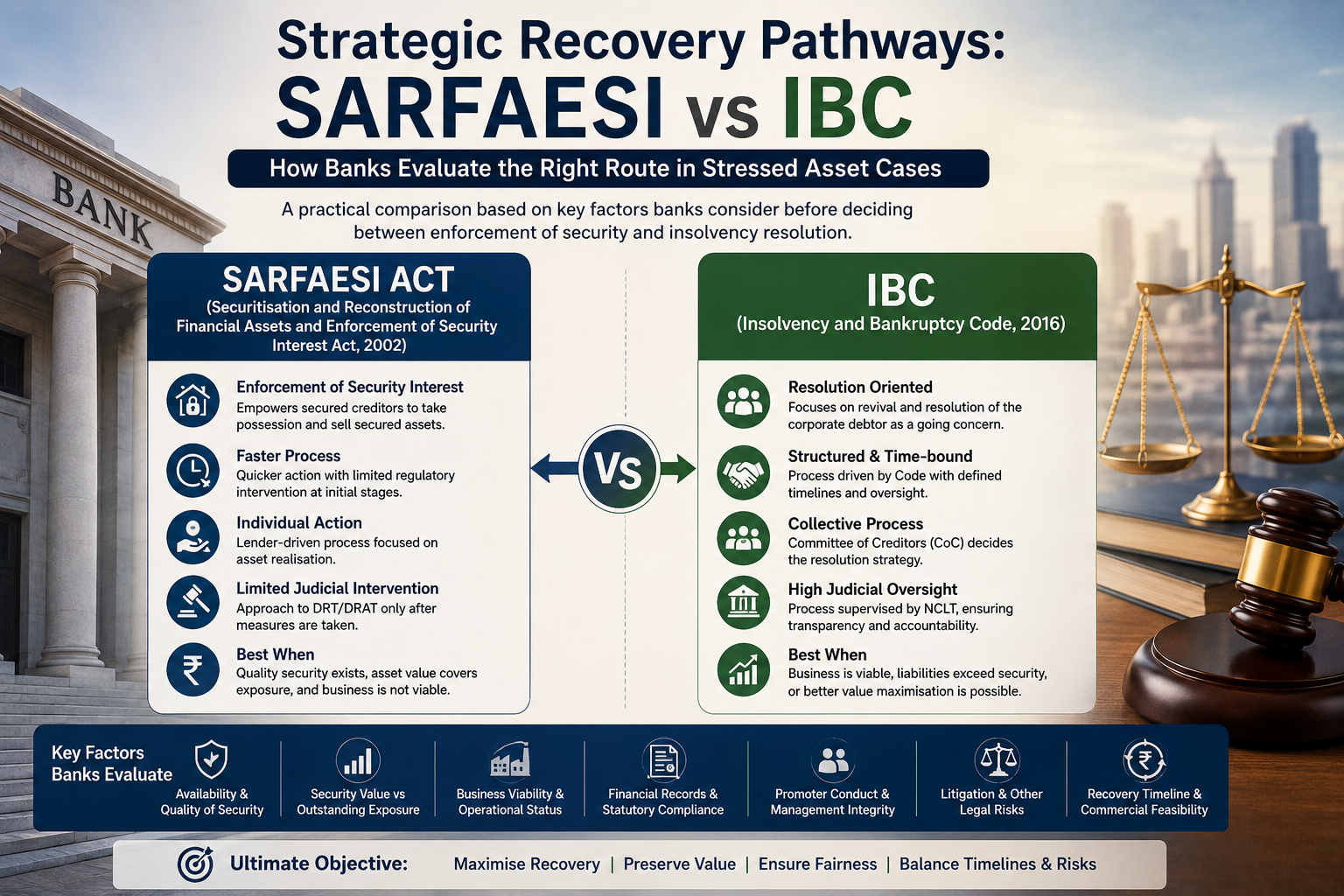
    The SARFAESI Act primarily enables secured creditors to enforce their security interest and recover dues through possession and sale of secured assets without requiring direct court intervention at the initial stages.

    The Insolvency and Bankruptcy Code (IBC), on the other hand, provides a structured insolvency resolution mechanism focused on revival and resolution of the corporate debtor through a collective process supervised by the Adjudicating Authority.

    While SARFAESI is generally associated with enforcement of security, IBC is more focused on resolution, restructuring, and preservation of enterprise value wherever feasible.

    Accordingly, lenders usually evaluate multiple practical aspects before deciding the appropriate route.

    2. Availability and Quality of Secured Assets

    One of the primary considerations for banks is the quality and enforceability of the available security.

    Lenders generally assess:

    1. Whether adequate mortgage or security is available.
    2. Marketability and realizable value of assets.
    3. Physical condition and location of the secured property.
    4. Ease of taking possession and conducting sale.
    5. Existence of title disputes or property-related litigation.

    Where secured assets are commercially valuable, identifiable, and capable of relatively faster realization, lenders may consider SARFAESI proceedings as a practical recovery mechanism.

    However, availability of security alone may not always ensure effective recovery if enforcement becomes commercially difficult or legally complicated.

    3. Security Value Versus Outstanding Exposure

    Another important consideration is whether the realizable security value is sufficient to substantially cover the total outstanding dues.

    Banks usually evaluate:

    1. Probability of recovery shortfall after sale.
    2. Risk of distress value erosion.
    3. Future depreciation in value of assets.
    4. Additional unsecured exposure and contingent liabilities.

    In many stressed accounts, total liabilities significantly exceed the realizable value of secured assets. In such situations, isolated sale of properties may not generate meaningful recovery.

    Further, piecemeal sale of assets may adversely affect the future viability of the remaining business operations. Consequently, lenders may examine whether collective resolution under IBC could potentially provide better value maximization.

    4. Operational Status and Viability of Business

    From a strategic perspective, lenders also evaluate whether the borrower’s business is still operational and commercially viable.

    Important practical considerations include:

    1. Continuity of operations.
    2. Existing cash flow generation.
    3. Market sustainability of the business.
    4. Availability of operational records and management information.
    5. Potential for revival as a going concern.

    Where business continuity and revival appear commercially feasible, lenders may consider IBC proceedings more strategically instead of relying solely on distress sale of individual assets.

    Continuation of operations under a regulated framework may sometimes preserve significantly higher enterprise value.

    5. Financial Records and Statutory Compliance Position

    In practical recovery matters, one of the biggest challenges faced by banks is poor financial discipline and non-compliance by stressed borrowers.

    Lenders commonly examine:

    1. Availability and reliability of financial statements.
    2. GST compliance status and return filings.
    3. Income Tax liabilities and pending proceedings.
    4. ROC filings and corporate compliance status.
    5. Pending statutory dues and notices.
    6. Audit irregularities and compliance gaps.

    In several stressed accounts, records may be incomplete, unreliable, or outdated, making independent decision-making difficult for banks and lenders.

    In such situations, lenders may sometimes prefer the structured mechanism available under IBC because the Resolution Professional (RP) is legally obligated to function in accordance with law and under the supervision of the Committee of Creditors (CoC) and Adjudicating Authority.

    This framework often provides financial creditors with better visibility and collective oversight of the insolvency process.

    6. Promoter Cooperation and Governance Concerns

    Promoter conduct and management cooperation materially influence recovery strategy.

    Banks usually evaluate:

    1. Cooperation from promoters and directors.
    2. Availability of books, records, and asset-related details.
    3. Governance standards and transparency.
    4. Concerns relating to diversion or siphoning of funds.
    5. Willingness to support restructuring or settlement.

    Where governance issues become serious or promoter cooperation remains weak, lenders may consider independent monitoring under IBC to be commercially more suitable.

    7. Employee, Labour, and Litigation-Related Exposure

    In many stressed accounts, recovery proceedings are further complicated by multiple litigations and stakeholder claims.

    These may include:

    1. Employee and labour dues.
    2. Operational creditor claims.
    3. Tax disputes and statutory proceedings.
    4. Civil and regulatory litigation.
    5. Proceedings affecting assets or business operations.

    Standalone enforcement under SARFAESI in such situations may sometimes create fragmented legal complications and procedural delays.

    One of the important features under IBC is the moratorium mechanism, which restricts certain recovery actions and legal proceedings against the corporate debtor during the insolvency process.

    This protection may help maintain continuity of operations despite litigation pressure and enable the business to function under a regulated framework.

    8. Why IBC May Sometimes Be Strategically Preferred

    In complex stressed accounts involving multiple stakeholders, statutory non-compliances, operational issues, or litigation exposure, lenders may sometimes strategically evaluate the IBC route.

    Some commonly observed reasons include:

    1. Management shifts to an independent Resolution Professional.
    2. RP functions under provisions of law and directions of the CoC.
    3. Proceedings remain under supervision of the Adjudicating Authority.
    4. Moratorium protection may support continuity of operations.
    5. Financial creditors obtain a collective and structured view of the corporate debtor.

    In certain cases, lenders may consider that continuation of the business as a going concern under regulated supervision could potentially result in better long-term recovery than immediate distress sale of individual secured assets.

    9. Resolution Possibility and Economic Considerations

    Another important commercial consideration is whether the stressed entity can attract successful resolution applicants or new investors.

    Banks may evaluate:

    1. Possibility of fresh fund infusion.
    2. Scope for takeover by new management.
    3. Preservation of employment and operations.
    4. Continuation of economic activity.
    5. Long-term stakeholder value creation.

    Where viable resolution becomes possible, the business may continue under better management with improved operational efficiency.

    Such outcomes may benefit:

    • Financial creditors
    • Operational creditors
    • Employees
    • Statutory authorities
    • Suppliers and vendors
    • Overall economic activity

    Accordingly, preservation of a viable enterprise under IBC may sometimes serve broader commercial and economic interests beyond immediate recovery.

    10. Time, Cost, and Recovery Efficiency

    Finally, lenders generally conduct a practical cost-benefit analysis before deciding the recovery route.

    Key considerations include:

    1. Estimated timelines.
    2. Litigation risks and procedural delays.
    3. Cost of proceedings.
    4. Probability of effective realization.
    5. Commercial feasibility of enforcement.

    Ultimately, recovery strategy is often influenced more by practical recoverability and value maximization rather than theoretical security coverage alone.

    Conclusion

    In practical banking and insolvency matters, the choice between SARFAESI and IBC is not merely a legal decision but a strategic commercial assessment based on the facts and circumstances of each case.

    Banks, financial institutions, insolvency professionals, chartered accountants, legal advisors, and other stakeholders generally evaluate asset quality, operational viability, statutory compliance, governance concerns, litigation exposure, stakeholder interests, and long-term recovery prospects before selecting the appropriate framework.

    In some situations, enforcement under SARFAESI may appear commercially appropriate. In other cases — particularly where operational continuity, compliance supervision, enterprise revival, and stakeholder protection become important — proceedings under IBC may potentially provide better value realization.

    The evolving recovery and insolvency ecosystem continues to shape how lenders balance enforcement, resolution, and economic sustainability in stressed asset matters.

    Professionals may also share additional practical factors which, in their experience, significantly influence such strategic decision-making processes.

    Disclaimer

    This article is intended solely for academic discussion, professional knowledge-sharing, and general awareness purposes. It does not constitute legal advice, financial recommendation, recovery opinion, insolvency opinion, or strategic guidance for any specific account or proceeding. Decisions relating to SARFAESI actions, insolvency proceedings, restructuring, or recovery mechanisms should always be taken after considering the specific facts, applicable laws, regulatory framework, judicial developments, and professional advice relevant to each individual case.

    Ashok Kakkar

    Advocate & Insolvency Professional, Former Banker

    Ashok Kakkar is an independent writer, banking professional, and financial awareness enthusiast with extensive experience in banking operations, recovery matters, and legal-practical issues relating to finance and insolvency. He regularly shares simplified and experience-based insights on banking systems, credit discipline, recovery mechanisms, financial literacy, and legal awareness with the objective of making complex subjects understandable for professionals, borrowers, students, and the general public.

     Tags:
    #IBC, #SARFAESI, #Banking, #Recovery, #Insolvency, #NPA, #Finance, #CIRP, #ResolutionProfessional ,#CreditRisk, #Bankers,#

  • Banking & Legal Wisdom Series- By Ashok Kakkar

    Banking & Legal Wisdom Series

    Experience-Based Knowledge for Structured Financial Understanding

    The Banking & Legal Wisdom Series is a collection of practical, experience-driven books authored by Ashok Kakkar, Advocate, Insolvency Professional, and Senior Banking Professional with over four decades of professional experience.

    This series is built on a simple premise:

    Financial clarity prevents legal complications.

    The books are designed to bridge the gap between theoretical concepts and real-world banking practice. They aim to simplify complex financial structures, documentation processes, credit mechanisms, and risk indicators for professionals, borrowers, students, and informed readers.

    The Foundation of the Series

    The series draws upon:

    • Extensive experience in corporate credit and banking operations
    • Practical exposure to loan documentation and security structuring
    • Risk monitoring and early warning signal identification
    • Insolvency and resolution processes under structured legal frameworks
    • Observations from professional decision-making environments

    Each publication reflects structured analysis rather than academic abstraction.

    Purpose of the Series

    The objectives of the Banking & Legal Wisdom Series are:

    • To promote financial discipline and documentation awareness
    • To clarify practical distinctions in banking operations
    • To enhance understanding of credit risk and compliance
    • To provide accessible knowledge for non-technical readers
    • To encourage responsible financial conduct

    The series is written in simple, precise language while maintaining professional integrity.

    Who Should Read This Series?

    These books are particularly relevant for:

    • Banking professionals
    • Credit officers and risk managers
    • Chartered Accountants
    • Insolvency professionals
    • Law students
    • Entrepreneurs and borrowers
    • Individuals seeking structured financial understanding

    Practical Approach

    Unlike purely academic publications, this series emphasizes:

    • Real-world examples
    • Risk-based thinking
    • Documentation clarity
    • Preventive financial vigilance
    • Ethical professional conduct

    The focus is not only on understanding banking structures but also on understanding their consequences.

    Independent Authorship & Transparency

    While language refinement tools may assist in structuring certain content, all professional insights, interpretations, and subject-matter perspectives are independently developed and reviewed by the author.

    The series reflects cumulative professional experience and structured reflection.

    A Continuing Knowledge Initiative

    The Banking & Legal Wisdom Series is an evolving body of work. Future publications will continue to address:

    • Practical banking frameworks
    • Legal-financial intersections
    • Risk awareness
    • Documentation discipline
    • Professional ethics

    The intention is not promotion, but structured contribution.

    Ashok Kakkar

    Knowledge, when structured through experience, becomes wisdom.

    Books Available on Amazon KDP

    Banking & Legal Wisdom Series – by Ashok Kakkar

    The following titles are currently available through Amazon Kindle Direct Publishing (KDP):

    1. Understanding CIBIL Score and Credit Health in India

    A Practical Guide for Borrowers and Bankers
    Book in Banking & Legal Wisdom Series – by Ashok Kakkar

    2. Fund-Based and Non-Fund-Based Credit Facilities Explained

    A Practical Guide on Working Capital, Letters of Credit, and Bank Guarantees
    Book in Banking & Legal Wisdom Series – by Ashok Kakkar

    3. Early Warning Signals in Bank Accounts

    A Practical Guide for Bankers and Borrowers
    Book in Banking & Legal Wisdom Series – by Ashok Kakkar

    4. Charge on Property by Banks and Financial Institutions

    Legal and Practical Perspective
    Book in Banking & Legal Wisdom Series – by Ashok Kakkar
    5. A Lesson Learned Late

    Clarity, Balance, and Purpose in the Later Stage of Professional Life
    Book in Banking & Legal Wisdom Series – by Ashok Kakkar

    Series Note

    These books are based on structured professional experience and are written in accessible language to support bankers, borrowers, students, professionals, and informed readers seeking clarity in financial and legal matters.