google-site-verification: googledf360471e5e08135.html

Tag: #Corporate Law

  • KYC Compliance: What Every Bank Customer Should Know

    KYC Compliance: What Every Bank Customer Should Know

    KYC Compliance: What Every Bank Customer Should Know

    Executive Summary

    Know Your Customer (KYC) compliance is not just a regulatory formality but a critical safeguard for customers and financial institutions. The Reserve Bank of India (RBI), under the Prevention of Money Laundering Act (PMLA), 2002, has mandated KYC to prevent misuse of financial systems for fraud, money laundering, and terrorism financing.

    The updated RBI guidelines (2024–2025) now make compliance easier through extended grace periods for low-risk customers, simplified processes for low-income groups, and multiple digital update options such as Video KYC and Aadhaar-based e-KYC. This write-up explains why KYC is essential, when and how customers should update it, and provides a step-by-step roadmap for compliance.

    1. Introduction

    1.1 What is KYC?
    KYC (Know Your Customer) is the process of verifying the identity and address of a customer before providing banking or financial services. It ensures that institutions know who they are dealing with, thus protecting the financial system.

    1.2 Why KYC Matters

    • Prevents identity theft and fraud.
    • Complies with Anti-Money Laundering (AML) and Combating Financing of Terrorism (CFT) regulations.
    • Builds trust between customers and financial institutions.
    • Keeps accounts, lockers, and investment instruments active and safe.

    2. Applicability of KYC

    2.1 Banks and Other Financial Institutions
    KYC compliance is mandatory for:

    • Banks (public, private, cooperative).
    • NBFCs (Non-Banking Financial Companies).
    • Financial Institutions and Payment System Operators.
    • Insurance companies, mutual funds, and other entities regulated under RBI and SEBI guidelines.

    2.2 Why Customers Must Care
    Ignoring KYC reminders can lead to restrictions on accounts, freezing of transactions, and inability to access lockers, loans, or investment products.

    3. When is KYC Required?

    3.1 At Account Opening
    Every new account—savings, current, loan, or locker—requires full KYC compliance.

    3.2 Periodic Updates Based on Risk Profile

    • High-Risk Customers: Every 2 years.
    • Medium-Risk Customers: Every 8 years.
    • Low-Risk Customers: Every 10 years.

    3.3 Special Situations

    • Change of address, mobile number,or email.
    • Large or suspicious transactions.
    • Reactivating a dormant account.

    4. Documents Required for KYC

    As per RBI’s Master Directions (2016, updated 2025), “Officially Valid Documents” (OVDs) include:

    • Aadhaar Card (preferred for e-KYC).
    • Passport.
    • Voter ID Card.
    • Driving License.
    • PAN Card (mandatory for tax-linked transactions).
    • NREGA Job Card.

    For address proof, utility bills, rent agreements, or bank statements (not older than 3 months) can also be used.

    5. Simplified KYC for Low-Income Groups

    5.1 Small Accounts
    For financially weaker sections, accounts can be opened with minimal documentation:

    • Recent photograph.
    • Signature or thumb impression.
    • Self-declaration of address or letter from local authority.

    5.2 Validity and Restrictions

    • Valid for 12 months, extendable by another 12 months if proof of having applied for OVD is provided.
    • Maximum balance: ₹50,000.
    • Annual credit limit: ₹1,00,000.
    • Monthly withdrawal limit: ₹10,000.
    • No foreign remittances allowed.

    These accounts ensure financial inclusion while maintaining safeguards.

    6. The Updated RBI Guidelines (2024–2025)

    6.1 Grace Period for Low-Risk Customers
    Customers can continue operations even if KYC is due, with an extended window up to 30 June 2026.

    6.2 Mandatory Reminder System
    Banks must issue at least three reminders before and after the due date, including one physical letter, to ensure customers are well-informed.

    6.3 Multiple Update Options

    • Aadhaar-based biometric e-KYC.
    • Video KYC (equivalent to face-to-face verification).
    • DigiLocker document submission.
    • Self-declaration for unchanged details.
    • Business Correspondents (BCs) in rural/remote areas.

    6.4 No Fresh Verification for Existing Customers
    If you already have an updated KYC, no fresh compliance is needed for new accounts or services with the same bank.

    7. Step-by-Step Roadmap for Customers

    1. Check Due Date – Review bank reminders or request KYC status.
    2. Collect Documents – Aadhaar, PAN, and any address proof if needed.
    3. Choose Mode – Visit branch, update online, or use Video KYC.
    4. Submit & Verify – Provide documents and complete biometric/OTP verification.
    5. Get Acknowledgment – Retain confirmation SMS, email, or receipt.
    6. Stay Updated – Update whenever personal details change.

    8. Common Mistakes to Avoid

    • Submitting expired or unclear documents.
    • Ignoring reminders until account freeze.
    • Signature mismatch with bank records.
    • Not updating contact information after shifting residence.

    9. Customer Rights and Data Privacy

    • Banks cannot share your KYC data without legal necessity.
    • Information is stored securely under RBI and data protection laws.
    • Customers can request their KYC status anytime.

    10. Message to Customers

    Compliance with KYC is protection for your own financial safety. With extended deadlines, simplified procedures, and digital convenience, updating your KYC is now hassle-free. Every customer should treat it as a financial hygiene step—like renewing an ID card—to keep accounts, lockers, and investments secure.

    11. Conclusion

    The RBI’s updated framework strikes a balance between security and inclusion. By easing compliance for low-risk and low-income customers, and empowering banks with digital and local solutions, the system has become more user-friendly. For customers, staying proactive with KYC ensures smooth, uninterrupted banking.

    Disclaimer

    This write-up is based on RBI’s Master Direction – KYC, 2016 (as amended up to 2025). It is for general informational purposes only and does not constitute legal or professional advice. Customers are advised to check the latest RBI circulars and their bank’s official policy before acting.

    References (RBI Circulars & Directions)

    • RBI Master Direction – Know Your Customer (KYC), 2016 (updated 2025).
    • RBI Circular on Simplified KYC for Low-Income Groups, 2024.
    • RBI Notification on KYC Periodic Updation & Reminder System, June 2025.

    By:- Ashok Kakkar
    Advocate, Resolution Professional & Former Banker

     Email: Kakkarwisdomhub@gmail.com

     Website: legalwisdomhub.in

  • Before You Sign as a Loan Guarantor: Understanding the Hidden Risks and Legal Consequences

    Before You Sign as a Loan Guarantor: Understanding the Hidden Risks and Legal Consequences


    Before You Sign as a Loan Guarantor: Understanding the Hidden Risks and Legal Consequences

    A Practical and Professional Perspective on Rights, Responsibilities and Risk Management

    By Ashok Kakkar
    (Advocate | Insolvency Professional | Former Banker)

    Introduction: A Risk Often Underestimated

    In the course of banking and financial dealings, one often encounters individuals who readily agree to act as guarantors for loans extended to friends, relatives, or business associates. Such decisions are frequently driven by trust, goodwill, or social obligation. However, what appears to be a simple act of support can, in reality, evolve into a serious and legally enforceable financial commitment.

    It is not uncommon to observe that individuals suffer financial distress, credit impairment, and prolonged legal complications—not because they borrowed funds themselves, but because they undertook the responsibility of a guarantor without fully understanding its implications.

    This article seeks to present a comprehensive and practical insight into the risks, legal position, and precautions associated with becoming a loan guarantor, particularly from the perspective of banking practice and professional advisory.

    Understanding the Legal Character of a Guarantee

    A guarantee is not a ceremonial or procedural formality. It is a contractual obligation, governed by the provisions of the Indian Contract Act, 1872, wherein a third party (the guarantor or surety) undertakes to discharge the liability of the borrower (principal debtor) in the event of default.

    The most significant principle governing guarantees is that the liability of the guarantor is co-extensive with that of the borrower. In practical terms, this means that the guarantor assumes responsibility for the entire outstanding liability, including principal, interest, penal charges, and other costs, unless specifically limited by the terms of the agreement.

    Importantly, the lender is legally entitled to proceed against the guarantor without first exhausting remedies against the borrower. Thus, the guarantor stands on almost equal footing with the borrower in matters of recovery.

    Why Do Banks Insist on Guarantees?

    From a banking perspective, lending decisions are guided by risk assessment and regulatory prudence. A guarantee is not sought as a routine requirement, but as a risk-mitigation mechanism in situations where the lender perceives potential inadequacy in the borrower’s repayment capacity.

    Typically, guarantees are insisted upon in cases where:

    • The borrower lacks sufficient financial strength or asset backing
    • The loan is unsecured or partially secured
    • The borrower is a newly established entity or has limited credit history
    • The exposure is relatively high or carries extended tenure

    Thus, a guarantee functions as an additional layer of security, providing comfort to the lender against potential default.

    Nature and Forms of Guarantees in Practice

    In practical banking operations, guarantees may take various forms depending upon the nature of the borrower and the transaction:

    • Personal Guarantees, often obtained from promoters, partners, directors, or family members
    • Third-Party Guarantees, where an independent individual assumes liability
    • Corporate Guarantees, provided by companies, subject to compliance with corporate laws
    • Property-Backed Guarantees, where the guarantor offers immovable property as security
    • Government Guarantees, in specific cases involving public sector or infrastructure lending

    Each form of guarantee carries distinct implications, particularly in terms of enforcement and compliance.

    Major Risks Associated with Becoming a Guarantor

    1. Full Financial Liability Without Direct Benefit

    One of the most critical aspects of a guarantee is that the guarantor assumes complete financial liability without deriving any direct benefit from the loan. In the event of default, the guarantor is obligated to repay the entire outstanding amount.

    2. Impact on Credit Profile and Financial Standing

    Once an individual stands as a guarantor, the exposure is reflected in their credit profile as a contingent liability. Any delay or default by the borrower can adversely affect the guarantor’s creditworthiness.

    This may result in:

    • Difficulty in obtaining future loans
    • Higher interest rates
    • Reduced access to credit facilities

    3. Exposure to Direct Recovery Proceedings

    A common misconception is that the lender will first proceed against the borrower. In reality, the lender may initiate recovery proceedings directly against the guarantor.

    Such actions may include:

    • Issuance of legal notices
    • Initiation of proceedings before appropriate forums
    • Attachment and sale of assets
    • Action under applicable recovery laws in case of secured assets

    Thus, the guarantor’s personal assets, savings, and investments may be at risk.

    4. Reduction in Borrowing Capacity

    Financial institutions consider guarantee obligations while assessing credit eligibility. Even if no default has occurred, the guarantor’s financial capacity is viewed as partially committed, thereby reducing eligibility for future borrowings.

    5. Legal Complications and Mental Stress

    In cases of default, the guarantor may be drawn into prolonged legal proceedings, including litigation and recovery actions. The associated financial burden, time involvement, and uncertainty often result in considerable mental stress.

    6. Strain on Personal and Professional Relationships

    Guarantees are frequently extended on the basis of personal relationships. However, when financial defaults occur, these relationships may deteriorate, leading to disputes and long-term estrangement.

    7. Financial Vulnerability in Emergencies

    Repayment of another person’s loan can significantly deplete personal savings and reserves, thereby affecting the guarantor’s ability to meet their own financial obligations, particularly in times of emergency.

    Right of Recovery: A Limited Practical Relief

    Legally, a guarantor who repays the loan acquires the right to recover the amount from the borrower. However, in practical terms, this often involves further legal proceedings, additional costs, and considerable delay, making the remedy difficult to enforce effectively.

    Common Misconceptions That Need Correction

    Several misconceptions prevail in practice:

    • The belief that acting as a guarantor is merely a formality
    • The assumption that recovery will first be pursued against the borrower
    • Reliance on personal trust without financial assessment
    • Dependence on verbal assurances rather than written terms

    Such assumptions often lead to unintended financial consequences.

    Precautions Before Accepting the Role of a Guarantor

    Before agreeing to act as a guarantor, it is prudent to undertake a careful and objective evaluation:

    • Assess the borrower’s repayment capacity and financial discipline
    • Read and understand all documents thoroughly before signing
    • Evaluate one’s own financial ability to discharge the liability if required
    • Ensure clarity regarding the extent and limits of liability
    • Avoid signing under emotional or social pressure
    • Explore alternative financing options where guarantees may not be required

    A well-informed decision at the outset can prevent significant hardship in the future.

    Special Situations Requiring Additional Caution

    Certain situations demand heightened awareness:

    • Consortium lending, where multiple lenders may independently enforce guarantees
    • Corporate guarantees, requiring compliance with statutory provisions
    • Loans from NBFCs or private lenders, where terms may be less transparent
    • Insolvency scenarios, where guarantors may face independent proceedings under applicable laws

    Professionals advising clients must pay particular attention to these aspects.

    Conclusion: A Decision That Requires Careful Consideration

    Becoming a loan guarantor is not a casual or symbolic act. It is a serious financial commitment with far-reaching consequences.

    While the intention to support others is commendable, such decisions must be guided by informed judgment rather than emotional considerations.

    Before signing any guarantee document, one must reflect:

    “Am I financially prepared to discharge this obligation if the borrower fails?”

    If there is any uncertainty, it is advisable to exercise restraint.

    Disclaimer

    This article is intended for general informational and educational purposes only. It is based on practical banking experience and general legal understanding. Readers are advised to seek professional advice before taking any financial or legal decision.

    Ashok Kakkar

  • Practical Banking Perspective: What Lenders Examine Before Sanctioning Loans

    Practical Banking Perspective: What Lenders Examine Before Sanctioning Loans

    Practical Banking Perspective: What Lenders Examine Before Sanctioning Loans

    Understanding Credit Assessment, Financial Discipline, Documentation, and Risk Evaluation in Modern Lending Practices

    Applicable To:

    Individuals • Professionals • Students • Home Buyers • Business Owners • First-Time Borrowers

    1. Introduction

    In today’s financial environment, loans have become an important part of economic and personal growth. Whether a person wishes to purchase a house, expand a business, pursue higher education, buy a vehicle, or manage temporary financial needs, borrowing has become a common financial tool.

    However, many borrowers still approach the loan process without fully understanding how banks and financial institutions actually evaluate loan applications. From a practical banking perspective, loan sanctioning is not merely about filling forms or submitting documents. It is a detailed process involving financial assessment, legal verification, credit evaluation, compliance checking, and risk management.

    Every lender — whether a bank, NBFC, housing finance company, or cooperative institution — must ensure that the proposed borrowing remains financially sustainable and legally secure.

    2. Core Objectives of Loan Evaluation

    Before approving any loan, lenders generally try to evaluate three major aspects:

    2.1 Repayment Capacity

    Whether the borrower has sufficient and stable income to repay the loan comfortably throughout the loan tenure.

    2.2 Genuineness of Purpose

    Whether the loan requirement appears genuine, reasonable, and properly disclosed by the borrower.

    2.3 Overall Credit Risk

    Whether the overall financial and legal risk involved in the proposal is acceptable according to the lender’s policy and regulatory framework.

    3. Identity Verification and KYC Compliance

    The first stage of loan processing usually involves identity verification and KYC compliance.

    Lenders commonly ask for:

    1. PAN Card
    2. Aadhaar Card
    3. Passport
    4. Voter ID
    5. Driving Licence
    6. Address Proof
    7. Recent Photographs

    This process helps financial institutions:

    1. Prevent fraud and impersonation
    2. Comply with RBI and anti-money laundering regulations
    3. Verify the borrower’s identity and address authenticity

    Even minor mismatches in documents may sometimes delay loan processing.

    4. Income Source and Financial Stability

    One of the most important aspects of loan assessment is repayment capability.

    Lenders generally evaluate:

    1. Salary income
    2. Business income
    3. Professional income
    4. Rental income
    5. Agricultural income (where acceptable)
    6. Other regular earnings

    4.1 Documents Commonly Required from Salaried Individuals

    1. Salary slips
    2. Form 16
    3. Bank statements
    4. Employment proof

    4.2 Documents Commonly Required from Self-Employed Borrowers

    1. Income Tax Returns (ITRs)
    2. GST returns
    3. Balance Sheet
    4. Profit & Loss Account
    5. Business registration documents

    The purpose is to assess whether income is stable and sustainable during the loan period.

    5. Existing Liabilities and Debt Burden

    Banks also assess the borrower’s current financial obligations before sanctioning fresh credit.

    These may include:

    1. Existing home loans
    2. Personal loans
    3. Vehicle loans
    4. Credit card dues
    5. Business liabilities
    6. Overdraft facilities
    7. Guarantee obligations

    Lenders calculate the borrower’s FOIR (Fixed Obligation to Income Ratio) to determine whether the borrower is already overburdened with debt.

    6. Credit Score and Financial Discipline

    Modern lending systems heavily depend upon credit history and repayment behaviour.

    Lenders generally review:

    1. CIBIL score
    2. Past repayment history
    3. Delayed EMI payments
    4. Loan defaults
    5. Settlement history
    6. Number of recent loan enquiries

    Generally, a higher credit score improves:

    1. Loan approval chances
    2. Interest rate negotiation
    3. Faster processing possibilities

    A healthy credit profile reflects financial discipline and responsible borrowing habits.

    7. Bank Account Conduct and Transaction Behaviour

    Bank statements often reveal important details about the borrower’s financial discipline.

    Lenders examine:

    1. Salary credits
    2. Average monthly balance
    3. Frequency of cheque returns
    4. ECS dishonours
    5. Irregular cash deposits
    6. Transaction patterns
    7. Overall account conduct

    Poor account management may create a negative impression even if income appears satisfactory.

    8. Purpose of the Loan

    Lenders always try to understand why the borrower requires the loan.

    Different loan purposes involve different risk levels.

    8.1 Home Loans

    Focus generally remains on:

    1. Property documents
    2. Approved plans
    3. Long-term repayment stability
    4. Property valuation

    8.2 Business Loans

    Lenders may focus more on:

    1. Business turnover
    2. Cash flow
    3. GST returns
    4. Financial statements

    8.3 Personal Loans

    Greater importance is usually given to:

    1. Salary stability
    2. Existing EMIs
    3. Credit score

    8.4 Education Loans

    Banks may evaluate:

    1. Institution reputation
    2. Course quality
    3. Employability prospects
    4. Parent or co-applicant profile

    9. Property and Security Evaluation

    In secured loans, lenders also examine the legality and value of the collateral offered.

    Commonly required documents include:

    1. Sale deed
    2. Title documents
    3. Mutation records
    4. Approved building plans
    5. No-Encumbrance Certificate (NEC)
    6. Property valuation reports
    7. Tax receipts

    Banks conduct both legal scrutiny and technical valuation before accepting property as security.

    10. Evaluation of Composite Loans

    Composite loans involve:

    1. Purchase of land
    2. Construction of house

    These loans are useful for borrowers wishing to build customized homes instead of purchasing ready-built flats or apartments.

    However, lenders treat such loans cautiously because the final security gets created gradually during construction.

    Banks usually evaluate:

    1. Clear land ownership
    2. Approved construction plans
    3. Architect estimates
    4. Construction cost projections
    5. Stage-wise disbursement requirements
    6. Site inspection reports
    7. End-use monitoring of funds

    Funds are often released in phases such as:

    1. Land purchase stage
    2. Foundation stage
    3. Plinth stage
    4. Structure completion stage
    5. Finishing stage

    11. Common Mistakes Borrowers Frequently Make

    Many borrowers unknowingly create financial difficulties for themselves.

    Some common mistakes include:

    1. Focusing only on EMI amount
    2. Ignoring total repayment burden
    3. Signing documents without reading them
    4. Concealing liabilities
    5. Ignoring mortgage conditions
    6. Applying simultaneously to multiple lenders
    7. Ignoring insurance obligations
    8. Depending entirely on agents without verification

    Financial decisions should always be taken carefully and after proper understanding.

    12. Practical Suggestions for Borrowers

    Before approaching any lender, borrowers should ideally:

    1. Organize all financial documents properly
    2. Maintain healthy banking habits
    3. Check credit score regularly
    4. Avoid unnecessary loan enquiries
    5. Understand total repayment obligations
    6. Read all loan terms carefully
    7. Avoid signing blank documents
    8. Verify property papers independently
    9. Maintain financial discipline consistently
    10. Seek professional guidance whenever necessary


    13. Conclusion

    Lenders’ questions and documentation requirements are not merely procedural formalities. They are intended to protect both the lender and the borrower from future financial stress and legal complications.

    A borrower who maintains financial discipline, transparency, organized records, and realistic repayment planning generally stands a much better chance of obtaining loan approval smoothly and on favorable terms.

    In practical financial life, informed borrowing is just as important as informed earning.

    14. Message to Readers

    Loans can become powerful financial tools when used responsibly and with proper planning. However, borrowing without understanding long-term obligations may create unnecessary financial pressure.

    Before taking any loan:

    1. Understand the total repayment burden — not merely the EMI
    2. Read sanction terms and mortgage conditions carefully
    3. Verify property documents legally
    4. Maintain transparency with the lender
    5. Borrow according to actual repayment capacity

    Financial literacy, documentation discipline, and responsible borrowing habits play a major role in achieving long-term financial stability and peace of mind.

    15. Disclaimer

    This write-up is prepared purely for general educational and informational purposes based on practical banking understanding and standard lending practices in India. Lending policies, documentation requirements, eligibility criteria, and regulatory guidelines may vary between institutions and may change over time.

    Readers are advised to consult qualified financial, legal, banking, or professional advisors before making any financial decision. The author shall not be responsible for any action taken solely on the basis of the information contained in this article.

    Ashok Kakkar

    Advocate & Insolvency Professional, Former Banker

    Ashok Kakkar is an independent writer and financial literacy enthusiast with a keen interest in banking practices, legal awareness, and public financial education. He regularly writes on practical issues relating to loans, banking systems, financial discipline, and consumer awareness in simple and reader-friendly language.

  • Understanding Cross Guarantees: Legal Framework, Corporate Compliance, and Banking Perspective

    Understanding Cross Guarantees: Legal Framework, Corporate Compliance, and Banking Perspective

    Understanding Cross Guarantees: Legal Framework, Corporate Compliance, and Banking Perspective

    In modern banking and corporate finance, guarantees play an important role in securing loans and strengthening credit arrangements. One such concept frequently used in commercial lending is the Cross Guarantee. Although commonly used in banking terminology, the expression “cross guarantee” is not specifically defined under Indian statutory law. Instead, it is a practical commercial arrangement built upon the general principles of guarantee under Indian contract and corporate laws.

    Cross guarantees are widely used among group companies, sister concerns, business associates, and sometimes even independent entities where commercial dependency exists. For bankers, corporate professionals, borrowers, students, and legal practitioners, understanding the legal and practical implications of cross guarantees is essential.

    1. Meaning of Cross Guarantee

    A cross guarantee is a reciprocal arrangement where two or more parties guarantee each other’s financial obligations.

    For example:

    • Company A guarantees the loan taken by Company B.
    • Company B, in return, guarantees the loan taken by Company A.

    Thus, each entity acts as guarantor for the other.

    In legal terms, this arrangement consists of separate contracts of guarantee, even though commercially it is referred to as a “cross guarantee.”

    2. Legal Foundation Under Indian Contract Act, 1872

    The legal framework governing guarantees is primarily contained in Chapter VIII (Sections 126 to 147) of the Indian Contract Act, 1872.

    Important provisions include:

    (i) Section 126 – Contract of Guarantee

    This section defines:

    • Principal Debtor
    • Creditor
    • Surety (Guarantor)

    A guarantee is a promise to discharge the liability of another person in case of default.

    (ii) Section 127 – Consideration for Guarantee

    Anything done for the benefit of the principal debtor may constitute valid consideration for the guarantee.

    (iii) Section 128 – Co-Extensive Liability

    The liability of the guarantor is generally co-extensive with that of the borrower unless otherwise provided in the contract.

    This means the creditor may proceed directly against the guarantor without first exhausting remedies against the borrower.

     (iv) Sections 133–139 – Discharge of Surety

    These provisions describe situations where the guarantor may be discharged from liability due to changes in contractual terms or conduct of the creditor.

    (v) Sections 140 and 145 – Rights of Surety

    These sections provide:

    • Right of subrogation
    • Right to indemnification from the principal debtor

    Thus, the Indian Contract Act provides the complete legal basis for enforceability of cross guarantees.

    3. Cross Guarantee vs Corporate Guarantee

    A corporate guarantee refers to a guarantee provided by a company for obligations of another entity.

    A cross guarantee is essentially a reciprocal corporate guarantee arrangement.

    Therefore:

    • Every cross guarantee involving companies generally contains two corporate guarantees.
    • Legally, there is no separate “cross guarantee law.”

    Banks rely upon:

    1. Executed guarantee documents,
    2. Loan agreements,
    3. Security documents,
    4. Applicable recovery laws.

    4. Applicability Among Group Companies

    Cross guarantees are most common among:

    • Holding companies,
    • Subsidiaries,
    • Sister concerns,
    • Associate entities,
    • Companies under common management.

    Banks prefer such arrangements because:

    • There is shared business interest,
    • Financial dependence exists,
    • Promoters are common,
    • Recovery prospects improve.

    In many consortium and multiple banking arrangements, cross guarantees are treated as additional comfort for lenders.

    5. Cross Guarantees Between Independent Entities

    A cross guarantee is not restricted only to group companies.

    Even unrelated entities may legally provide guarantees for each other if:

    • A valid commercial purpose exists,
    • Proper approvals are obtained,
    • The arrangement benefits the guarantor.

    For example:

    • A purchaser may support the supplier’s loan,
    • A strategic business partner may guarantee funding arrangements.

    However, unrelated guarantees attract greater scrutiny from:

    • Banks,
    • Auditors,
    • Shareholders,
    • Regulators,
    • Insolvency professionals.

    The directors must justify that the transaction is in the company’s interest and not merely a gratuitous favour.

    6. Corporate Law Provisions Under Companies Act, 2013

    Several provisions of the Companies Act become relevant when companies provide guarantees.

    (i) Section 186 – Loans, Guarantees, Security and Investments

    This is the principal provision governing corporate guarantees.

    Requirements generally include:

    1. Board Resolution,
    2. Compliance with prescribed limits,
    3. Special Resolution if limits are exceeded,
    4. Disclosure in financial statements.

    Section 186 is the primary statutory provision regulating cross guarantees among companies.

     (ii) Section 179 – Powers of the Board

    The Board of Directors must approve guarantees through resolutions passed at board meetings.

    Banks usually insist upon:

    • Certified Board Resolution,
    • Authority letter,
    • Specimen signatures of authorised officials.

     (iii) Section 185 – Loans to Directors

    If guarantees benefit directors or related entities:

    • Certain transactions may be prohibited,
    • Others may require strict compliance conditions.

    Banks carefully examine compliance before accepting corporate guarantees.

    7. Financial Statement Disclosure

    Corporate guarantees create contingent liabilities.

    Therefore:

    • Disclosure is generally required in financial statements,
    • Auditors may comment upon material guarantees,
    • Related party disclosures may apply.

    Such disclosures are important from governance and transparency perspectives.

    8. Banking Perspective and Due Diligence

    Before accepting a cross guarantee, banks generally verify:

    1. Memorandum and Articles of Association,
    2. Board and shareholder approvals,
    3. Compliance with Sections 185 and 186,
    4. Financial strength of guarantor,
    5. Net worth and repayment capacity,
    6. Authority of signatories,
    7. Proper execution and stamping.

    Banks also assess whether:

    • The guarantor has genuine business interest,
    • The arrangement is commercially viable,
    • The guarantee enhances overall security coverage.

    9. Enforcement of Cross Guarantees

    In case of default, lenders may:

    • Invoke the guarantee,
    • Initiate recovery proceedings,
    • Proceed simultaneously against borrower and guarantor.

    Recovery mechanisms may include:

    • Civil suits,
    • Proceedings before Debt Recovery Tribunal (DRT),
    • Action under the SARFAESI Act,
    • Insolvency proceedings under IBC.

    The guarantor’s liability may become immediate upon invocation of guarantee.

    10. Impact Under Insolvency and Bankruptcy Code (IBC)

    Under the Insolvency and Bankruptcy Code, 2016:

    • Creditors may proceed against both borrower and corporate guarantor,
    • Claims may be filed against guarantors,
    • CIRP may be initiated against corporate guarantors.

    Indian courts, including the Supreme Court of India, have repeatedly recognised the enforceability of guarantees and creditors’ rights against guarantors.

    This makes cross guarantees commercially significant but legally sensitive arrangements.

    11. Risks Associated With Cross Guarantees

    Although useful, cross guarantees involve substantial risks.

    Major concerns include:

    1. Increased financial exposure,
    2. Contingent liability burden,
    3. Possibility of simultaneous defaults,
    4. Group insolvency impact,
    5. Corporate governance concerns,
    6. Regulatory scrutiny,
    7. Impact on credit ratings and borrowing capacity.

    A weak entity within a group may financially affect stronger entities through guarantee obligations.

    12. Practical Importance in Banking

    Cross guarantees are commonly used in:

    • Working capital finance,
    • Consortium lending,
    • Infrastructure financing,
    • Real estate projects,
    • Group company financing,
    • SME and MSME funding.

    For lenders, they provide:

    • Additional security comfort,
    • Expanded recovery avenues,
    • Better monitoring of group exposure.

    For borrowers, they may help:

    • Obtain higher credit limits,
    • Improve lender confidence,
    • Support financially weaker entities.

    Conclusion

    A cross guarantee is essentially a reciprocal guarantee arrangement commonly used in banking and corporate finance. Though not separately defined under Indian law, its validity and enforceability arise from the general law of guarantees under Sections 126–147 of the Indian Contract Act, 1872, together with corporate compliance requirements under the Companies Act, 2013.

    In practical banking operations, cross guarantees are widely used among group companies and related entities to strengthen lending structures and improve recovery security. However, such guarantees also create significant legal and financial obligations for guarantors. Therefore, proper documentation, corporate approvals, commercial justification, and regulatory compliance become extremely important.

    For bankers, directors, professionals, and borrowers, cross guarantees should never be treated as routine formalities. They are legally enforceable commitments capable of creating substantial financial liability in case of default.

    Disclaimer

    This article is intended purely for educational, academic, and general informational purposes. The legal provisions mentioned are based on general principles of Indian law and may vary depending upon specific contractual terms, judicial interpretations, regulatory amendments, and factual circumstances. Readers are advised to seek independent legal, financial, or professional advice before acting upon any matter relating to guarantees, corporate liabilities, banking documentation, or insolvency proceedings.

    By: Ashok Kakkar

    #Cross Guarantee #Corporate Guarantee #Banking Law #Indian Contract Act #CompaniesAct2013 #Corporate Finance #Banking And Finance #IBC  #Loan Security #Corporate Compliance

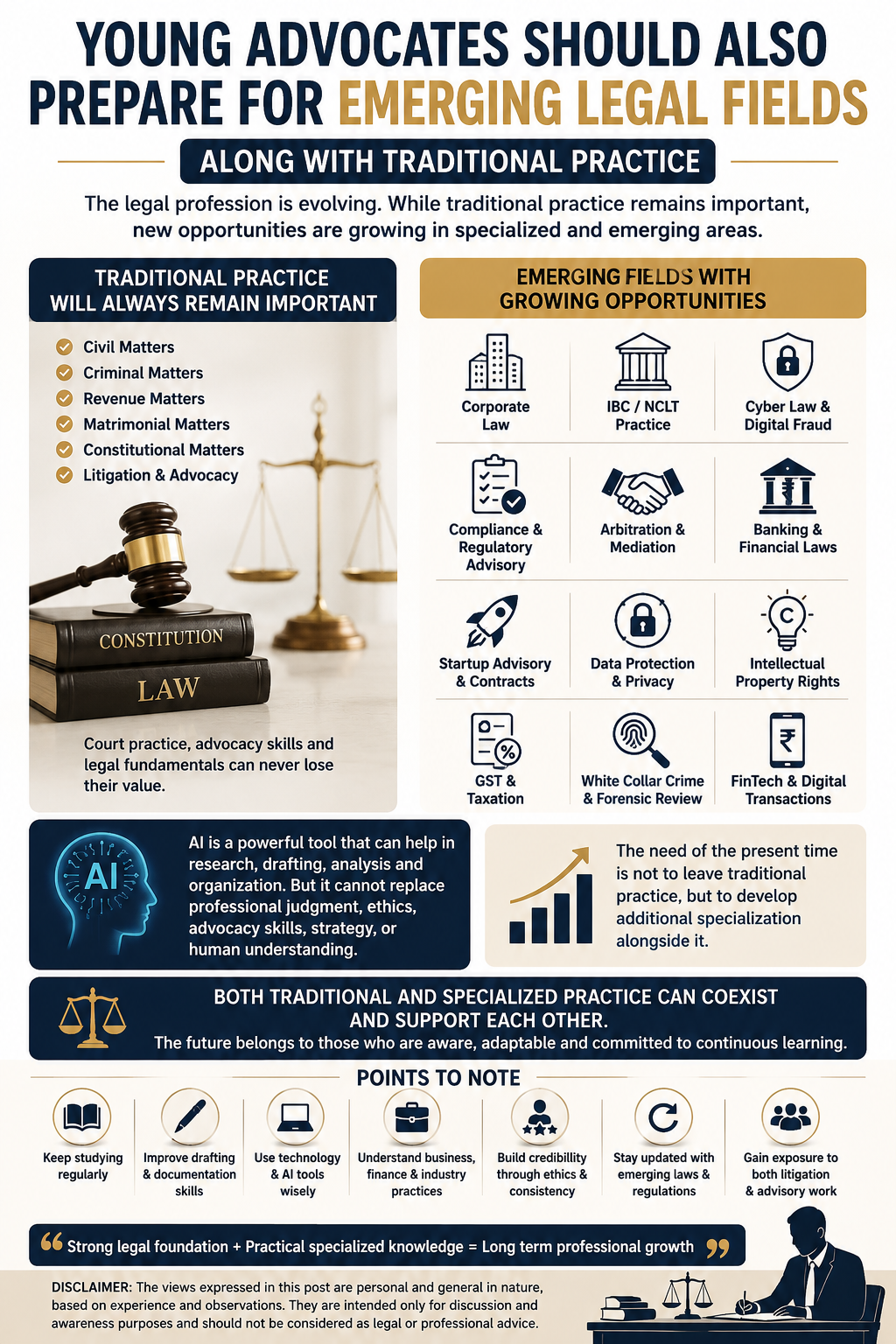
  • Traditional Litigation Will Always Remain Important — but Young Professionals Should Also Prepare for Emerging Legal Fields

    Traditional Litigation Will Always Remain Important — but Young Professionals Should Also Prepare for Emerging Legal Fields

    Traditional Litigation Will Always Remain Important — but Young Professionals Should Also Prepare for Emerging Legal Fields

    Introduction

    The legal profession in India is gradually undergoing a major transformation. Traditional litigation practice relating to civil, criminal, revenue, matrimonial, labour, taxation, and constitutional matters continues to remain the backbone of our justice delivery system. Courtroom advocacy, drafting, legal reasoning, and practical litigation experience will always retain their importance and dignity.

    However, alongside traditional practice, rapid developments in business, technology, finance, digital transactions, startups, regulatory systems, and corporate governance have created entirely new opportunities for legal and financial professionals.

    Today, businesses, startups, NBFCs, banks, fintech companies, and technology platforms increasingly require professionals who understand not only legal provisions but also practical commercial realities, compliance structures, financial systems, risk management, and regulatory frameworks.

    As a result, several specialized legal and compliance-related fields are expanding rapidly and creating meaningful professional opportunities for advocates, chartered accountants, company secretaries, insolvency professionals, and young legal practitioners.

    Emerging Areas Creating Professional Opportunities

    In the present environment, the following areas are witnessing substantial growth:

    1. Insolvency & Bankruptcy (IBC/NCLT)

    IBC practice has emerged as one of the fastest-growing professional areas in India. Matters relating to corporate insolvency resolution, liquidation, creditor rights, restructuring, claims verification, and proceedings before NCLT/NCLAT have significantly increased.

    This field requires coordination between advocates, chartered accountants, insolvency professionals, bankers, and corporate advisors.

    2. Corporate Law & Compliance

    With increasing corporate regulation and business expansion, companies now require continuous support in areas such as:

    • Corporate governance
    • Regulatory filings
    • Shareholder agreements
    • Board compliance
    • Corporate restructuring
    • Due diligence
    • Contract management

    Professionals having both legal and financial understanding are increasingly valued.

    3. Banking & Financial Laws

    Banking and finance-related legal work continues to offer long-term opportunities, particularly in:

    • SARFAESI matters
    • DRT proceedings
    • Loan documentation
    • Recovery proceedings
    • Financial frauds
    • Regulatory compliance
    • Negotiable Instruments Act matters

    India’s expanding financial ecosystem continues to generate substantial professional work in these sectors.

    4. Cyber Law & Digital Fraud Matters

    The rapid increase in digital banking, online transactions, fintech platforms, and social media usage has also increased cyber-related disputes and digital fraud cases.

    Legal and financial professionals are increasingly required for:

    • Cyber fraud advisory
    • Digital evidence handling
    • Data protection compliance
    • Online financial fraud disputes
    • IT Act matters
    • Digital transaction-related litigation

    5. Arbitration & Commercial Dispute Resolution

    Commercial entities now increasingly prefer arbitration and mediation for quicker dispute resolution instead of prolonged litigation.

    This has created opportunities in:

    • Domestic arbitration
    • Commercial mediation
    • Infrastructure disputes
    • Contractual disputes
    • Corporate settlements

    6. Startup Advisory & Documentation

    India’s startup ecosystem is expanding rapidly. Startups require support in:

    • Founder agreements
    • Investment documentation
    • ESOP structuring
    • Commercial contracts
    • Regulatory compliance
    • Data privacy frameworks

    Young professionals with strong drafting and documentation skills can build specialized expertise in this area.

    Role of AI & Technology in Professional Practice

    We are now living in an AI-driven and technology-oriented environment. Artificial Intelligence tools are gradually becoming part of professional practice across sectors including law, finance, compliance, and taxation.

    AI can certainly assist in:

    • Legal research
    • Drafting
    • Data organization
    • Compliance review
    • Document analysis
    • Preliminary due diligence

    However, AI cannot replace:

    • Professional judgment
    • Ethics
    • Strategic thinking
    • Practical experience
    • Human understanding
    • Advocacy skills
    • Negotiation ability

    Technology should therefore be treated as a supporting professional tool and not as a substitute for genuine competence and continuous learning.

    Importance of Continuous Learning

    One of the most important realities of the present professional environment is that continuous learning has become essential.

    Professionals today may benefit by:

    • Regular reading and updating
    • Understanding emerging regulations
    • Learning practical drafting
    • Developing technology awareness
    • Understanding financial and commercial systems
    • Building interdisciplinary knowledge

    The future may increasingly favour professionals who combine:

    • legal understanding,
    • financial awareness,
    • commercial practicality,
    • and technological adaptability.

    Traditional Practice Will Continue to Remain Important

    While discussing emerging opportunities, it is equally important to understand that traditional litigation practice will never lose its significance.

    Civil courts, criminal courts, revenue authorities, taxation forums, tribunals, and constitutional courts will continue to remain central to the legal system.

    The need of the present time may therefore not be to abandon traditional practice, but to strengthen oneself with additional specialization and practical knowledge alongside it.

    Both traditional litigation and specialized advisory practice can coexist and complement each other effectively.

    Conclusion

    The professional environment in India is changing steadily due to technological advancement, digital transactions, regulatory expansion, and evolving business systems.

    Young advocates and professionals who remain proactive, disciplined, and continuously updated may find significant opportunities in emerging fields such as:

    • IBC/NCLT
    • Corporate Law
    • Banking & Financial Laws
    • Cyber Law
    • Compliance
    • Arbitration
    • Startup Advisory
    • Data Protection
    • Digital Fraud Matters

    At the same time, traditional litigation skills, ethics, drafting ability, and practical understanding will continue to remain foundational to the legal profession.

    The future may belong to professionals who successfully combine strong fundamentals with continuous learning, practical exposure, and adaptability.

    Disclaimer

    The views expressed in this article are personal, general, and experience-based reflections shared purely for educational and awareness purposes. The article does not constitute legal, financial, career, or professional advice. Readers are advised to exercise their own independent judgment and professional discretion.

    Ashok Kakkar
    Advocate | Insolvency Professional | Former Banker
    Chandigarh

    Ashok Kakkar is an Advocate, Insolvency Professional, and Former Banker with over 40 years of combined experience in banking, finance, recovery, insolvency, and legal practice. He regularly writes and shares practical insights on emerging legal fields, banking laws, IBC/NCLT practice, and professional development for young advocates and professionals.

    #Corporate Law, #IBC, NCLT, #Cyber Law, #Banking Laws, #Arbitration, #Compliance, #Young Advocates, #Legal Profession, #AI, #Professional Development

  • Kakkar Wisdom Hub is Now on YouTube

    Kakkar Wisdom Hub is Now on YouTube

    I am pleased to share that Kakkar Wisdom Hub has expanded its knowledge-sharing initiative through a dedicated YouTube channel.

    The channel aims to provide practical insights and simplified discussions on Banking, Finance, Recovery, Insolvency, and Legal Awareness based on professional experience accumulated over several decades in banking and legal practice.

    The objective is to make complex subjects easier to understand for students, young professionals, bankers, advocates, entrepreneurs, and individuals interested in these fields.

    I invite readers and learners to explore the channel and share their valuable suggestions for future topics and discussions.

    YouTube Channel:
    https://youtube.com/@kakkarwisdomhub

    Learning from Experience, Sharing with Purpose.

    Ashok Kakkar
    Advocate | Insolvency Professional | Former Banker

  • Welcome to Professional Wisdom Hub

    Welcome to Professional Wisdom Hub

    Welcome to Professional Wisdom Hub

    Banking • Finance • Legal Learning Series

    Turning Experience into Learning Opportunities for Future Professionals

    In every profession, knowledge is acquired through education, training, observation, and experience. While academic learning provides a strong foundation, practical understanding develops through years of professional engagement, decision-making, problem-solving, and interaction with real-life situations. The lessons learned through experience often extend beyond what can be found in textbooks and classrooms.

    With this belief and objective, I am pleased to introduce Professional Wisdom Hub, a knowledge-sharing initiative dedicated to practical learning and professional development in the fields of Banking, Finance, Recovery, Insolvency, and Law.

    Having spent more than four decades in the banking sector and subsequently practicing as an Advocate and Insolvency Professional, I have had the opportunity to work across diverse areas including banking operations, credit management, loan documentation, recovery proceedings, legal compliance, SARFAESI matters, Debt Recovery Tribunal (DRT) proceedings, creation and enforcement of security interests, CERSAI registrations, insolvency resolution processes, and related legal and financial issues.

    Throughout this professional journey, one observation has remained constant: there exists a significant gap between theoretical knowledge and practical application. Students and young professionals often possess strong academic qualifications but seek practical insights that can help them understand how principles operate in real-world situations. At the same time, many experienced professionals carry valuable knowledge and practical wisdom that deserves to be documented, shared, and passed on to future generations.

    Professional Wisdom Hub has been conceived as a platform to bridge this gap.

    The initiative aims to create an environment where practical experiences, professional insights, case studies, regulatory developments, and real-world perspectives can be shared in a simple, understandable, and meaningful manner. The focus is not merely on explaining legal provisions or banking concepts but on understanding their practical implications and applications.

    The platform is intended for:

    • Banking professionals and banking aspirants
    • Finance professionals and students
    • Chartered Accountants, Company Secretaries, and management students
    • Advocates and law students
    • Insolvency professionals and insolvency enthusiasts
    • Entrepreneurs and business owners
    • Individuals interested in banking, finance, legal, and insolvency matters

    The proposed areas of discussion and learning include:

    • Banking Operations and Practices
    • Credit Management and Loan Documentation
    • Creation and Enforcement of Security Interests
    • Mortgages, Hypothecation, and Guarantees
    • SARFAESI Act and Recovery Mechanisms
    • Debt Recovery Tribunal (DRT) Proceedings
    • CERSAI Registration and Compliance
    • Insolvency and Bankruptcy Code (IBC)
    • Banking Frauds and Preventive Measures
    • Letters of Credit and Bank Guarantees
    • Regulatory and Legal Developments
    • Practical Case Studies and Professional Experiences

    Professional Wisdom Hub is envisioned not merely as a training programme but as a community of learning. Through articles, discussions, webinars, videos, interactive sessions, and knowledge-sharing initiatives, the endeavour seeks to encourage continuous learning and professional growth.

    The objective is simple: to transform professional experience into meaningful learning opportunities for those preparing to enter or advance within their chosen professions. Equally important is the opportunity to learn from the perspectives and experiences of others, thereby creating a mutually beneficial environment for knowledge exchange.

    I believe that professional wisdom acquires its true value when it is shared. Every experience, whether successful or challenging, carries lessons that may help others avoid mistakes, make informed decisions, and grow with confidence.

    I warmly invite professionals, students, practitioners, educators, and lifelong learners to join this journey of knowledge sharing and professional development. Your participation, suggestions, experiences, and perspectives will contribute to making this initiative meaningful and beneficial for all.

    Together, let us build a platform where experience becomes knowledge, knowledge becomes understanding, and understanding contributes to professional excellence.

    Professional Wisdom Hub

    Banking • Finance • Legal Learning Series

    Learning from Experience, Sharing with Purpose

    Ashok Kakkar
    M.Com, LL.B., LL.M., CAIIB
    Advocate | Insolvency Professional | Former Banker

     kakkarwisdomhub@gmail.com
    https://legalwisdomhub.in

    #Banking & Finance ,#Legal Education,# Insolvency & Bankruptcy ,#Career Guidance,# Knowledge Sharing