google-site-verification: googledf360471e5e08135.html

Category: Ashok Kakkar

  • Understanding Reverse Mortgage Banking Facilities for Elderly Homeowners in India

    Understanding Reverse Mortgage Banking Facilities for Elderly Homeowners in India

    Understanding Reverse Mortgage Banking Facilities for Elderly Homeowners in India

    A Practical and Often Overlooked Financial Facility for Senior Citizens

    1. Background and Genesis of the Scheme

    India’s demographic structure is undergoing a structural shift. With increasing life expectancy and urban nuclear family systems, a large number of senior citizens today:

    • Own residential property
    • Lack adequate pension income
    • Face rising healthcare expenses
    • Prefer financial independence

    Recognizing this gap, the Reverse Mortgage Scheme (RMS) was introduced in 2007 as a regulated financial product under guidelines issued by the Reserve Bank of India and supported by the National Housing Bank.

    Amendments were also made under the Income Tax Act:

    • Section 47(xvi) – Reverse mortgage not treated as transfer
    • Section 10(43) – Amount received exempt from income tax

    The objective was clear:

    Enable senior citizens to unlock the value of their home without selling or vacating it.

    2. Purpose Behind Formation

    The scheme was designed with the following policy objectives:

    1. To provide supplementary income post-retirement
    2. To reduce dependency on children
    3. To address healthcare funding gaps
    4. To promote dignified aging
    5. To utilize dormant residential wealth productively

    In India, for many retirees, the house is the largest asset but produces no income. RMS converts “illiquid wealth” into “income flow.”

    3. What is Reverse Mortgage?

    Reverse Mortgage is a loan facility where:

    • A senior citizen mortgages a self-occupied residential property to a bank.
    • The bank pays periodic income (monthly/quarterly) or lump sum.
    • No EMI is payable during the borrower’s lifetime.
    • Loan is settled after death.

    Unlike a conventional home loan:

    • In a normal loan → borrower pays bank.
    • In reverse mortgage → bank pays borrower.

    4. RBI & Banking Guidelines (Regulatory Framework)

    4.1 Eligibility Criteria

    1. Primary borrower: 60 years or above
    2. Spouse (co-borrower): Minimum 55 years
    3. Property:
      • Self-owned
      • Self-occupied
      • Freehold
      • Free from encumbrance
      • Clear title

    4.2 Loan Quantum

    • Generally up to 60% of property value
    • Based on:
      • Age of borrower (higher age → higher eligibility)
      • Market value
      • Location
      • Residual life of property
    • Property revaluation typically every 5 years

    4.3 Tenure

    • Usually 10–15 years
    • Some institutions allow up to 20 years
    • No repayment obligation during lifetime

    4.4 Disbursement Modes

    1. Monthly income
    2. Quarterly income
    3. Lump sum (mostly for medical expenses)
    4. Hybrid model

    4.5 Interest & Security

    • Interest rates similar to housing loans
    • Compounded periodically
    • Non-recourse loan (limited to property value)

    This means heirs are not personally liable beyond property value.

    5. Implementation by Banks in India

    The Reverse Mortgage Scheme is available with several Public Sector Banks and select financial institutions in India. While the framework is based on RBI/NHB guidelines, operational terms and conditions may vary depending upon each bank’s internal policy and risk management framework.”

    Implementation Process:

    1. Application submission
    2. Property valuation
    3. Legal scrutiny
    4. Mortgage execution
    5. Loan agreement
    6. Periodic payout

    Banks conduct due diligence similar to housing loan appraisal but with added counseling on implications.

    6. How It Works After Death of Borrower

    Upon demise of last surviving borrower:

    1. Legal heirs are informed.
    2. They may:
      • Repay loan and retain property, OR
      • Allow bank to sell property.
    3. Bank recovers outstanding dues.
    4. Surplus (if any) returned to heirs.

    This structure preserves family interest.

    7. Status, Progress & Outcome in India

    7.1 Uptake Status

    Despite policy support, the scheme has seen very limited adoption since 2007.

    Reasons:

    • Emotional attachment to house
    • Cultural reluctance
    • Low awareness
    • Family resistance
    • Fear of losing property

    Estimated usage remains negligible compared to eligible population.

    7.2 Outcome for Users

    Where adopted:

    ✔ Provides steady supplementary income
    ✔ Covers medical emergencies
    ✔ Ensures residential stability
    ✔ Avoids distress sale

    Defaults are rare because recovery is property-backed.

    8. Accessibility Across India

    • Available through selected banks and HFCs
    • More common in urban/metropolitan areas
    • Limited traction in rural/semi-urban regions due to:
      • Valuation challenges
      • Legal title issues
      • Financial literacy gap

    Digital banking has improved access but awareness remains the key bottleneck.

    9. Public Acceptance in India

    Cultural Factors:

    FactorImpact
    Home as legacy assetResistance
    Family honor perceptionEmotional hesitation
    Joint family traditionsLow adoption
    Awareness gapMajor barrier

    Only a very small fraction of eligible seniors use the scheme.

    10. Is Reverse Mortgage Useful? (Practical Evaluation)

    10.1 Advantages

    1. Financial independence
    2. No EMI burden
    3. Retain ownership
    4. Tax benefits
    5. Non-recourse protection

    10.2 Limitations

    1. Accruing interest reduces final estate
    2. Complex documentation
    3. Emotional resistance
    4. Not suitable if heirs strongly object

    10.3 Suitable For

    • Senior citizens with:
      • No pension
      • Limited savings
      • High medical needs
      • Children settled elsewhere
      • Desire for independent living

    11. Comparison With Other Options

    OptionProsCons
    Selling HouseImmediate fundsLoss of residence
    RentingRegular incomeRequires relocation
    Reverse Mortgageincome Loan accrualStay in home

    From a dignified aging perspective, reverse mortgage remains the most balanced alternative.

    12. Challenges & Reform Recommendations

    1. Strong awareness campaigns
    2. Simplified documentation
    3. Government-backed interest subsidy
    4. Standardized RBI guidelines
    5. Financial literacy drives

    Given India’s aging population, RMS may become more relevant in coming decades.

    13. Conclusion

    The Reverse Mortgage Scheme represents a socially progressive financial innovation. It transforms residential property into a structured income stream without displacement.

    However, policy success depends not only on regulatory framework but on:

    • Awareness
    • Cultural acceptance
    • Banking outreach
    • Advisory clarity

    For many elderly homeowners, it can be a dignified bridge between retirement and financial stability.

    14. Message to the Reader

    If you or your parents own a house but lack sufficient retirement income, do not ignore this option merely due to hesitation or misinformation.

    Understand it. Evaluate it. Discuss it within the family.

    Financial dignity in old age is not a compromise — it is a right.

    15. Disclaimer

    This article is intended for educational and informational purposes only. It does not constitute financial, legal, or investment advice. Readers are advised to consult their bank, financial advisor, or legal professional before making any decision regarding reverse mortgage facilities, as terms and policies may vary across institutions.

    By. Ashok Kakkar

    # Reverse Mortgage India # Reverse Mortgage Scheme # RBI Guidelines Reverse Mortgage#Senior Citizen Loan India# Retirement Income India#Home Equity Loan for Seniors#Property Mortgage Scheme #Banking Scheme for Elderly  #Financial Planning After Retirement # Housing Loan for Senior Citizens

  • Common Financial and Banking Mistakes Made by Borrowers

    Common Financial and Banking Mistakes Made by Borrowers

    Common Financial and Banking Mistakes Made by Borrowers
    Understanding Loan Behaviour, Compliance Issues, and Preventive Banking Practices

    Background: Understanding How Banks Function

    Banks are not private money-lending businesses run at the discretion of individual officers. They are regulated financial institutions entrusted with public money. Every rupee lent by a bank belongs to depositors—ordinary citizens, senior citizens, businesses, and institutions—who expect safety and accountability.

    Bank decisions are governed by:

    • Regulatory guidelines issued by the Reserve Bank of India (RBI)
    • Government policies and statutory requirements
    • Internal credit policies and exposure norms
    • Digital systems, ratings, and automated checks
    • Audit, vigilance, and compliance frameworks

    In the modern banking environment, decisions are increasingly system-driven. Concepts such as CIBIL reports, internal credit ratings, CERSAI registration, GST verification, online KYC, and automated monitoring leave very little scope for personal discretion. This reality is often misunderstood by borrowers, leading to frustration and conflict.

    This article explains common mistakes made by borrowers while dealing with banks and how both borrowers and bankers can avoid avoidable stress through discipline, transparency, and mutual understanding.

    1. Relying on Verbal Assurances Instead of Written Communication

    One of the most frequent mistakes borrowers make is relying on verbal discussions with bank officials. Borrowers often assume that a verbal indication of approval, interest concession, or renewal is sufficient to proceed with commitments such as purchasing property, placing orders, or investing funds.

    In banking practice, only written communication has value. Verbal assurances are not binding and cannot override policy restrictions, regulatory constraints, or system approvals. If an officer is transferred or if policy conditions change, such verbal assurances may no longer hold good.

    A borrower should ensure that:

    • All documents submitted to the bank are accompanied by a proper covering letter or email
    • Acknowledgement of submission is obtained
    • Any important discussion is followed by written confirmation

    Where early commitment is required, borrowers should seek “sanction in principle”, which reflects the bank’s intent subject to fulfillment of conditions. Acting solely on verbal understanding can lead to serious financial loss if the proposal does not ultimately materialize.

    2. Signing Loan and Security Documents Without Proper Understanding

    Loan documentation is the legal backbone of a banking relationship. Many borrowers sign documents hastily, assuming them to be routine formalities. This is a serious error.

    Loan agreements and security documents define:

    • Repayment obligations
    • Interest and penal interest
    • Rights of the bank in case of default
    • Liability of guarantors
    • Enforcement mechanisms

    Once signed, these documents are legally binding. Claims of ignorance carry little weight. Borrowers must read documents carefully and ensure:

    • Documents are properly stamped and executed
    • No blank or incomplete documents are signed
    • All undertakings are fully understood

    From the banker’s side, it is equally important to ensure proper execution, witnessing, stamping, and compliance with internal and regulatory guidelines. Poor documentation weakens enforceability and invites litigation.

    3. Borrowing Beyond Realistic Repayment Capacity

    Many borrowers accept the maximum loan offered by the bank without objectively assessing repayment capacity. This is often driven by optimism about future income or business growth.

    Bank eligibility does not automatically mean affordability. Income fluctuations, market downturns, health issues, or business disruptions can quickly turn manageable loans into stress accounts.

    Borrowers must realistically assess:

    • Regular and stable income
    • Existing obligations
    • Contingency requirements
    • Ability to absorb temporary shocks

    Bankers, too, must carefully scrutinize income and cash flows to prevent over-financing. Over-borrowing benefits neither the borrower nor the bank and often results in accounts slipping into SMA or NPA categories.

    4. Lack of Financial Discipline in Account Operations

    Financial discipline after loan sanction is as important as eligibility at the time of sanction. Irregular repayments, cheque returns, overdrawing, and diversion of funds send early warning signals to banks.

    Common issues include:

    • Delay in EMI or interest servicing
    • Cheque bounces for statutory payments
    • Diversion of working capital for non-business use
    • Manipulation of stock statements or financial data

    Such conduct damages credit history and weakens borrower credibility. Maintaining discipline in repayments, routing business transactions through the bank account, and ensuring transparency builds long-term trust.

    5. Casual Approach Towards Compliance and Periodic Documentation

    Banks require regular submission of documents such as:

    • Financial statements
    • GST returns
    • Income tax returns
    • Stock statements
    • Insurance policies
    • KYC updates

    Many borrowers treat these requirements casually, submitting incomplete or delayed information. Non-compliance can result in:

    • Freezing of limits
    • Suspension of disbursements
    • Non-renewal of facilities

    Borrowers must understand that compliance is not optional. It is a continuous obligation linked directly to risk assessment and regulatory accountability.

    6. Ignoring Credit History and Online Monitoring Systems

    Modern banking operates on integrated digital systems. Credit history is tracked through CIBIL and other bureaus, while securities are registered with CERSAI. GST, ROC, and income tax data are readily accessible to banks.

    Any concealment, inconsistency, or misrepresentation is easily detected. Borrowers should:

    • Regularly review their credit reports
    • Ensure accuracy of reported data
    • Address discrepancies promptly

    A healthy credit history is a valuable financial asset that directly impacts interest rates, loan approvals, and future access to credit.

    7. Avoiding Communication During Financial Stress

    When borrowers face financial difficulty, silence is the worst response. Many borrowers avoid banks due to fear or embarrassment, assuming that non-communication will buy time.

    From a bank’s perspective, silence indicates lack of intent rather than inability. This often triggers recovery mechanisms.

    Banks today have structured options such as:

    • Restructuring
    • Rescheduling
    • Moratoriums
    • Working Capital Term Loans (WCTL)
    • Interest adjustments

    However, these options are available only when the borrower communicates early and transparently. Timely dialogue allows banks to distinguish between temporary stress and structural failure.

    8. Signing Personal Guarantees Without Understanding the Risk

    Personal guarantees are often signed casually, especially for business loans. Many guarantors fail to understand that a guarantee creates direct and personal liability.

    In the event of default, the bank can proceed against the guarantor’s personal assets irrespective of business failure. Guarantees are not symbolic—they are enforceable legal commitments.

    Before signing a guarantee, one must:

    • Understand the amount and scope of liability
    • Assess the borrower’s financial strength
    • Seek professional advice where required

    9. Ignoring Early Warning Signals and Bank Communications

    Banks closely monitor early warning signals such as irregular operations, declining turnover, delayed submissions, and adverse audit observations.

    Notices or reminders issued by banks are not routine paperwork. They are indicators of stress that require immediate attention. Ignoring them accelerates deterioration of the account.

    Prompt response, corrective action, and regular engagement can prevent escalation and preserve goodwill.

    10. Viewing Banks as Adversaries Instead of Stakeholders

    A confrontational approach towards banks often worsens matters. Banks are not adversaries; they are stakeholders whose funds are deployed in the borrower’s business.

    It must be remembered that bank funds are public money, not private capital. Bankers are duty-bound to protect depositor interests while supporting viable businesses.

    A cooperative, transparent, and professional relationship benefits all parties and creates scope for resolution even during difficult phases.

    Conclusion

    Most borrower–bank disputes do not arise from fraud or bad intent. They arise gradually due to misunderstanding, indiscipline, delayed communication, and casual handling of responsibilities.

    A disciplined, informed, and transparent approach transforms banking from a source of stress into a source of stability and growth. Awareness of regulatory realities, documentation discipline, and open communication are the pillars of a healthy banking relationship.

    Message to the Reader

    A bank loan is not merely money received—it is a responsibility accepted.
    When handled with awareness and discipline, it becomes a powerful tool for growth.
    When handled casually, it becomes a long-term burden.

    Small precautions today can save years of financial and legal difficulty tomorrow.

    Disclaimer

    This article is intended for general informational and educational purposes only. It does not constitute legal, financial, or professional advice. Banking regulations, policies, and procedures vary across institutions and are subject to change. Readers are advised to consult qualified professionals or their respective banks for guidance specific to their individual circumstances.

    Ashok Kakkar

    #Banking Awareness # Borrower Responsibilities# Loan Management     # Credit Discipline # Banking Compliance # Financial Literacy

  • KYC Compliance: What Every Bank Customer Should Know

    KYC Compliance: What Every Bank Customer Should Know

    KYC Compliance: What Every Bank Customer Should Know

    Executive Summary

    Know Your Customer (KYC) compliance is not just a regulatory formality but a critical safeguard for customers and financial institutions. The Reserve Bank of India (RBI), under the Prevention of Money Laundering Act (PMLA), 2002, has mandated KYC to prevent misuse of financial systems for fraud, money laundering, and terrorism financing.

    The updated RBI guidelines (2024–2025) now make compliance easier through extended grace periods for low-risk customers, simplified processes for low-income groups, and multiple digital update options such as Video KYC and Aadhaar-based e-KYC. This write-up explains why KYC is essential, when and how customers should update it, and provides a step-by-step roadmap for compliance.

    1. Introduction

    1.1 What is KYC?
    KYC (Know Your Customer) is the process of verifying the identity and address of a customer before providing banking or financial services. It ensures that institutions know who they are dealing with, thus protecting the financial system.

    1.2 Why KYC Matters

    • Prevents identity theft and fraud.
    • Complies with Anti-Money Laundering (AML) and Combating Financing of Terrorism (CFT) regulations.
    • Builds trust between customers and financial institutions.
    • Keeps accounts, lockers, and investment instruments active and safe.

    2. Applicability of KYC

    2.1 Banks and Other Financial Institutions
    KYC compliance is mandatory for:

    • Banks (public, private, cooperative).
    • NBFCs (Non-Banking Financial Companies).
    • Financial Institutions and Payment System Operators.
    • Insurance companies, mutual funds, and other entities regulated under RBI and SEBI guidelines.

    2.2 Why Customers Must Care
    Ignoring KYC reminders can lead to restrictions on accounts, freezing of transactions, and inability to access lockers, loans, or investment products.

    3. When is KYC Required?

    3.1 At Account Opening
    Every new account—savings, current, loan, or locker—requires full KYC compliance.

    3.2 Periodic Updates Based on Risk Profile

    • High-Risk Customers: Every 2 years.
    • Medium-Risk Customers: Every 8 years.
    • Low-Risk Customers: Every 10 years.

    3.3 Special Situations

    • Change of address, mobile number,or email.
    • Large or suspicious transactions.
    • Reactivating a dormant account.

    4. Documents Required for KYC

    As per RBI’s Master Directions (2016, updated 2025), “Officially Valid Documents” (OVDs) include:

    • Aadhaar Card (preferred for e-KYC).
    • Passport.
    • Voter ID Card.
    • Driving License.
    • PAN Card (mandatory for tax-linked transactions).
    • NREGA Job Card.

    For address proof, utility bills, rent agreements, or bank statements (not older than 3 months) can also be used.

    5. Simplified KYC for Low-Income Groups

    5.1 Small Accounts
    For financially weaker sections, accounts can be opened with minimal documentation:

    • Recent photograph.
    • Signature or thumb impression.
    • Self-declaration of address or letter from local authority.

    5.2 Validity and Restrictions

    • Valid for 12 months, extendable by another 12 months if proof of having applied for OVD is provided.
    • Maximum balance: ₹50,000.
    • Annual credit limit: ₹1,00,000.
    • Monthly withdrawal limit: ₹10,000.
    • No foreign remittances allowed.

    These accounts ensure financial inclusion while maintaining safeguards.

    6. The Updated RBI Guidelines (2024–2025)

    6.1 Grace Period for Low-Risk Customers
    Customers can continue operations even if KYC is due, with an extended window up to 30 June 2026.

    6.2 Mandatory Reminder System
    Banks must issue at least three reminders before and after the due date, including one physical letter, to ensure customers are well-informed.

    6.3 Multiple Update Options

    • Aadhaar-based biometric e-KYC.
    • Video KYC (equivalent to face-to-face verification).
    • DigiLocker document submission.
    • Self-declaration for unchanged details.
    • Business Correspondents (BCs) in rural/remote areas.

    6.4 No Fresh Verification for Existing Customers
    If you already have an updated KYC, no fresh compliance is needed for new accounts or services with the same bank.

    7. Step-by-Step Roadmap for Customers

    1. Check Due Date – Review bank reminders or request KYC status.
    2. Collect Documents – Aadhaar, PAN, and any address proof if needed.
    3. Choose Mode – Visit branch, update online, or use Video KYC.
    4. Submit & Verify – Provide documents and complete biometric/OTP verification.
    5. Get Acknowledgment – Retain confirmation SMS, email, or receipt.
    6. Stay Updated – Update whenever personal details change.

    8. Common Mistakes to Avoid

    • Submitting expired or unclear documents.
    • Ignoring reminders until account freeze.
    • Signature mismatch with bank records.
    • Not updating contact information after shifting residence.

    9. Customer Rights and Data Privacy

    • Banks cannot share your KYC data without legal necessity.
    • Information is stored securely under RBI and data protection laws.
    • Customers can request their KYC status anytime.

    10. Message to Customers

    Compliance with KYC is protection for your own financial safety. With extended deadlines, simplified procedures, and digital convenience, updating your KYC is now hassle-free. Every customer should treat it as a financial hygiene step—like renewing an ID card—to keep accounts, lockers, and investments secure.

    11. Conclusion

    The RBI’s updated framework strikes a balance between security and inclusion. By easing compliance for low-risk and low-income customers, and empowering banks with digital and local solutions, the system has become more user-friendly. For customers, staying proactive with KYC ensures smooth, uninterrupted banking.

    Disclaimer

    This write-up is based on RBI’s Master Direction – KYC, 2016 (as amended up to 2025). It is for general informational purposes only and does not constitute legal or professional advice. Customers are advised to check the latest RBI circulars and their bank’s official policy before acting.

    References (RBI Circulars & Directions)

    • RBI Master Direction – Know Your Customer (KYC), 2016 (updated 2025).
    • RBI Circular on Simplified KYC for Low-Income Groups, 2024.
    • RBI Notification on KYC Periodic Updation & Reminder System, June 2025.

    By:- Ashok Kakkar
    Advocate, Resolution Professional & Former Banker

     Email: Kakkarwisdomhub@gmail.com

     Website: legalwisdomhub.in

  • Residential Plot Loans in India: Understanding Bank Finance, Construction Conditions, and Lending Practices for Plot Purchases

    Residential Plot Loans in India: Understanding Bank Finance, Construction Conditions, and Lending Practices for Plot Purchases

    Residential Plot Loans in India: Understanding Bank Finance, Construction Conditions, and Lending Practices for Plot Purchases

    A Practical Banking Perspective on Housing Finance, Construction Intent, RBI Framework, and Investment-Oriented Plot Purchases

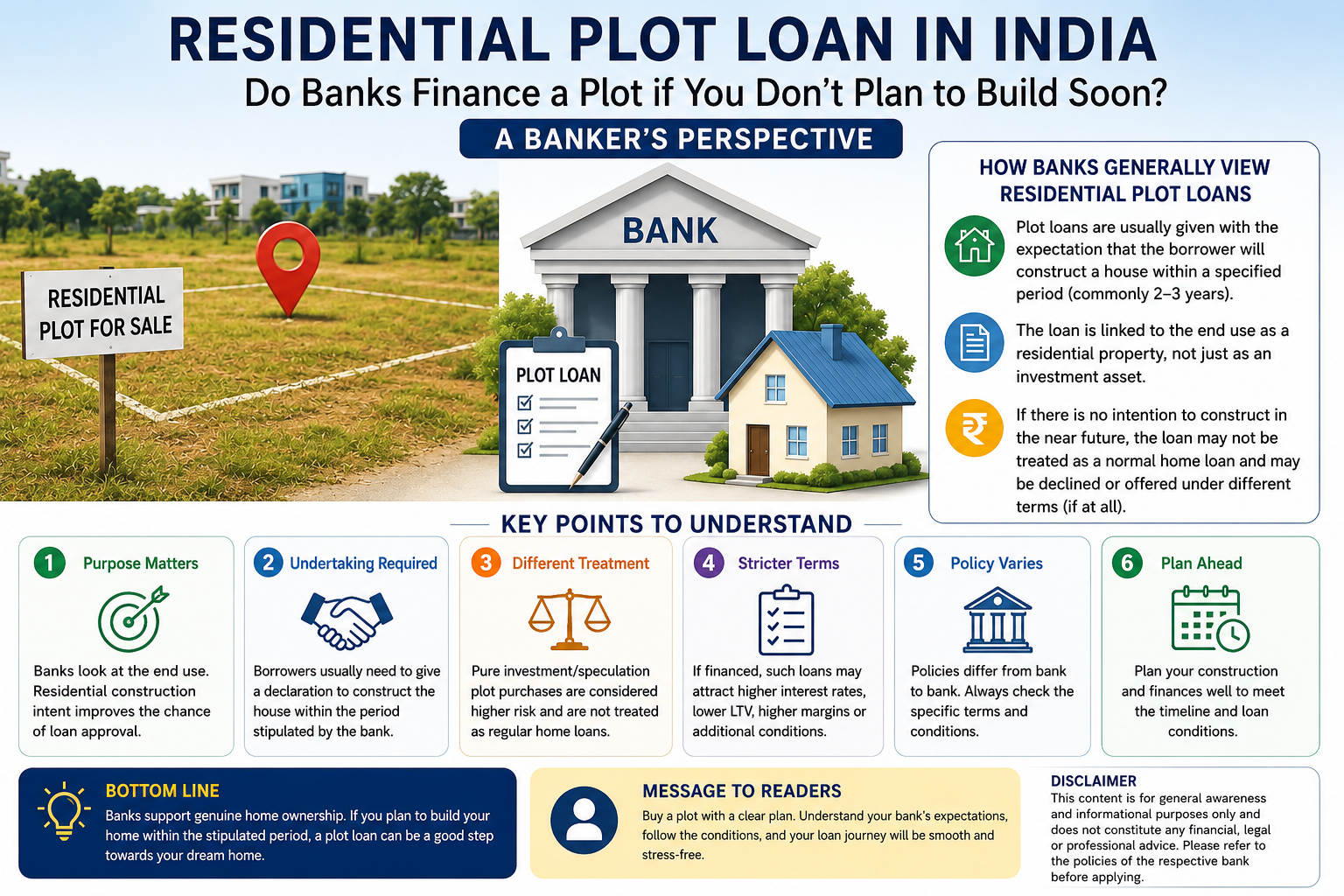
    Owning a residential plot is a dream for many individuals and families in India. For some, it is the first step toward building a future home, while for others, it is a long-term financial investment. In growing cities and developing areas, purchasing land is often considered a secure asset with future appreciation potential. However, an important question frequently arises:

    Will banks finance the purchase of a residential plot if the borrower has no immediate intention to construct a house?

    This question is highly relevant for borrowers, professionals, students, bankers, and investors. The answer is not entirely straightforward because plot loans are treated differently from ordinary home loans by most banks and financial institutions.

    1. Understanding the Difference Between a Home Loan and a Plot Loan

    A normal housing loan is generally sanctioned for:

    1. Purchase of a ready-built house or flat
    2. Construction of a residential house
    3. Purchase of a plot along with construction of a house

    In all these cases, the end use of funds is directly connected with residential housing.

    A plot loan, however, is different because the borrower purchases only land and no residential structure exists at the time of financing. Therefore, banks become cautious about the future purpose and use of the property.

    Most banks expect that the borrower will eventually construct a residential house on the plot within a specified period.

    2. Why Banks Treat Plot Loans Differently

    Banks are generally more comfortable financing a constructed property than financing vacant land. This is because a completed house has immediate utility and stable valuation, whereas land prices may fluctuate significantly depending on market conditions and speculative demand.

    From a banking perspective, there is a major difference between:

    • Buying a plot for future residential construction; and
    • Buying a plot purely for investment or speculative purposes.

    Banks usually support genuine residential requirements. However, they remain cautious when the purchase appears to be only for investment or future appreciation in land value.

    This cautious approach is mainly based upon:

    1. Risk management principles
    2. Internal lending policies
    3. Exposure norms
    4. Ethical lending practices
    5. Regulatory treatment of housing finance

    3. RBI Framework and Banking Practice

    There is no absolute prohibition by the Reserve Bank of India on granting loans for the purchase of residential plots. However, RBI guidelines relating to housing finance generally connect such loans with the borrower’s intention to construct a residential house.

    In practice, banks normally obtain:

    • A declaration or undertaking from the borrower;
    • Confirmation regarding future construction plans;
    • Proposed timeline for construction.

    Most banks stipulate that construction should commence or be completed within a period of approximately 2 to 3 years, depending upon the terms of sanction and internal policy.

    Therefore, while banks may finance residential plots, they generally do so with the expectation that the land will ultimately be used for residential construction.

    4. Why Pure Investment-Oriented Plot Purchases Face Difficulty

    If a borrower clearly states that:

    “The plot is being purchased only for investment and there is no intention to build a house in the foreseeable future,”

    then many banks may hesitate to sanction the loan under normal housing finance schemes.

    The reasons are practical as well as regulatory:

    1. Land values may fluctuate sharply.
    2. Speculative investments involve higher risk.
    3. Such transactions may not qualify as housing finance in the traditional sense.
    4. Banks prefer productive and identifiable end use of funds.
    5. Excessive speculative exposure in real estate is generally discouraged in prudent banking practice.

    As a result, banks may:

    • Decline the proposal;
    • Seek further clarification;
    • Ask for additional security;
    • Charge higher interest rates; or
    • Consider the proposal under some other general lending scheme instead of a regular home loan category.

    5. How Banks Usually Structure Plot Loans

    When a residential plot loan is sanctioned, banks often include several important conditions in the sanction terms.

    Common Features Include:

    a) Construction Undertaking

    The borrower may be required to undertake that a residential house will be constructed within a stipulated period.

    b) Proportionate Disbursement

    In some cases, banks release a certain percentage for purchase of the plot and link further funding with construction progress.

    c) Monitoring of Construction

    Banks may ask for:

    • Approved building plans
    • Municipal permissions
    • Progress photographs
    • Completion certificates

    d) Interest Rate Structure

    Composite loans for plot plus construction generally enjoy normal housing loan interest rates. Pure plot loans may attract higher rates.

    6. What Happens If Construction Is Not Completed Within the Stipulated Period

    This is one of the most important practical issues in plot financing.

    If the borrower fails to construct the house within the agreed timeline, banks may take action according to the loan agreement and sanction terms.

    Possible consequences include:

    1. Stoppage of Further Disbursement

    Any undisbursed construction component may be frozen.

    2. Reclassification of Loan

    The account may be reclassified from housing finance to another category such as:

    • Plot loan
    • Loan against property
    • General retail exposure

    3. Increase in Interest Rate

    Banks may charge higher interest rates because the loan no longer qualifies under normal housing finance treatment.

    4. Penal Charges

    Additional penal interest or covenant breach charges may be levied.

    5. Recall of Loan

    In serious cases of non-compliance, the bank may reserve the right to recall the facility as per loan conditions.

    However, in practical banking, many banks first attempt restructuring, pricing adjustments, or timeline extensions before taking extreme action.

    7. Importance of Transparency by Borrowers

    One of the fundamental principles of sound banking is clarity regarding the purpose and end use of funds.

    Borrowers should always:

    1. Clearly disclose their intentions;
    2. Explain future construction plans honestly;
    3. Read sanction conditions carefully;
    4. Understand the consequences of non-compliance;
    5. Seek written clarification wherever required.

    Transparency helps avoid future disputes, misunderstandings, and financial stress.

    8. Practical Advice for Borrowers

    Before applying for a residential plot loan, borrowers should consider the following:

    a) Understand the Bank’s Policy

    Different banks follow different internal policies regarding plot finance.

    b) Plan Future Construction Costs

    Purchasing the plot is only the first stage. Future construction expenses should also be evaluated realistically.

    c) Avoid Misrepresentation

    Incorrect declarations may create legal and financial complications later.

    d) Maintain Documentation

    Keep all approvals, sanction letters, and construction-related documents properly recorded.

    e) Negotiate Genuine Delays

    If delays occur due to unavoidable circumstances, borrowers should approach the bank early and request extensions formally.

    9. A Balanced Perspective

    It would be incorrect to say that banks never finance residential plots. Such loans are common and form part of retail banking business across many institutions.

    At the same time, it would also be inaccurate to assume that every plot purchase automatically qualifies as a normal home loan.

    The final decision depends upon:

    • Borrower’s intention
    • Repayment capacity
    • Nature and location of property
    • Internal bank policy
    • Risk assessment standards
    • Compliance with housing finance conditions

    The borrower’s genuine residential purpose remains one of the most important factors in obtaining favorable treatment under housing finance schemes.

    Conclusion

    Residential plot loans occupy a unique position in Indian banking. While banks generally support genuine housing requirements, they remain cautious toward purely speculative land purchases.

    There is no complete prohibition against financing residential plots. However, banking practice and housing finance guidelines usually expect the borrower to construct a residential dwelling within a reasonable period.

    Understanding these distinctions helps borrowers make informed financial decisions, approach banks with realistic expectations, and avoid future complications relating to interest rates, loan classification, or compliance conditions.

    Careful planning, transparency, and awareness of loan terms are the keys to a smooth and financially disciplined borrowing experience.

    Message to Readers

    Before purchasing a residential plot through bank finance, borrowers should evaluate not only the immediate cost of acquisition but also the long-term obligations connected with construction timelines and loan conditions. Informed borrowing always leads to healthier financial management and better banking relationships.

    — Ashok Kakkar
    Advocate | Insolvency Professional | Former Banker

    Disclaimer

    This article is intended solely for educational and awareness purposes. The views expressed are based on general banking principles, regulatory understanding, and practical industry experience. Lending policies vary among institutions and may change from time to time. Readers are advised to verify applicable terms with the concerned bank and seek professional advice before taking financial or borrowing decisions.

    #Residential Plot Loan,Housing Finance ,Home LoanBanking Awareness,Personal Finance,Real Estate Finance,Property Purchase,Financial Literacy

  • Before You Sign as a Loan Guarantor: Understanding the Hidden Risks and Legal Consequences

    Before You Sign as a Loan Guarantor: Understanding the Hidden Risks and Legal Consequences


    Before You Sign as a Loan Guarantor: Understanding the Hidden Risks and Legal Consequences

    A Practical and Professional Perspective on Rights, Responsibilities and Risk Management

    By Ashok Kakkar
    (Advocate | Insolvency Professional | Former Banker)

    Introduction: A Risk Often Underestimated

    In the course of banking and financial dealings, one often encounters individuals who readily agree to act as guarantors for loans extended to friends, relatives, or business associates. Such decisions are frequently driven by trust, goodwill, or social obligation. However, what appears to be a simple act of support can, in reality, evolve into a serious and legally enforceable financial commitment.

    It is not uncommon to observe that individuals suffer financial distress, credit impairment, and prolonged legal complications—not because they borrowed funds themselves, but because they undertook the responsibility of a guarantor without fully understanding its implications.

    This article seeks to present a comprehensive and practical insight into the risks, legal position, and precautions associated with becoming a loan guarantor, particularly from the perspective of banking practice and professional advisory.

    Understanding the Legal Character of a Guarantee

    A guarantee is not a ceremonial or procedural formality. It is a contractual obligation, governed by the provisions of the Indian Contract Act, 1872, wherein a third party (the guarantor or surety) undertakes to discharge the liability of the borrower (principal debtor) in the event of default.

    The most significant principle governing guarantees is that the liability of the guarantor is co-extensive with that of the borrower. In practical terms, this means that the guarantor assumes responsibility for the entire outstanding liability, including principal, interest, penal charges, and other costs, unless specifically limited by the terms of the agreement.

    Importantly, the lender is legally entitled to proceed against the guarantor without first exhausting remedies against the borrower. Thus, the guarantor stands on almost equal footing with the borrower in matters of recovery.

    Why Do Banks Insist on Guarantees?

    From a banking perspective, lending decisions are guided by risk assessment and regulatory prudence. A guarantee is not sought as a routine requirement, but as a risk-mitigation mechanism in situations where the lender perceives potential inadequacy in the borrower’s repayment capacity.

    Typically, guarantees are insisted upon in cases where:

    • The borrower lacks sufficient financial strength or asset backing
    • The loan is unsecured or partially secured
    • The borrower is a newly established entity or has limited credit history
    • The exposure is relatively high or carries extended tenure

    Thus, a guarantee functions as an additional layer of security, providing comfort to the lender against potential default.

    Nature and Forms of Guarantees in Practice

    In practical banking operations, guarantees may take various forms depending upon the nature of the borrower and the transaction:

    • Personal Guarantees, often obtained from promoters, partners, directors, or family members
    • Third-Party Guarantees, where an independent individual assumes liability
    • Corporate Guarantees, provided by companies, subject to compliance with corporate laws
    • Property-Backed Guarantees, where the guarantor offers immovable property as security
    • Government Guarantees, in specific cases involving public sector or infrastructure lending

    Each form of guarantee carries distinct implications, particularly in terms of enforcement and compliance.

    Major Risks Associated with Becoming a Guarantor

    1. Full Financial Liability Without Direct Benefit

    One of the most critical aspects of a guarantee is that the guarantor assumes complete financial liability without deriving any direct benefit from the loan. In the event of default, the guarantor is obligated to repay the entire outstanding amount.

    2. Impact on Credit Profile and Financial Standing

    Once an individual stands as a guarantor, the exposure is reflected in their credit profile as a contingent liability. Any delay or default by the borrower can adversely affect the guarantor’s creditworthiness.

    This may result in:

    • Difficulty in obtaining future loans
    • Higher interest rates
    • Reduced access to credit facilities

    3. Exposure to Direct Recovery Proceedings

    A common misconception is that the lender will first proceed against the borrower. In reality, the lender may initiate recovery proceedings directly against the guarantor.

    Such actions may include:

    • Issuance of legal notices
    • Initiation of proceedings before appropriate forums
    • Attachment and sale of assets
    • Action under applicable recovery laws in case of secured assets

    Thus, the guarantor’s personal assets, savings, and investments may be at risk.

    4. Reduction in Borrowing Capacity

    Financial institutions consider guarantee obligations while assessing credit eligibility. Even if no default has occurred, the guarantor’s financial capacity is viewed as partially committed, thereby reducing eligibility for future borrowings.

    5. Legal Complications and Mental Stress

    In cases of default, the guarantor may be drawn into prolonged legal proceedings, including litigation and recovery actions. The associated financial burden, time involvement, and uncertainty often result in considerable mental stress.

    6. Strain on Personal and Professional Relationships

    Guarantees are frequently extended on the basis of personal relationships. However, when financial defaults occur, these relationships may deteriorate, leading to disputes and long-term estrangement.

    7. Financial Vulnerability in Emergencies

    Repayment of another person’s loan can significantly deplete personal savings and reserves, thereby affecting the guarantor’s ability to meet their own financial obligations, particularly in times of emergency.

    Right of Recovery: A Limited Practical Relief

    Legally, a guarantor who repays the loan acquires the right to recover the amount from the borrower. However, in practical terms, this often involves further legal proceedings, additional costs, and considerable delay, making the remedy difficult to enforce effectively.

    Common Misconceptions That Need Correction

    Several misconceptions prevail in practice:

    • The belief that acting as a guarantor is merely a formality
    • The assumption that recovery will first be pursued against the borrower
    • Reliance on personal trust without financial assessment
    • Dependence on verbal assurances rather than written terms

    Such assumptions often lead to unintended financial consequences.

    Precautions Before Accepting the Role of a Guarantor

    Before agreeing to act as a guarantor, it is prudent to undertake a careful and objective evaluation:

    • Assess the borrower’s repayment capacity and financial discipline
    • Read and understand all documents thoroughly before signing
    • Evaluate one’s own financial ability to discharge the liability if required
    • Ensure clarity regarding the extent and limits of liability
    • Avoid signing under emotional or social pressure
    • Explore alternative financing options where guarantees may not be required

    A well-informed decision at the outset can prevent significant hardship in the future.

    Special Situations Requiring Additional Caution

    Certain situations demand heightened awareness:

    • Consortium lending, where multiple lenders may independently enforce guarantees
    • Corporate guarantees, requiring compliance with statutory provisions
    • Loans from NBFCs or private lenders, where terms may be less transparent
    • Insolvency scenarios, where guarantors may face independent proceedings under applicable laws

    Professionals advising clients must pay particular attention to these aspects.

    Conclusion: A Decision That Requires Careful Consideration

    Becoming a loan guarantor is not a casual or symbolic act. It is a serious financial commitment with far-reaching consequences.

    While the intention to support others is commendable, such decisions must be guided by informed judgment rather than emotional considerations.

    Before signing any guarantee document, one must reflect:

    “Am I financially prepared to discharge this obligation if the borrower fails?”

    If there is any uncertainty, it is advisable to exercise restraint.

    Disclaimer

    This article is intended for general informational and educational purposes only. It is based on practical banking experience and general legal understanding. Readers are advised to seek professional advice before taking any financial or legal decision.

    Ashok Kakkar

  • Practical Banking Perspective: What Lenders Examine Before Sanctioning Loans

    Practical Banking Perspective: What Lenders Examine Before Sanctioning Loans

    Practical Banking Perspective: What Lenders Examine Before Sanctioning Loans

    Understanding Credit Assessment, Financial Discipline, Documentation, and Risk Evaluation in Modern Lending Practices

    Applicable To:

    Individuals • Professionals • Students • Home Buyers • Business Owners • First-Time Borrowers

    1. Introduction

    In today’s financial environment, loans have become an important part of economic and personal growth. Whether a person wishes to purchase a house, expand a business, pursue higher education, buy a vehicle, or manage temporary financial needs, borrowing has become a common financial tool.

    However, many borrowers still approach the loan process without fully understanding how banks and financial institutions actually evaluate loan applications. From a practical banking perspective, loan sanctioning is not merely about filling forms or submitting documents. It is a detailed process involving financial assessment, legal verification, credit evaluation, compliance checking, and risk management.

    Every lender — whether a bank, NBFC, housing finance company, or cooperative institution — must ensure that the proposed borrowing remains financially sustainable and legally secure.

    2. Core Objectives of Loan Evaluation

    Before approving any loan, lenders generally try to evaluate three major aspects:

    2.1 Repayment Capacity

    Whether the borrower has sufficient and stable income to repay the loan comfortably throughout the loan tenure.

    2.2 Genuineness of Purpose

    Whether the loan requirement appears genuine, reasonable, and properly disclosed by the borrower.

    2.3 Overall Credit Risk

    Whether the overall financial and legal risk involved in the proposal is acceptable according to the lender’s policy and regulatory framework.

    3. Identity Verification and KYC Compliance

    The first stage of loan processing usually involves identity verification and KYC compliance.

    Lenders commonly ask for:

    1. PAN Card
    2. Aadhaar Card
    3. Passport
    4. Voter ID
    5. Driving Licence
    6. Address Proof
    7. Recent Photographs

    This process helps financial institutions:

    1. Prevent fraud and impersonation
    2. Comply with RBI and anti-money laundering regulations
    3. Verify the borrower’s identity and address authenticity

    Even minor mismatches in documents may sometimes delay loan processing.

    4. Income Source and Financial Stability

    One of the most important aspects of loan assessment is repayment capability.

    Lenders generally evaluate:

    1. Salary income
    2. Business income
    3. Professional income
    4. Rental income
    5. Agricultural income (where acceptable)
    6. Other regular earnings

    4.1 Documents Commonly Required from Salaried Individuals

    1. Salary slips
    2. Form 16
    3. Bank statements
    4. Employment proof

    4.2 Documents Commonly Required from Self-Employed Borrowers

    1. Income Tax Returns (ITRs)
    2. GST returns
    3. Balance Sheet
    4. Profit & Loss Account
    5. Business registration documents

    The purpose is to assess whether income is stable and sustainable during the loan period.

    5. Existing Liabilities and Debt Burden

    Banks also assess the borrower’s current financial obligations before sanctioning fresh credit.

    These may include:

    1. Existing home loans
    2. Personal loans
    3. Vehicle loans
    4. Credit card dues
    5. Business liabilities
    6. Overdraft facilities
    7. Guarantee obligations

    Lenders calculate the borrower’s FOIR (Fixed Obligation to Income Ratio) to determine whether the borrower is already overburdened with debt.

    6. Credit Score and Financial Discipline

    Modern lending systems heavily depend upon credit history and repayment behaviour.

    Lenders generally review:

    1. CIBIL score
    2. Past repayment history
    3. Delayed EMI payments
    4. Loan defaults
    5. Settlement history
    6. Number of recent loan enquiries

    Generally, a higher credit score improves:

    1. Loan approval chances
    2. Interest rate negotiation
    3. Faster processing possibilities

    A healthy credit profile reflects financial discipline and responsible borrowing habits.

    7. Bank Account Conduct and Transaction Behaviour

    Bank statements often reveal important details about the borrower’s financial discipline.

    Lenders examine:

    1. Salary credits
    2. Average monthly balance
    3. Frequency of cheque returns
    4. ECS dishonours
    5. Irregular cash deposits
    6. Transaction patterns
    7. Overall account conduct

    Poor account management may create a negative impression even if income appears satisfactory.

    8. Purpose of the Loan

    Lenders always try to understand why the borrower requires the loan.

    Different loan purposes involve different risk levels.

    8.1 Home Loans

    Focus generally remains on:

    1. Property documents
    2. Approved plans
    3. Long-term repayment stability
    4. Property valuation

    8.2 Business Loans

    Lenders may focus more on:

    1. Business turnover
    2. Cash flow
    3. GST returns
    4. Financial statements

    8.3 Personal Loans

    Greater importance is usually given to:

    1. Salary stability
    2. Existing EMIs
    3. Credit score

    8.4 Education Loans

    Banks may evaluate:

    1. Institution reputation
    2. Course quality
    3. Employability prospects
    4. Parent or co-applicant profile

    9. Property and Security Evaluation

    In secured loans, lenders also examine the legality and value of the collateral offered.

    Commonly required documents include:

    1. Sale deed
    2. Title documents
    3. Mutation records
    4. Approved building plans
    5. No-Encumbrance Certificate (NEC)
    6. Property valuation reports
    7. Tax receipts

    Banks conduct both legal scrutiny and technical valuation before accepting property as security.

    10. Evaluation of Composite Loans

    Composite loans involve:

    1. Purchase of land
    2. Construction of house

    These loans are useful for borrowers wishing to build customized homes instead of purchasing ready-built flats or apartments.

    However, lenders treat such loans cautiously because the final security gets created gradually during construction.

    Banks usually evaluate:

    1. Clear land ownership
    2. Approved construction plans
    3. Architect estimates
    4. Construction cost projections
    5. Stage-wise disbursement requirements
    6. Site inspection reports
    7. End-use monitoring of funds

    Funds are often released in phases such as:

    1. Land purchase stage
    2. Foundation stage
    3. Plinth stage
    4. Structure completion stage
    5. Finishing stage

    11. Common Mistakes Borrowers Frequently Make

    Many borrowers unknowingly create financial difficulties for themselves.

    Some common mistakes include:

    1. Focusing only on EMI amount
    2. Ignoring total repayment burden
    3. Signing documents without reading them
    4. Concealing liabilities
    5. Ignoring mortgage conditions
    6. Applying simultaneously to multiple lenders
    7. Ignoring insurance obligations
    8. Depending entirely on agents without verification

    Financial decisions should always be taken carefully and after proper understanding.

    12. Practical Suggestions for Borrowers

    Before approaching any lender, borrowers should ideally:

    1. Organize all financial documents properly
    2. Maintain healthy banking habits
    3. Check credit score regularly
    4. Avoid unnecessary loan enquiries
    5. Understand total repayment obligations
    6. Read all loan terms carefully
    7. Avoid signing blank documents
    8. Verify property papers independently
    9. Maintain financial discipline consistently
    10. Seek professional guidance whenever necessary


    13. Conclusion

    Lenders’ questions and documentation requirements are not merely procedural formalities. They are intended to protect both the lender and the borrower from future financial stress and legal complications.

    A borrower who maintains financial discipline, transparency, organized records, and realistic repayment planning generally stands a much better chance of obtaining loan approval smoothly and on favorable terms.

    In practical financial life, informed borrowing is just as important as informed earning.

    14. Message to Readers

    Loans can become powerful financial tools when used responsibly and with proper planning. However, borrowing without understanding long-term obligations may create unnecessary financial pressure.

    Before taking any loan:

    1. Understand the total repayment burden — not merely the EMI
    2. Read sanction terms and mortgage conditions carefully
    3. Verify property documents legally
    4. Maintain transparency with the lender
    5. Borrow according to actual repayment capacity

    Financial literacy, documentation discipline, and responsible borrowing habits play a major role in achieving long-term financial stability and peace of mind.

    15. Disclaimer

    This write-up is prepared purely for general educational and informational purposes based on practical banking understanding and standard lending practices in India. Lending policies, documentation requirements, eligibility criteria, and regulatory guidelines may vary between institutions and may change over time.

    Readers are advised to consult qualified financial, legal, banking, or professional advisors before making any financial decision. The author shall not be responsible for any action taken solely on the basis of the information contained in this article.

    Ashok Kakkar

    Advocate & Insolvency Professional, Former Banker

    Ashok Kakkar is an independent writer and financial literacy enthusiast with a keen interest in banking practices, legal awareness, and public financial education. He regularly writes on practical issues relating to loans, banking systems, financial discipline, and consumer awareness in simple and reader-friendly language.

  • IBC (Amendment) Act, 2026: Understanding the Key Reforms and Their Potential Impact on India’s Insolvency Framework

    IBC (Amendment) Act, 2026: Understanding the Key Reforms and Their Potential Impact on India’s Insolvency Framework

    IBC (Amendment) Act, 2026: Understanding the Key Reforms and Their Potential Impact on India’s Insolvency Framework

    Introduction

    The Insolvency and Bankruptcy Code, 2016 (IBC) marked a significant shift in India’s approach towards insolvency and debt resolution. Prior to the enactment of the Code, recovery proceedings were often fragmented across multiple laws and forums, resulting in delays, uncertainty, and value erosion of distressed businesses.

    Over the last decade, the IBC has evolved through judicial interpretations, regulatory changes, and practical experiences gained from numerous insolvency cases. While the Code has achieved notable success in improving credit discipline and facilitating resolution of stressed assets, stakeholders have also identified challenges such as procedural delays, prolonged litigation, declining asset values during insolvency proceedings, and complexities involving group companies and cross-border assets.

    Recognizing these issues, Parliament enacted the Insolvency and Bankruptcy Code (Amendment) Act, 2026, and the Central Government has notified major provisions of the Amendment Act through Gazette Notification dated 25 May 2026, bringing them into force from 26 May 2026.

    This article provides a general overview of the important reforms introduced by the Amendment Act and their likely impact on India’s insolvency ecosystem.

    Why Were Further Amendments Considered Necessary?

    The primary objective of the IBC has always been:

    • Timely resolution of financial distress;
    • Preservation and maximization of asset value;
    • Promotion of entrepreneurship;
    • Availability of credit;
    • Balancing the interests of all stakeholders.

    Although significant progress has been achieved, many insolvency cases have exceeded prescribed timelines due to litigation and procedural complexities. Delays often reduce the value of business assets and negatively affect recoveries for creditors.

    The recent amendments seek to address some of these practical concerns while preserving the core principles of the Code.

    Major Areas of Reform

    1. Greater Emphasis on Early Resolution

    One of the important policy objectives reflected in the amendments is encouraging intervention before financial stress becomes irreversible.

    Early identification and resolution of distress can help preserve business operations, retain employment, protect supplier relationships, and maximize enterprise value.

    A faster response to financial difficulties generally increases the possibility of a successful resolution compared to situations where assets have already deteriorated significantly.

    2. Streamlining Insolvency Resolution Processes

    The amendments seek to improve procedural efficiency and reduce avoidable delays in insolvency proceedings.

    Over time, stakeholders have expressed concerns regarding prolonged admission proceedings, multiple rounds of litigation, and delays in implementation of approved plans.

    The reforms are expected to support:

    • Faster decision-making;
    • Improved procedural clarity;
    • Better coordination among stakeholders;
    • More efficient conduct of insolvency proceedings.

    A streamlined process can contribute significantly towards preserving asset value and enhancing recovery prospects.

    3. Increased Flexibility in Resolution Planning

    Business structures today are often complex and diversified. A single resolution strategy may not always be suitable for every distressed enterprise.

    The amendments introduce greater flexibility in designing resolution plans and restructuring proposals.

    This approach may allow stakeholders to consider practical solutions tailored to specific circumstances rather than relying exclusively on conventional models.

    Flexibility in resolution planning can potentially attract a larger pool of investors and resolution applicants, thereby improving competition and value realization.

    4. Focus on Value Maximization

    Value maximization remains one of the central objectives of the insolvency framework.

    Delays and uncertainty often lead to deterioration of business assets, loss of customers, and reduced investor interest.

    The reforms aim to support timely decision-making and preserve the economic value of distressed enterprises.

    Where value is preserved, all stakeholders—including creditors, employees, suppliers, investors, and local communities—stand to benefit.

    5. Strengthening Creditor Confidence

    A well-functioning insolvency system plays a crucial role in maintaining confidence within the financial system.

    Banks and financial institutions rely upon effective recovery mechanisms while extending credit.

    The amendments seek to strengthen the overall effectiveness of insolvency proceedings and provide greater certainty regarding outcomes.

    Improved confidence among lenders can contribute to healthier credit markets and support economic growth.

    6. Improvements in Liquidation Processes

    Not every distressed business can be successfully revived.

    In situations where resolution is not feasible, an efficient liquidation process becomes important for realizing value from available assets.

    The reforms seek to strengthen and streamline liquidation-related procedures so that closure of non-viable businesses can be completed more efficiently.

    Faster liquidation can reduce administrative costs and improve recoveries for stakeholders.

    7. Recognition of Group Insolvency Issues

    Modern corporate structures frequently involve multiple interconnected entities operating within a group.

    Financial distress affecting one company may have implications for several related entities.

    The amendments acknowledge the need for a more coordinated approach in dealing with such situations.

    A structured framework for addressing group insolvency issues may reduce duplication of efforts and facilitate more effective resolution outcomes.

    8. Cross-Border Insolvency Considerations

    Businesses increasingly operate across jurisdictions and may possess assets, creditors, or contractual obligations in different countries.

    Traditional insolvency proceedings often encounter challenges when dealing with international elements.

    The Amendment Act introduces provisions intended to strengthen India’s approach to cross-border insolvency matters and enhance cooperation with foreign jurisdictions.

    Such developments may improve certainty for international investors and creditors while supporting efficient administration of insolvency cases involving overseas assets.

    9. Enhanced Safeguards Against Improper Transactions

    An effective insolvency regime must ensure that assets are not improperly diverted before commencement of proceedings.

    The reforms strengthen mechanisms relating to scrutiny of transactions that may adversely affect creditor interests.

    These safeguards promote transparency, accountability, and fairness within the insolvency process.

    They also reinforce confidence among stakeholders that insolvency proceedings will be conducted in accordance with established legal principles.

    10. Supporting Ease of Doing Business

    An efficient insolvency framework is widely regarded as an important component of a modern economy.

    Investors, lenders, entrepreneurs, and businesses often assess the effectiveness of legal remedies available in cases of financial distress.

    By improving procedural efficiency and reducing uncertainty, the amendments are expected to contribute positively to India’s business environment and investment ecosystem.

    What Could Be the Practical Impact?

    While the ultimate success of any legislation depends upon implementation and judicial interpretation, the reforms may potentially contribute to:

    • Faster resolution of distressed companies;
    • Better preservation of enterprise value;
    • Enhanced recoveries for creditors;
    • Greater investor participation;
    • Reduced procedural uncertainty;
    • Improved confidence in credit markets;
    • Stronger insolvency infrastructure.

    At the same time, stakeholders may continue to monitor implementation challenges, regulatory developments, and emerging judicial decisions that will shape the practical operation of the amended framework.

    Conclusion

    The Insolvency and Bankruptcy Code (Amendment) Act, 2026 represents an important step in the continuing evolution of India’s insolvency regime. The reforms appear to focus on improving efficiency, encouraging timely resolution, preserving economic value, and strengthening stakeholder confidence.

    As India’s economy becomes increasingly sophisticated and interconnected, a responsive and effective insolvency framework remains essential for supporting entrepreneurship, facilitating credit growth, and maintaining financial stability.

    The coming years will reveal how these reforms operate in practice, but the overall direction reflects a continuing effort to strengthen the insolvency ecosystem and promote a more efficient resolution environment for businesses and creditors alike.

    Disclaimer

    This article is intended solely for general awareness and educational purposes. It provides a broad overview of the Insolvency and Bankruptcy Code (Amendment) Act, 2026 and should not be construed as legal, financial, regulatory, or professional advice. Readers should refer to the relevant statutory provisions, rules, regulations, official notifications, and professional advisors before acting on any matter discussed herein.

    By: Ashok Kakkar


    #IBC #IBCAmendmentAct2026 #InsolvencyLaw #CIRP #ResolutionProfessional #NCLT #CorporateLaw #BankingLaw #CreditorRights #DebtResolution #Liquidation #BusinessRestructuring #CorporateGovernance #CrossBorderInsolvency #LegalAwareness

  • Understanding Cross Guarantees: Legal Framework, Corporate Compliance, and Banking Perspective

    Understanding Cross Guarantees: Legal Framework, Corporate Compliance, and Banking Perspective

    Understanding Cross Guarantees: Legal Framework, Corporate Compliance, and Banking Perspective

    In modern banking and corporate finance, guarantees play an important role in securing loans and strengthening credit arrangements. One such concept frequently used in commercial lending is the Cross Guarantee. Although commonly used in banking terminology, the expression “cross guarantee” is not specifically defined under Indian statutory law. Instead, it is a practical commercial arrangement built upon the general principles of guarantee under Indian contract and corporate laws.

    Cross guarantees are widely used among group companies, sister concerns, business associates, and sometimes even independent entities where commercial dependency exists. For bankers, corporate professionals, borrowers, students, and legal practitioners, understanding the legal and practical implications of cross guarantees is essential.

    1. Meaning of Cross Guarantee

    A cross guarantee is a reciprocal arrangement where two or more parties guarantee each other’s financial obligations.

    For example:

    • Company A guarantees the loan taken by Company B.
    • Company B, in return, guarantees the loan taken by Company A.

    Thus, each entity acts as guarantor for the other.

    In legal terms, this arrangement consists of separate contracts of guarantee, even though commercially it is referred to as a “cross guarantee.”

    2. Legal Foundation Under Indian Contract Act, 1872

    The legal framework governing guarantees is primarily contained in Chapter VIII (Sections 126 to 147) of the Indian Contract Act, 1872.

    Important provisions include:

    (i) Section 126 – Contract of Guarantee

    This section defines:

    • Principal Debtor
    • Creditor
    • Surety (Guarantor)

    A guarantee is a promise to discharge the liability of another person in case of default.

    (ii) Section 127 – Consideration for Guarantee

    Anything done for the benefit of the principal debtor may constitute valid consideration for the guarantee.

    (iii) Section 128 – Co-Extensive Liability

    The liability of the guarantor is generally co-extensive with that of the borrower unless otherwise provided in the contract.

    This means the creditor may proceed directly against the guarantor without first exhausting remedies against the borrower.

     (iv) Sections 133–139 – Discharge of Surety

    These provisions describe situations where the guarantor may be discharged from liability due to changes in contractual terms or conduct of the creditor.

    (v) Sections 140 and 145 – Rights of Surety

    These sections provide:

    • Right of subrogation
    • Right to indemnification from the principal debtor

    Thus, the Indian Contract Act provides the complete legal basis for enforceability of cross guarantees.

    3. Cross Guarantee vs Corporate Guarantee

    A corporate guarantee refers to a guarantee provided by a company for obligations of another entity.

    A cross guarantee is essentially a reciprocal corporate guarantee arrangement.

    Therefore:

    • Every cross guarantee involving companies generally contains two corporate guarantees.
    • Legally, there is no separate “cross guarantee law.”

    Banks rely upon:

    1. Executed guarantee documents,
    2. Loan agreements,
    3. Security documents,
    4. Applicable recovery laws.

    4. Applicability Among Group Companies

    Cross guarantees are most common among:

    • Holding companies,
    • Subsidiaries,
    • Sister concerns,
    • Associate entities,
    • Companies under common management.

    Banks prefer such arrangements because:

    • There is shared business interest,
    • Financial dependence exists,
    • Promoters are common,
    • Recovery prospects improve.

    In many consortium and multiple banking arrangements, cross guarantees are treated as additional comfort for lenders.

    5. Cross Guarantees Between Independent Entities

    A cross guarantee is not restricted only to group companies.

    Even unrelated entities may legally provide guarantees for each other if:

    • A valid commercial purpose exists,
    • Proper approvals are obtained,
    • The arrangement benefits the guarantor.

    For example:

    • A purchaser may support the supplier’s loan,
    • A strategic business partner may guarantee funding arrangements.

    However, unrelated guarantees attract greater scrutiny from:

    • Banks,
    • Auditors,
    • Shareholders,
    • Regulators,
    • Insolvency professionals.

    The directors must justify that the transaction is in the company’s interest and not merely a gratuitous favour.

    6. Corporate Law Provisions Under Companies Act, 2013

    Several provisions of the Companies Act become relevant when companies provide guarantees.

    (i) Section 186 – Loans, Guarantees, Security and Investments

    This is the principal provision governing corporate guarantees.

    Requirements generally include:

    1. Board Resolution,
    2. Compliance with prescribed limits,
    3. Special Resolution if limits are exceeded,
    4. Disclosure in financial statements.

    Section 186 is the primary statutory provision regulating cross guarantees among companies.

     (ii) Section 179 – Powers of the Board

    The Board of Directors must approve guarantees through resolutions passed at board meetings.

    Banks usually insist upon:

    • Certified Board Resolution,
    • Authority letter,
    • Specimen signatures of authorised officials.

     (iii) Section 185 – Loans to Directors

    If guarantees benefit directors or related entities:

    • Certain transactions may be prohibited,
    • Others may require strict compliance conditions.

    Banks carefully examine compliance before accepting corporate guarantees.

    7. Financial Statement Disclosure

    Corporate guarantees create contingent liabilities.

    Therefore:

    • Disclosure is generally required in financial statements,
    • Auditors may comment upon material guarantees,
    • Related party disclosures may apply.

    Such disclosures are important from governance and transparency perspectives.

    8. Banking Perspective and Due Diligence

    Before accepting a cross guarantee, banks generally verify:

    1. Memorandum and Articles of Association,
    2. Board and shareholder approvals,
    3. Compliance with Sections 185 and 186,
    4. Financial strength of guarantor,
    5. Net worth and repayment capacity,
    6. Authority of signatories,
    7. Proper execution and stamping.

    Banks also assess whether:

    • The guarantor has genuine business interest,
    • The arrangement is commercially viable,
    • The guarantee enhances overall security coverage.

    9. Enforcement of Cross Guarantees

    In case of default, lenders may:

    • Invoke the guarantee,
    • Initiate recovery proceedings,
    • Proceed simultaneously against borrower and guarantor.

    Recovery mechanisms may include:

    • Civil suits,
    • Proceedings before Debt Recovery Tribunal (DRT),
    • Action under the SARFAESI Act,
    • Insolvency proceedings under IBC.

    The guarantor’s liability may become immediate upon invocation of guarantee.

    10. Impact Under Insolvency and Bankruptcy Code (IBC)

    Under the Insolvency and Bankruptcy Code, 2016:

    • Creditors may proceed against both borrower and corporate guarantor,
    • Claims may be filed against guarantors,
    • CIRP may be initiated against corporate guarantors.

    Indian courts, including the Supreme Court of India, have repeatedly recognised the enforceability of guarantees and creditors’ rights against guarantors.

    This makes cross guarantees commercially significant but legally sensitive arrangements.

    11. Risks Associated With Cross Guarantees

    Although useful, cross guarantees involve substantial risks.

    Major concerns include:

    1. Increased financial exposure,
    2. Contingent liability burden,
    3. Possibility of simultaneous defaults,
    4. Group insolvency impact,
    5. Corporate governance concerns,
    6. Regulatory scrutiny,
    7. Impact on credit ratings and borrowing capacity.

    A weak entity within a group may financially affect stronger entities through guarantee obligations.

    12. Practical Importance in Banking

    Cross guarantees are commonly used in:

    • Working capital finance,
    • Consortium lending,
    • Infrastructure financing,
    • Real estate projects,
    • Group company financing,
    • SME and MSME funding.

    For lenders, they provide:

    • Additional security comfort,
    • Expanded recovery avenues,
    • Better monitoring of group exposure.

    For borrowers, they may help:

    • Obtain higher credit limits,
    • Improve lender confidence,
    • Support financially weaker entities.

    Conclusion

    A cross guarantee is essentially a reciprocal guarantee arrangement commonly used in banking and corporate finance. Though not separately defined under Indian law, its validity and enforceability arise from the general law of guarantees under Sections 126–147 of the Indian Contract Act, 1872, together with corporate compliance requirements under the Companies Act, 2013.

    In practical banking operations, cross guarantees are widely used among group companies and related entities to strengthen lending structures and improve recovery security. However, such guarantees also create significant legal and financial obligations for guarantors. Therefore, proper documentation, corporate approvals, commercial justification, and regulatory compliance become extremely important.

    For bankers, directors, professionals, and borrowers, cross guarantees should never be treated as routine formalities. They are legally enforceable commitments capable of creating substantial financial liability in case of default.

    Disclaimer

    This article is intended purely for educational, academic, and general informational purposes. The legal provisions mentioned are based on general principles of Indian law and may vary depending upon specific contractual terms, judicial interpretations, regulatory amendments, and factual circumstances. Readers are advised to seek independent legal, financial, or professional advice before acting upon any matter relating to guarantees, corporate liabilities, banking documentation, or insolvency proceedings.

    By: Ashok Kakkar

    #Cross Guarantee #Corporate Guarantee #Banking Law #Indian Contract Act #CompaniesAct2013 #Corporate Finance #Banking And Finance #IBC  #Loan Security #Corporate Compliance

  • DEAF Fund and Unclaimed Financial Assets in India

    DEAF Fund and Unclaimed Financial Assets in India


    DEAF Fund and Unclaimed Financial Assets in India

    How Depositors, Investors, Nominees, and Legal Heirs Can Recover Forgotten Wealth

    By Ashok Kakkar

    In India, thousands of bank accounts, fixed deposits, insurance policies, mutual fund investments, provident fund balances, shares, and pension amounts remain unclaimed every year. Many families are unaware that money belonging to them may still be lying with banks, insurance companies, mutual funds, or government authorities.

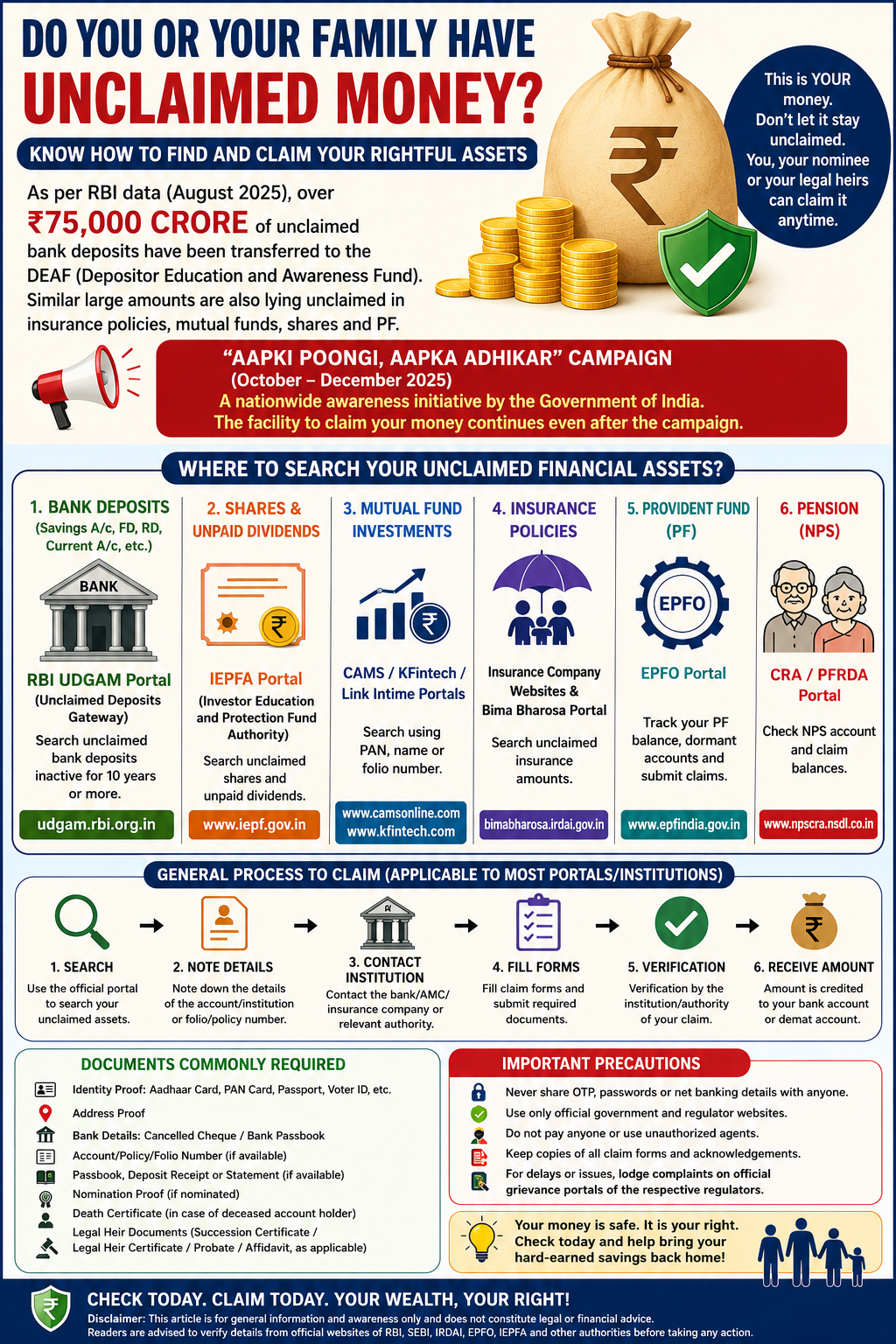
    In recent years, public awareness regarding unclaimed financial assets has increased significantly. Reports indicated that more than ₹75,000 crore worth of unclaimed bank deposits had been transferred to the Depositor Education and Awareness Fund (DEAF) maintained by the Reserve Bank of India. This issue also gained public attention during the “Aapki Poongi, Aapka Adhikar” awareness campaign launched by the Ministry of Finance during 2025. Although the campaign period ended, the facility to trace and recover unclaimed financial assets continues to remain available through official platforms and regulatory systems.

    This article explains the DEAF Fund, the UDGAM portal, and other important platforms through which citizens, nominees, and legal heirs can trace and recover their forgotten financial assets in India.

    1. What is the DEAF Fund?

    DEAF stands for Depositor Education and Awareness Fund. It was established by the Reserve Bank of India under the Banking Regulation framework for handling unclaimed bank deposits.

    When bank accounts or deposits remain inoperative or unclaimed for ten years or more, banks are required to transfer such balances to the DEAF Fund maintained by RBI. These may include:

    1. Savings Bank Accounts
    2. Current Accounts
    3. Fixed Deposits
    4. Recurring Deposits
    5. Demand Drafts
    6. Other eligible unclaimed balances

    However, transfer to the DEAF Fund does not mean the money is forfeited. The depositor, nominee, or legal heir continues to retain full rights over the amount.

    2. Can Depositors Still Claim Money After Transfer to DEAF?

    Yes. Even after transfer to the DEAF Fund:

    • The original depositor can claim the amount.
    • Registered nominees can submit claims.
    • Legal heirs may recover the amount after completing required formalities.

    The concerned bank remains responsible for verifying and settling the claim. After payment to the claimant, the bank obtains reimbursement from the DEAF Fund.

    Thus, the money remains recoverable even after many years.

    3. RBI UDGAM Portal for Unclaimed Bank Deposits

    To simplify the process of locating dormant bank deposits, RBI introduced the UDGAM Portal.

    RBI UDGAM Portal

    The portal allows individuals to search unclaimed deposits across participating banks from a single platform.

    Basic Process

    1. Register using mobile number.
    2. Verify OTP.
    3. Enter name and identification details.
    4. Search for unclaimed deposits.
    5. Identify the concerned bank.
    6. Contact the bank branch and submit claim documents.

    The portal is especially useful for tracing old savings accounts, salary accounts, fixed deposits, or accounts belonging to deceased family members.

    4. Documents Commonly Required for DEAF Claims

    For Original Account Holder

    • PAN Card
    • Aadhaar Card
    • Passbook or deposit receipt
    • Bank account details
    • Cancelled cheque
    • Claim form

    For Nominee

    • Identity proof
    • Nomination proof
    • Death certificate of depositor
    • Bank details

    For Legal Heirs

    • Death certificate
    • Succession certificate where required
    • Legal heir certificate or probate
    • PAN and Aadhaar
    • Affidavits or indemnity documents if prescribed by the bank

    Requirements may vary depending on the bank’s internal policy and amount involved.

    5. Unclaimed Insurance Policies

    Many insurance claims remain unpaid because policyholders fail to update contact details or nominees are unaware of the policy.

    Under regulatory guidelines, insurance companies are required to maintain searchable records of unclaimed policy amounts.

    IRDAI Official Website

    Bima Bharosa Portal

    Most insurers also provide “Unclaimed Amount Search” facilities on their own websites.

    Commonly Required Documents

    • Policy number
    • PAN and Aadhaar
    • Identity proof
    • Bank account details
    • Death certificate where applicable
    • Nominee proof

    6. Unclaimed Shares and Dividends

    Large amounts of dividends and shares remain unclaimed for years because investors forget investments or fail to update records.

    Such amounts are transferred to the Investor Education and Protection Fund (IEPF).

    IEPFA Portal

    Basic Claim Process

    1. Search for unclaimed amounts.
    2. File Forms
    3. Upload required documents.
    4. Submit documents to the company’s Nodal Officer.
    5. Verification and refund process is completed.

    Investors may recover both unpaid dividends and transferred shares through this mechanism.

    7. Unclaimed Mutual Fund Investments

    Many investors forget old mutual fund folios, dividend payouts, or redemption proceeds.

    These may be traced through registrar platforms such as:

    CAMS Online

    KFin Technologies

    Investors can generally search using:

    • PAN number
    • Folio number
    • Name of investor

    After verification, the Asset Management Company may release the unclaimed amount.

    8. Provident Fund and Pension Balances

    Employees frequently change jobs and may forget older PF accounts.

    EPFO Portal

    Using UAN credentials, members can:

    1. View PF balances
    2. Transfer old accounts
    3. Submit withdrawal claims
    4. Trace dormant balances

    Similarly, pension-related claims may be processed through relevant pension authorities or NPS service providers.

    9. Important Precautions While Claiming Unclaimed Assets

    While tracing financial assets, individuals should remain cautious.


    Important Safety Measures

    1. Use only official portals and websites.
    2. Never share OTPs or banking passwords.
    3. Avoid unauthorized agents demanding advance fees.
    4. Maintain copies of claim forms and acknowledgements.
    5. Verify claim procedures directly from official authorities.

    If a bank or institution delays processing, grievance mechanisms of RBI, IRDAI, SEBI, EPFO, or IEPFA may be used.

    10. Importance for Legal Heirs and Families

    In many cases, legal heirs are unaware of financial assets left behind by deceased family members. Lack of nominations, missing records, or outdated addresses often create difficulties.

    Families should therefore:

    • Maintain proper financial records.
    • Register nominees in all accounts and investments.
    • Periodically review dormant investments.
    • Inform family members about major financial assets.

    A simple review of old documents, emails, passbooks, insurance papers, or tax records may help identify forgotten wealth.

    Conclusion

    Unclaimed financial assets are not merely inactive numbers in institutional records; they represent the hard-earned savings of ordinary citizens and families. Whether the amount relates to a dormant bank account, forgotten fixed deposit, unpaid insurance claim, mutual fund investment, provident fund, or old shareholding, rightful owners continue to retain legal rights over such assets.

    The DEAF Fund, RBI UDGAM Portal, IEPFA mechanism, insurance search facilities, mutual fund registrars, and EPFO systems have significantly simplified the process of tracing and recovering unclaimed money.

    A few minutes spent checking these official portals today may help recover valuable financial assets tomorrow.

    Disclaimer

    This article is intended solely for educational and public awareness purposes. Rules, procedures, claim requirements, and regulatory guidelines may change from time to time. Readers are advised to verify the latest information directly from RBI, IRDAI, SEBI, IEPFA, EPFO, banks, insurers, mutual fund registrars, and other competent authorities before taking any action. Professional legal or financial advice should be obtained wherever necessary.

    Ashok Kakkar

    #DEAFFund #UnclaimedDeposits #RBIUDGAM # FinancialAwareness #BankDeposits #IEPFA#EPFO #InsuranceClaims #MutualFunds #LegalHeirs

  • Introducing Professional Wisdom Hub – Banking, Finance & Legal Learning SeriesLearning from Experience, Sharing with Purpose.

    Introducing Professional Wisdom Hub – Banking, Finance & Legal Learning SeriesLearning from Experience, Sharing with Purpose.

    After more than four decades of experience in banking, recovery, legal practice and insolvency matters, I am pleased to introduce Professional Wisdom Hub – Banking • Finance • Legal Learning Series.

    The objective of this initiative is to share practical knowledge, real-life experiences, case studies and professional insights with bankers, finance professionals, advocates, students and aspiring practitioners. Through discussions and experience-based learning, I hope to contribute towards bridging the gap between academic knowledge and practical application.

    I welcome suggestions, participation and collaboration from all those interested in continuous learning and professional growth.

    Learning from Experience, Sharing with Purpose.

    Ashok Kakkar
    M.Com, LL.B., LL.M., CAIIB
    Advocate | Insolvency Professional | Former Banker

    ProfessionalWisdomHub #BankingEducation #FinanceProfessionals #LegalLearning #IBCIndia #KnowledgeSharing