
How Resolution Professionals, bankers, creditors and o
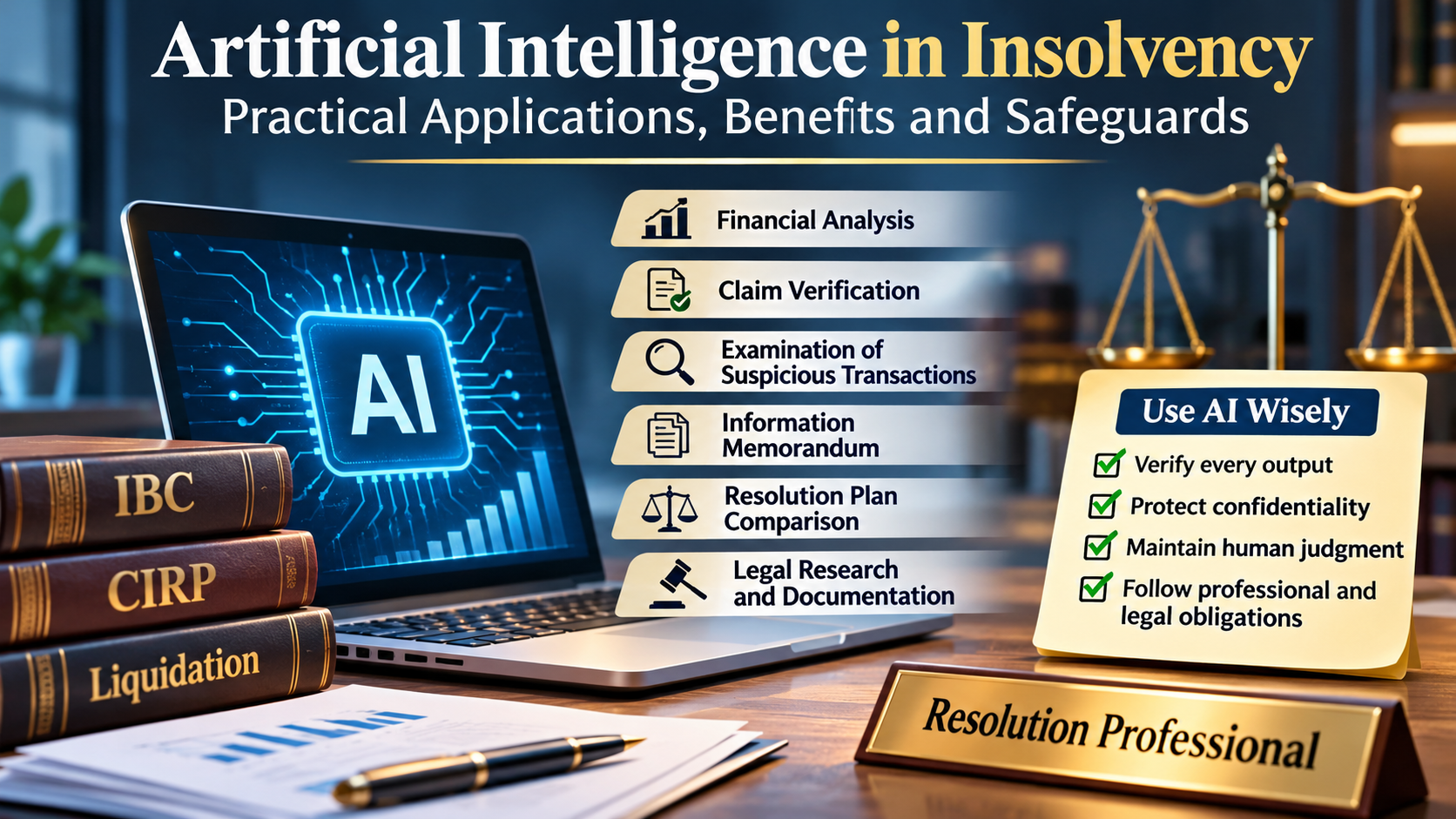
Artificial Intelligence in Insolvency: Practical Applications, Benefits and Safeguards
How Resolution Professionals, bankers, creditors and other stakeholders can use AI to improve financial analysis, claim verification and the management of insolvency assignments.
By Ashok Kakkar
Advocate | Insolvency Professional | Former Chief Manager, Punjab National Bank
1. Introduction
During my banking career, I witnessed several important technological changes. Manual records gave way to computers, branch operations moved to core banking systems, and traditional banking services expanded through digital platforms. Each development improved efficiency, but none eliminated the need for a banker’s professional judgment.
Artificial Intelligence (AI) represents another significant development. It is now finding applications in banking, finance, legal services and professional practice. Resolution Professionals (RPs), insolvency professionals, advocates, bankers, registered valuers and creditors are increasingly exploring how AI can assist them in their work.
Insolvency assignments are particularly document-intensive. A Corporate Insolvency Resolution Process (CIRP) or liquidation may involve thousands of pages of financial statements, bank records, loan documents, security papers, creditor claims, contracts, valuation reports and judicial orders. Examining and organising this information requires considerable time and professional effort.
AI can assist in reviewing such records, comparing financial information, identifying discrepancies, preparing summaries and supporting preliminary legal research. Its potential is not limited to administrative work; it can also support financial analysis and the identification of matters requiring closer examination.
However, AI-generated information may be inaccurate, incomplete or misleading. The professional who verifies a claim, signs a report or files an application remains responsible for the work.
The purpose of this article is to examine the practical applications of AI in insolvency proceedings, its benefits and the precautions that professionals should adopt while using it.
2. Where Can AI Assist in Insolvency Proceedings?
A. Examination of financial records
At the commencement of an insolvency assignment, an RP may receive extensive financial statements, ledgers, bank statements, loan documents and other corporate records.
AI can help in:
- Summarising financial statements and balance sheets.
- Analysing trends in sales, expenditure, profitability and borrowings.
- Comparing figures appearing in different financial records.
- Examining repayment patterns and outstanding liabilities.
- Identifying unusual entries or possible inconsistencies.
- Organising information relating to assets, liabilities and creditors.
This can provide the RP with an organised preliminary picture of the corporate debtor’s financial position. For bankers and financial creditors, similar tools may assist in understanding the borrower’s financial history and identifying possible areas of concern.
The underlying books of account and original documents must, however, be examined before any conclusion is reached.
B. Verification of claims
Claim verification is one of the most time-consuming activities during CIRP and liquidation, particularly where several creditors submit claims supported by extensive records.
AI can assist in:
- Extracting information from claim forms and supporting documents.
- Comparing claimed amounts with the corporate debtor’s ledgers.
- Examining bank statements and repayment records.
- Checking interest calculations and outstanding balances.
- Identifying duplicate or overlapping claims.
- Reconciling accounts involving multiple loan facilities.
- Listing missing documents and discrepancies requiring clarification.
For example, a financial creditor may submit a claim for an amount that differs from the balance appearing in the corporate debtor’s books. AI may help identify the difference and prepare a comparison for further examination.
This is a useful assistance mechanism, but not a substitute for verification. The RP must examine the original records, consider the supporting documents and independently determine the treatment of the claim in accordance with the applicable law and regulations.
C. Examination of suspicious and avoidable transactions
Examination of past transactions is an important responsibility in insolvency assignments. The RP may have to examine whether certain transactions fall within the provisions relating to preferential transactions, undervalued transactions, transactions defrauding creditors, extortionate credit transactions or fraudulent and wrongful trading, as applicable.
AI can assist by:
- Scanning large volumes of bank transactions and ledger entries.
- Highlighting unusual payments and fund transfers.
- Identifying transactions involving related parties.
- Preparing chronological summaries of transactions.
- Comparing transaction details with financial statements.
- Organising records for further forensic examination.
For instance, AI may flag a substantial payment made to a related entity shortly before the insolvency commencement date. This can alert the RP to examine the transaction, its commercial purpose, supporting documents and applicable statutory provisions.
An unusual transaction, however, is not automatically an avoidable transaction. AI can identify a possible red flag, but the professional must examine the evidence and reach an independent conclusion. A software-generated alert cannot by itself establish fraud or wrongdoing.
D. Preparation of the Information Memorandum
The Information Memorandum (IM) is an important document for prospective resolution applicants because it provides information about the corporate debtor and its business.
AI can assist in organising information, preparing preliminary drafts of standard sections, improving the presentation and bringing consistency to the document.
It may also help identify missing information or differences between records that require examination.
However, the facts, figures and disclosures in the IM must be based on verified records. The RP must ensure that the information is accurate and appropriate before it is shared with prospective applicants. An error in the IM may mislead bidders and lead to disputes or litigation.
E. Valuation and financial analysis
Valuation of a stressed business or its assets requires examination of financial statements, asset records, title documents, projections and market information.
AI may assist by:
- Organising financial and asset-related information.
- Comparing asset details across available documents.
- Summarising valuation reports.
- Identifying inconsistencies in financial projections.
- Preparing preliminary summaries of assets and liabilities.
- Highlighting information requiring further clarification.
Such assistance can help the RP and other stakeholders understand the available information more efficiently. It cannot replace the independent assessment and professional judgment of registered valuers. Valuation must continue to be undertaken in accordance with applicable legal and professional requirements.
F. Comparison of resolution plans and liquidation records
Resolution plans are often lengthy and contain detailed financial, commercial and implementation proposals.
AI can help prepare comparative statements showing:
- Amounts proposed for different creditor categories.
- Payment terms and proposed timelines.
- Differences in implementation conditions.
- Important provisions requiring clarification.
- Proposed milestones and other relevant commitments.
This can make the comparison of plans more structured and easier to review.
Nevertheless, the statutory compliance examination remains the responsibility of the RP, and the commercial decision on approval of a resolution plan belongs to the Committee of Creditors (CoC) within the framework of the IBC.
During liquidation, AI may similarly assist in organising asset details, preparing summaries and managing documentation. It cannot replace the liquidator’s statutory responsibilities.
G. Legal research and documentation
AI can assist advocates and insolvency professionals in preliminary research relating to the IBC, regulations and judicial decisions of the Supreme Court, NCLAT and NCLT.
It may also help summarise judgments, prepare litigation chronologies and produce preliminary drafts of applications, replies and written submissions.
This assistance can save time, but every legal reference must be independently verified. A fictitious judgment, incorrect citation or wrongly attributed paragraph can seriously affect the credibility of legal proceedings.
The Supreme Court has recently highlighted this very concern.
3. Supreme Court’s Caution: A Lesson for Every Professional
In Pooja Ramesh Singh v. Jammu and Kashmir Bank Ltd., Civil Appeal No. 11950 of 2025, decided on 2 July 2026 and reported as 2026 INSC 668, the Supreme Court examined serious errors in judicial references relied upon by the NCLT.
The NCLT had relied upon six purported judicial references. On examination, some judgments were found not to exist, while certain genuine judgments had been attributed paragraphs that were not part of those decisions. The Supreme Court recorded that the disputed authorities had emerged from the NCLT’s own research and that the errors had also escaped scrutiny before the NCLAT.
The Supreme Court set aside the orders of the NCLT and NCLAT and remitted the matter for fresh adjudication. While recognising the legitimate role of AI in assisting adjudication, the Court emphasised that human control must remain at every stage and that there should be zero tolerance for unverified AI-generated precedents.
The judgment does not prohibit AI. Its message is that technology must assist, not replace, human examination and responsibility.
For RPs, advocates and other insolvency stakeholders, the lesson is clear: every judgment, citation, paragraph reference and statutory provision must be checked against an authoritative source before being relied upon.
4. Benefits of AI in Insolvency Practice
Used appropriately, AI can offer several practical advantages:
- Time saving: Faster examination and summarisation of voluminous financial and corporate records.
- Improved productivity: Assistance with routine drafting, documentation and administrative work.
- Better financial analysis: Identification of trends, discrepancies and unusual transactions requiring further examination.
- Improved claim reconciliation: Assistance in comparing claims with books of account and bank records.
- Better information management: Organising scattered information into structured summaries and comparative statements.
- Faster preliminary research: Assistance in locating relevant legal provisions and research material.
- Consistency: Standardisation of reports, statements and documentation.
- Potential cost efficiency: Less time spent on repetitive work, allowing professionals to focus on matters requiring greater judgment.
The important distinction is that AI can improve efficiency, but it does not guarantee accuracy. Better-organised information can support better decisions only when it is properly verified.
5. Risks and Precautions: How Should Professionals Use AI Safely?
The use of AI in insolvency assignments requires particular care because the information handled is often commercially sensitive and confidential.
Confidentiality and data protection: CIRP records may contain financial statements, bank account details, creditor claims, commercial contracts, valuation reports and information relating to resolution applicants. Such records should not be uploaded to unauthorised public AI platforms. Professionals should use suitably authorised tools, understand their privacy and security arrangements, and mask sensitive information wherever practicable.
Verification of financial information: All figures, interest calculations, outstanding balances and reconciliations must be checked against original records. An AI-generated comparison is only a preliminary aid.
Verification of legal research: Every judgment, citation, paragraph and statutory provision must be independently verified from an authoritative source, including the latest applicable amendments.
Human supervision: AI should not decide whether a claim is admissible, whether a transaction is avoidable, whether a valuation is correct or whether a resolution plan should be approved. These matters require the independent examination and judgment of the appropriate professional or statutory decision-maker.
Review of documents: No report, notice, application, reply or other important document should be issued or filed merely because it has been prepared by AI. The responsible professional must review and approve it.
Internal policy: Insolvency firms and professional teams should consider adopting a written policy identifying permitted AI tools, the information that may be uploaded, confidentiality requirements and the level of human review necessary before any output is used.
A useful reference for responsible technology adoption in the financial sector is the Reserve Bank of India’s FREE-AI Committee Report of 13 August 2025. Its recommendations provide useful governance guidance, although they should not automatically be treated as binding rules for every insolvency professional.
6. A Practical Illustration
Consider a manufacturing company admitted into CIRP. The RP receives extensive financial records and several creditor claims.
An authorised AI tool is used to prepare a chronology from the admission order, which the RP checks against the original document. The tool then compares creditor claims with ledger balances and flags possible discrepancies in interest calculations. On examination, the team confirms some discrepancies but finds that one flag was incorrect.
The tool also identifies an unusual payment to a related entity before the commencement date. The RP treats it as a matter requiring further inquiry, not as proof of an avoidable transaction. Later, the tool prepares a comparative statement of two resolution plans, which the RP examines before placing the relevant information before the CoC.
This illustrates the appropriate use of AI: it helps find, organise and suggest; the professional verifies, evaluates and decides.
7. Conclusion: Technology Must Support Professional Judgment
Artificial Intelligence has the potential to improve the efficiency of insolvency assignments, particularly in the examination of financial records, claim verification, transaction analysis, valuation support, preparation of the Information Memorandum and comparison of resolution plans.
For Resolution Professionals, bankers, creditors, advocates and other stakeholders, the opportunity lies in using AI to reduce repetitive work and bring relevant information to attention more quickly.
However, the responsibilities under the IBC and applicable professional requirements cannot be transferred to a software tool. The RP remains responsible for the statutory functions of the office, registered valuers for their professional valuations, advocates for their legal work and the CoC for its commercial decisions within the statutory framework.
The future of insolvency practice will undoubtedly involve greater use of technology. The challenge is to adopt it without compromising accuracy, confidentiality, professional ethics or independent judgment.
AI can prepare, organise, analyse and suggest. The professional must verify, evaluate, decide and remain accountable.
Disclaimer: This article is intended for general awareness and educational purposes. It does not constitute legal or professional advice. Readers should verify applicable statutory provisions, regulations, judicial decisions and regulatory requirements from authoritative sources before relying upon them in any professional matter.
About the Author
Ashok Kakkar is an Advocate and Insolvency Professional and a former Chief Manager of Punjab National Bank. He has over four decades of experience in banking, finance, credit management, recovery, insolvency and commercial laws.
Keywords: Artificial Intelligence in Insolvency, AI in CIRP, AI for Resolution Professionals, Insolvency Practice, Claim Verification, Financial Analysis, Avoidance Transactions, Information Memorandum, Valuation in Insolvency, Resolution Plans, Insolvency and Bankruptcy Code, Professional Accountability.