
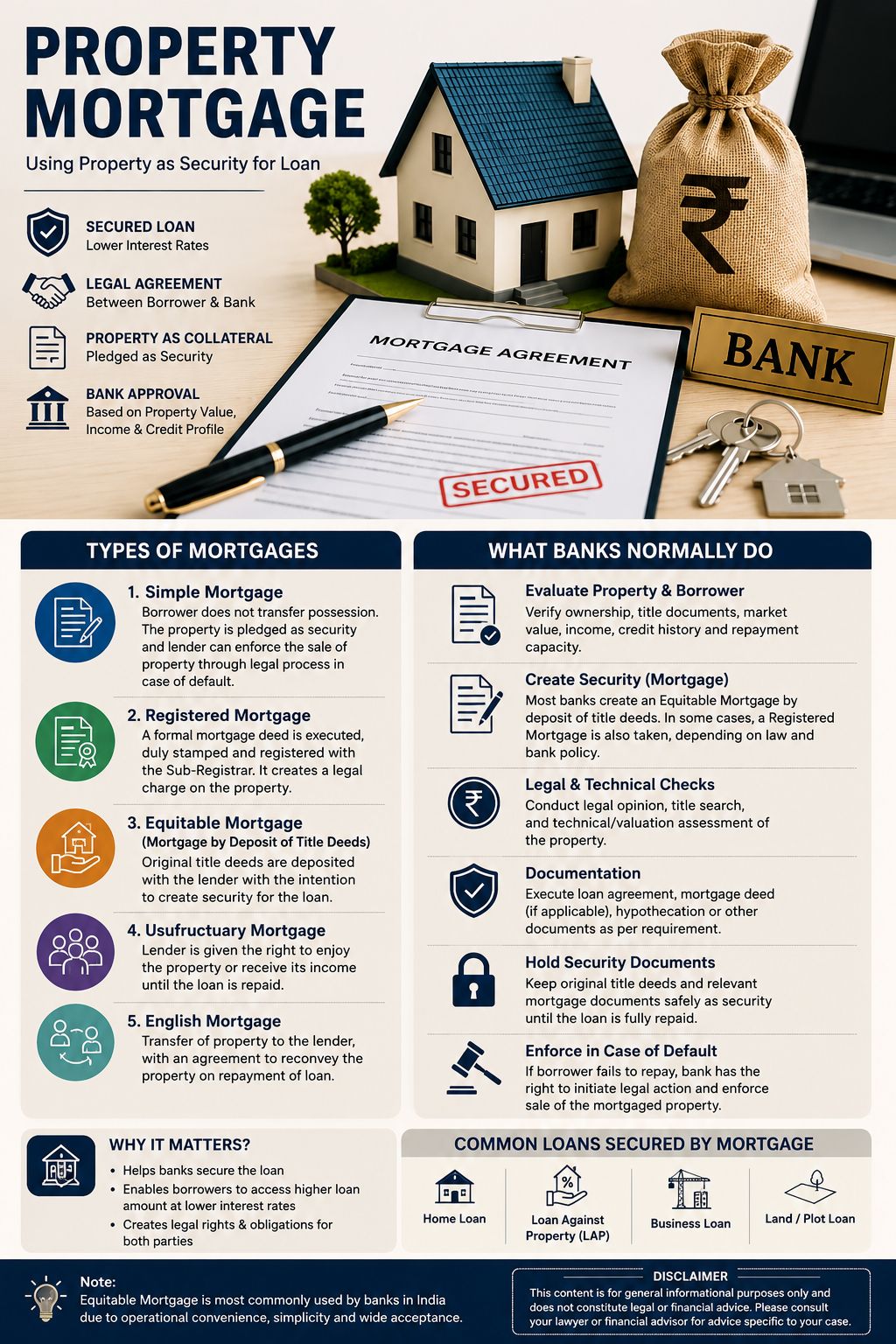
Simple Mortgage, Registered Mortgage & Equitable Mortgage Explained in Simple Language
Introduction
In modern banking and financial transactions, loans are often secured against immovable properties such as houses, flats, shops, factories, commercial buildings, plots, or agricultural land. Whenever a borrower offers property as security to a bank or financial institution for repayment of a loan, the arrangement is known as a mortgage.
The person who offers the property as security is called the Mortgagor (Borrower), while the bank or lender receiving the security is known as the Mortgagee.
In India, mortgages are mainly governed by the Transfer of Property Act, 1882. This law recognizes different types of mortgages, each having different legal implications, documentation requirements, and methods of enforcement.
Understanding mortgages is extremely important not only for bankers and legal professionals but also for borrowers and students because a mortgage directly affects legal rights, repayment obligations, and recovery procedures.
Many borrowers focus mainly on:
- Loan amount
- EMI
- Interest rate
- Processing charges
However, they often ignore the most important aspect — the type of mortgage being created over their property.
A proper understanding of mortgage helps in avoiding future disputes and ensures better financial awareness.
Meaning of Mortgage
In simple words, a mortgage means transferring an interest in immovable property to secure:
- Repayment of a loan
- Future debt
- Performance of a financial obligation
The borrower usually remains the owner of the property, but the bank gets legal rights over it until the loan is fully repaid.
If the borrower fails to repay the loan, the lender may enforce its legal rights against the mortgaged property for recovery of dues.
Importance of Mortgage in Banking
Mortgages form the backbone of secured lending in India. Most major loans such as:
- Home loans
- Loans against property
- Commercial property loans
- Business loans
- Housing finance
- MSME loans
are secured through mortgages.
For banks, mortgages provide legal security and reduce credit risk. For borrowers, mortgages help in obtaining larger loans at comparatively lower interest rates.
Types of Mortgages under the Transfer of Property Act, 1882
The law recognizes six principal types of mortgages.
1. Simple Mortgage
A Simple Mortgage is one where:
- the borrower does not hand over possession of the property to the lender,
- the borrower personally undertakes to repay the loan,
- and in case of default, the lender can approach the court for sale of the property.
Main Features
- Possession remains with borrower.
- Property acts as security for repayment.
- Personal liability of borrower exists.
- Mortgage deed is executed.
- Registration is generally compulsory.
- Court intervention is usually required for enforcement.
Practical Example
Suppose a businessman takes a loan of Rs.50 lakh against his commercial property. He continues using the property for business purposes, but if he fails to repay the loan, the bank may seek legal recovery through court proceedings and sale of the property.
Advantages
- Borrower retains possession and ownership.
- Strong legal documentation exists.
- Suitable for structured and high-value lending.
Limitations
- Registration expenses may be high.
- Documentation process is comparatively lengthy.
- Recovery process may take time due to court procedures.
2. Mortgage by Conditional Sale
Under this type:
- the borrower apparently sells the property to the lender,
- but the sale becomes absolute only if the borrower defaults.
If repayment is made on time, the property reverts back to the borrower.
Features
- Conditional sale arrangement exists.
- Default may convert transaction into actual sale.
- Rarely used in modern banking.
Practical Position
Banks generally avoid this type because it may create legal disputes and interpretation-related complications.
3. Usufructuary Mortgage
In a Usufructuary Mortgage:
- possession of the property is handed over to the lender,
- the lender enjoys income, rent, or profits from the property,
- such income is adjusted towards loan repayment or interest.
Main Features
- Possession transfers to lender.
- Recovery happens through property income.
- Borrower may not personally undertake repayment.
Example
Agricultural land may be given to the lender who collects crop income until the dues are recovered.
Modern Usage
This type was more common in agricultural and rural financing in earlier times and is comparatively uncommon in present-day banking.
4. English Mortgage
In an English Mortgage:
- the borrower transfers the property absolutely to the lender,
- with a condition that the property will be transferred back after repayment.
Features
- Property is temporarily transferred to lender.
- Borrower undertakes repayment on a fixed date.
- Re-transfer occurs after loan repayment.
Practical Position
This type is generally seen in large commercial transactions and is less common in ordinary home loans.
5. Mortgage by Deposit of Title Deeds (Equitable Mortgage)
This is popularly known as an Equitable Mortgage.
It is one of the most widely used forms in Indian banking practice today.
Under this method:
- the borrower deposits original title deeds with the bank,
- intention to create security is established,
- and the property becomes security for repayment.
Main Features
- Possession remains with borrower.
- Original title deeds are deposited with bank.
- Process is comparatively simple.
- Memorandum of Deposit (MOD) may be executed.
- Widely used in home loans and property loans.
Why Banks Prefer Equitable Mortgage
Banks generally prefer equitable mortgages because of the following reasons:
1. Faster Processing
Security can be created quickly.
2. Operational Convenience
Deposit of title deeds simplifies the process.
3. Lower Documentation Burden
Formal registered mortgage deed may not always be required.
4. Cost Efficiency
In many states, stamp duty and registration charges may be lower compared to registered mortgages.
5. Strong Legal Security
Banks still obtain enforceable rights over the property.
Memorandum of Deposit (MOD)
Banks generally obtain a Memorandum of Deposit of Title Deeds.
This document records:
- Details of title deeds deposited
- Borrower’s intention to create security
- Loan particulars
- Property details
Depending upon state laws, MOD may attract stamp duty or registration charges.
6. Anomalous Mortgage
An Anomalous Mortgage is a mortgage that does not fit exactly into the earlier categories.
It may combine features of:
- simple mortgage,
- usufructuary mortgage,
- conditional sale,
- or other arrangements.
This type is uncommon in regular retail banking.
Difference between Simple Mortgage and Equitable Mortgage
Simple Mortgage
- Created through registered mortgage deed.
- Registration generally compulsory.
- Formal legal documentation required.
- Court process usually needed for enforcement.
- More documentation involved.
Equitable Mortgage
- Created mainly through deposit of title deeds.
- Simpler operational process.
- Registration requirements differ state-wise.
- Faster and more convenient.
- Most widely used by banks in India.
What is a Registered Mortgage?
In practical banking language, the term “Registered Mortgage” generally refers to a mortgage where:
- A formal mortgage deed is executed
- Applicable stamp duty is paid
- Registration is completed before the Sub-Registrar office
Simple mortgages are commonly executed through registered deeds, which is why the terms are often used together in banking discussions.
Legal Checks Conducted by Banks
Before creating a mortgage, banks perform several legal and technical checks such as:
1. Title Verification
The bank verifies ownership of the property.
2. Legal Opinion
A lawyer confirms whether the title is clear and marketable.
3. Valuation
The property is valued by an approved valuer.
4. Encumbrance Check
The bank checks whether another loan or legal dispute exists on the property.
5. Credit Appraisal
Borrower’s income, repayment capacity, and credit history are examined.
What Happens in Case of Default?
If the borrower fails to repay the loan:
- The bank may initiate recovery proceedings.
- Legal notices may be issued.
- Action may be taken under the SARFAESI Act, 2002 in eligible cases.
- Property may be auctioned for recovery of dues.
However, banks cannot arbitrarily take away property. Proper legal procedures and notice requirements must be followed.
Important Points for Borrowers
Borrowers should always:
- Read mortgage documents carefully.
- Understand whether mortgage is equitable or registered.
- Clarify MOD charges and registration expenses.
- Keep copies of all submitted documents.
- Ensure proper repayment discipline.
Many borrowers sign documents without understanding their implications, which later creates confusion and disputes.
Importance for Students and Professionals
Students of banking, law, commerce, finance, and management should understand mortgage concepts because these are foundational elements of:
- banking law,
- secured lending,
- property documentation,
- and credit risk management.
Professionals dealing with legal verification, recovery matters, and property financing also benefit greatly from practical mortgage knowledge.
Conclusion
Mortgage is one of the most important concepts in modern banking and secured lending. It allows borrowers to obtain financial assistance while providing legal protection to banks and lenders.
Among the various types recognized under the Transfer of Property Act, 1882, the Equitable Mortgage (Mortgage by Deposit of Title Deeds) has become the most commonly used form in India because of its simplicity, speed, lower documentation burden, and operational convenience.
At the same time, Simple Mortgage and Registered Mortgage continue to play an important role in structured and high-value transactions.
Understanding the type of mortgage created over a property is extremely important for every borrower, banker, and student because it directly affects legal rights, obligations, and recovery procedures.
Message to Readers
Whether you are:
- a banker handling secured loans,
- a borrower purchasing property,
- or a student preparing for banking or legal examinations,
never treat mortgage documentation as a mere formality.
Always understand:
- What type of mortgage is being created
- What rights the bank gets
- What obligations the borrower undertakes
- What legal consequences may arise in case of default
Knowledge and awareness help in avoiding future disputes and building responsible financial practices.
Disclaimer
This article is prepared purely for educational and awareness purposes only. The discussion has been simplified for easier understanding of mortgage and banking concepts. It should not be treated as legal, financial, banking, or professional advice.
Mortgage laws, registration requirements, stamp duty provisions, and banking practices may vary from state to state and may change over time. Readers are advised to consult qualified legal professionals, bankers, or financial advisors before entering into any mortgage transaction or signing loan or security documents.
Ashok Kakkar
Advocate & Insolvency Professional, Former Banker
#Banking,#,Mortgage,# Equitable Mortgage,#, Simple #Registered Mortgage,, #Transfer of Property Act, Bank Loan,,#Loan Against Property, #Home Loan,,#Banking Law,,#Indian Banking,,#Property Documentation, ,#Banking Education,