
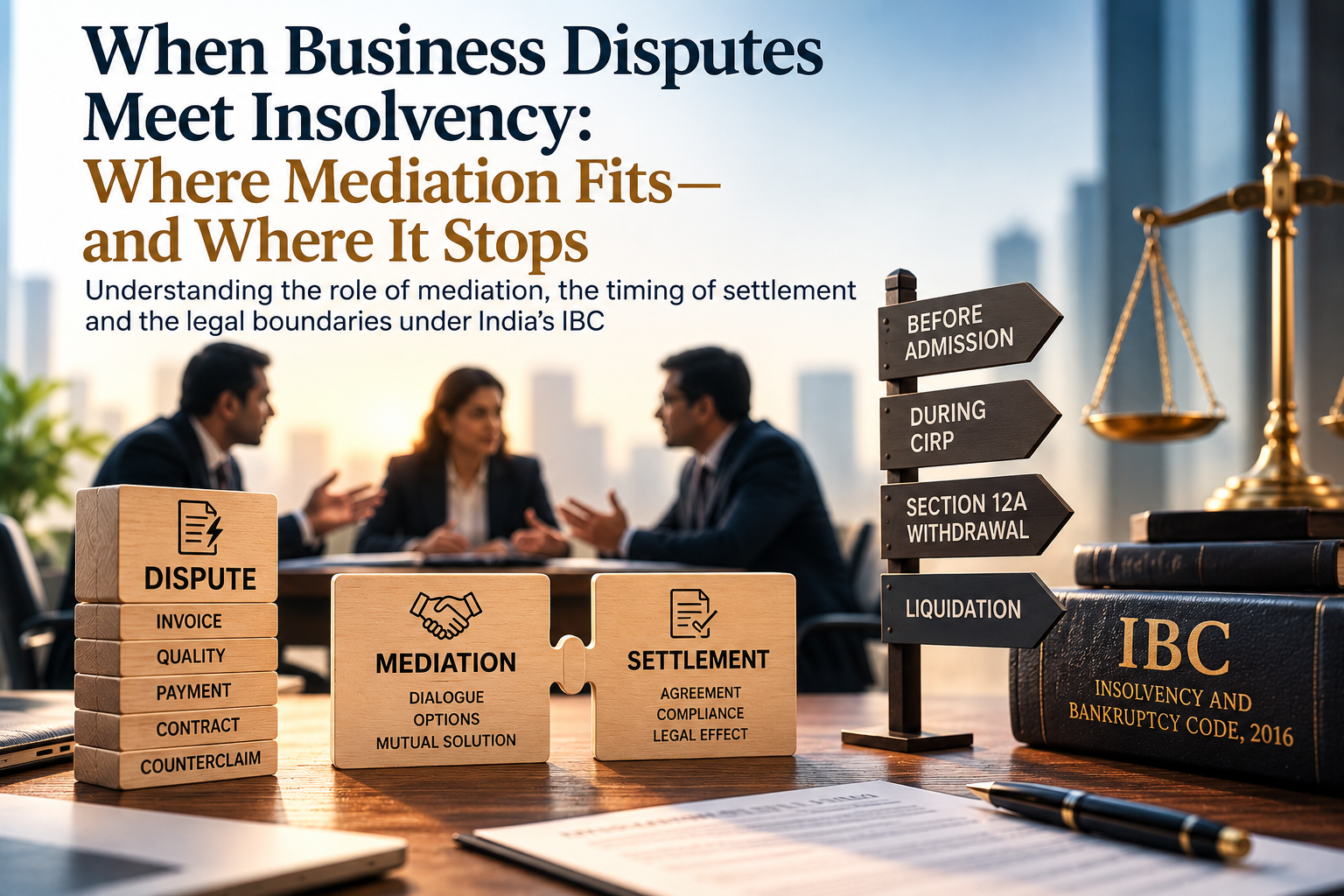
When Business Disputes Meet Insolvency
Where Mediation Fits, and Where It Stops
Understanding the role of mediation, the timing of settlement and the legal boundaries under India’s IBC
Ashok Kakkar, Advocate, Insolvency Professional, Former Banker
Background
The Insolvency and Bankruptcy Code, 2016 (IBC) was designed for genuine financial failure. It offers a collective, time-bound process, supervised by the National Company Law Tribunal (NCLT), in which the interests of all creditors are weighed together. It was never meant to be a routine tool for settling quarrels over invoices.
In practice, however, many notices and applications under the Code begin as ordinary commercial disagreements: a disputed invoice, a rejected consignment, a counterclaim, a broken line of communication. When such a dispute hardens into a legal threat, parties often discover that the Code leaves little room for negotiation once a case is admitted.
Mediation, in which an impartial person helps the parties find their own solution, is therefore attracting serious attention. This article explains in plain, point-wise language where mediation can help, at which stage, what the law does not allow to be bargained away, and who must do what. It is written for creditors, businesses, insolvency professionals and students, as general awareness and not as legal advice.
Discussion Points
1. A Dispute Can Be Real Without Being an Insolvency
A supplier has delivered goods. The buyer says some items failed inspection and deducts the cost of replacement. The supplier sees an overdue invoice; the buyer sees a legitimate counterclaim. Emails become sharper, payments stop, and someone begins preparing a demand notice under the IBC.
At this point, the parties may be facing a genuine inability to pay, or a commercial disagreement that has hardened into a legal dispute. Those are not the same thing. A neutral mediator may help the parties examine the disagreement before it becomes a formal insolvency proceeding. But mediation is not a universal remedy, and it cannot be used to bargain away statutory obligations.
The practical question is not whether mediation is good or bad. It is: what is the dispute, what stage has it reached, who may be affected, and what legal route is required to give effect to any agreement?
2. Settlement and Mediation: The Outcome and the Process
Parties settle disputes in many ways: direct discussion, correspondence between lawyers, a negotiated payment plan or a compromise recorded before a tribunal. Mediation is different because an independent facilitator helps the parties communicate, identify the issues beneath their stated positions and consider options. The mediator does not decide who is right and cannot impose a settlement.
This distinction matters in insolvency. A mediator may help a supplier and buyer reconcile their ledgers, separate an undisputed amount from a disputed component, or explore staged payment linked to future supply. The mediator cannot determine a statutory claim, direct the NCLT to admit or dismiss a petition, or terminate a corporate insolvency resolution process (CIRP).
A settlement is an outcome; mediation is one possible way of reaching it. The process is useful only if the parties have room to negotiate and the proposed outcome is legally permissible.
3. Why the Period Before Admission Deserves Attention
The Insolvency and Bankruptcy Board of India (IBBI), in its November 2024 discussion paper on mediation by operational creditors, referred to data up to 30 April 2024: 21,466 Section 9 applications had been disposed of before admission, while 3,818 had been admitted. The paper identified recurring issues such as disputes over the quality or performance of goods and services, alleged contractual breaches, disagreement about the amount due, and claims for set-off or damages.
These figures must be read carefully. Disposal before admission does not necessarily mean settlement; it may include different procedural outcomes. The figures therefore do not prove that every case could have been mediated. They do, however, support a policy discussion about whether some disputes could be addressed earlier through a structured, voluntary process.
Section 9 gives an operational creditor a route to initiate CIRP where the statutory conditions are met. It is not designed simply as a routine debt-collection mechanism. Where the real disagreement concerns invoices, quality, reconciliation or contractual performance, a short mediation attempt may help clarify whether the dispute can be resolved without commencing a collective insolvency process.
That should not become a compulsory obstacle for a creditor facing a genuine default. Mediation must not be used to buy time, dissipate assets or prevent a creditor from protecting its legal rights.
4. A Practical Test: Is the Dispute Suitable for Mediation?
Before proposing mediation, parties and professionals can ask four questions.
(a) Can the parties negotiate the issue? A disagreement about calculations, quality, timing of payment or performance may be negotiable. A question requiring a binding statutory determination may not be.
(b) Are the necessary people at the table? A deal between two parties may be ineffective if it prejudices other creditors, requires approval from the Committee of Creditors (CoC), or affects the rights of persons who are not participating.
(c) Is there enough time? The process must fit within the applicable legal timetable. Agreeing to mediate does not automatically pause limitation periods, demand-notice requirements or CIRP deadlines.
(d) Can the proposed result lawfully be implemented? The person negotiating must have authority, and the outcome must comply with the IBC, applicable regulations and any required approval or tribunal order.
5. Timing Changes Everything: A Stage-wise Explanation
What mediation can achieve, and the limit it must respect, depends on the stage the matter has reached. The position at each stage is explained below.
Before admission. This is the most promising stage. Mediation may help with reconciling accounts, disputed invoices, contractual performance, payment schedules or continued supplies. The limit is that the process must remain voluntary and must not obstruct a genuine insolvency filing or any statutory deadline.
After admission but before the CoC is formed. Parties may continue discussions on suitable issues. However, a settlement does not by itself authorise withdrawal. The revised Section 12A route must be followed, and that route is not available before the CoC is constituted.
After the CoC is formed and before the first invitation for resolution plans. A settlement may be explored where withdrawal is legally and commercially appropriate. The statutory Section 12A conditions, including 90 per cent CoC voting-share approval and an order of the NCLT, continue to apply.
During CIRP. Mediation may assist with selected supplier, landlord, contract, ledger or operational disputes that affect business continuity. It cannot suspend the duties of the Resolution Professional (RP), extend the CIRP timeline or bind non-consenting stakeholders.
During liquidation. Certain legacy contract disputes, receivables or lease-related disagreements may be suitable. The liquidator must protect the estate and act within statutory powers and applicable approvals.
6. The 2026 Amendments to Section 12A
The 2026 amendments make the post-admission position especially important. Under the substituted provision, withdrawal of an admitted application is confined to the statutory window after constitution of the CoC and before the first invitation for resolution plans, with the required 90 per cent voting-share approval and an order of the NCLT. The RP and parties should verify the current text, applicable regulations and prescribed procedure before acting.
The practical message is that the exit door narrows sharply once a case is admitted. This is the strongest reason to consider settlement before admission, wherever it is genuinely possible.
7. What Cannot Be Privately Bargained Away
Mediation is based on consent, but insolvency law also protects interests that extend beyond the immediate parties. A private settlement cannot override the statutory distribution framework, bind creditors who have not consented or prevent the NCLT from exercising its jurisdiction.
Avoidance and fraudulent or wrongful trading matters require particular care. Applications concerning preferential, undervalued, extortionate-credit or fraudulent or wrongful transactions engage statutory remedies and may affect the insolvency estate as a whole. Parties may clarify facts or resolve a separate commercial issue, but a private agreement cannot relieve the RP or liquidator of statutory duties or bind the tribunal to a particular finding.
Similarly, mediation cannot be used as a route around Section 29A eligibility requirements or to rearrange the Section 53 distribution waterfall for the benefit of one creditor. Statutory dues and public-law consequences cannot be compromised merely because private parties agree.
The point is not that every related conversation is prohibited. The point is that mediation must remain within the limits of lawful authority and cannot replace adjudication where a binding determination is required.
8. The Mediation Act: Enacted Does Not Always Mean in Force
The Mediation Act, 2023 creates a statutory framework, but provisions of an Act commence according to the relevant notifications. The October 2023 commencement notification brought specified provisions into force; it did not automatically bring every provision dealing with pre-litigation mediation, settlement enforcement, limitation or tribunal referrals into operation.
The Mediation Council of India was subsequently established by notification dated 27 August 2026. Establishment of the Council should not be treated as proof that every substantive provision or regulatory mechanism is operational. Before relying on a statutory enforcement route, readers should check the latest Gazette notifications and rules.
Until the relevant provisions are in force, the legal effect of a mediated settlement must be assessed under the law actually applicable to the matter, including contract law and any necessary consent terms or order of the competent forum. A signed document should not be assumed to have decree-like enforceability merely because the Mediation Act has been enacted.
9. What the IBBI Proposals Contribute
The IBBI Expert Committee’s January 2024 report recommended a voluntary, phased approach to insolvency mediation, with suitable institutional support and mediators who understand insolvency. In November 2024, the IBBI separately proposed voluntary mediation by operational creditors before filing a Section 9 application. The proposal contemplated a non-settlement report where mediation failed.
These were policy recommendations and a discussion paper, not by themselves binding requirements. Before use in a live matter, professionals should verify whether a final regulation or amendment has since been notified. The broader idea remains worth considering: offer a quick, structured opportunity to resolve suitable disputes, but allow the insolvency process to proceed promptly if no settlement is reached.
10. The Role of the Resolution Professional
Once a case is admitted, the RP stands at the centre of any discussion about consensual resolution. The role has several parts, each with its own limit.
Identifying suitable disputes. The RP is well placed to see which disagreements, such as ledger reconciliations, a supplier’s refusal to continue, a lease dispute or a problem in obtaining company records, can be discussed without disturbing the process.
Explaining the effect on the process. The RP should tell the parties how mediation will interact with the CIRP timeline, the claims process and any proposed withdrawal, so that no one assumes that talking has paused a deadline.
Placing matters before the CoC. Where a proposed settlement affects the estate, CIRP costs, business operations or a withdrawal, the RP should identify the required approvals before the process begins and place the matter before the CoC.
Remaining impartial. The RP must protect the interests of the corporate debtor and all its stakeholders, and must not favour any one party to the discussion.
Observing the limits. The RP cannot unilaterally compromise a claim, bind the estate beyond lawful authority or promise that the NCLT will approve a settlement. A mediation meeting does not suspend the RP’s duty to provide information, alter a claim by decision, or prevent the RP from seeking directions from the NCLT where necessary.
Keeping records. A simple register of disputes considered for consensual resolution, with their status, costs and deadlines, helps the RP and the CoC monitor progress. It should be handled consistently with confidentiality obligations and the RP’s reporting duties.
11. Who Else Has a Part to Play
Creditor and debtor. Each must decide whether it is willing to participate and must ensure that its representative has authority to negotiate.
The mediator. The mediator facilitates the conversation but does not decide claims or approve settlements.
The CoC. Its approval may be necessary for matters affecting the estate or withdrawal, but approval cannot cure an arrangement that is otherwise unlawful.
The liquidator. A liquidator must similarly act in the interests of the liquidation estate and within the applicable statutory framework.
The NCLT. It remains the adjudicating authority. Where the Code requires an application or order, a mediated understanding is not a substitute for that formal step.
12. Seven Checks Before Agreeing to Mediate
- Identify the precise issue: debt amount, quality, contractual performance, payment timing or another matter.
- Confirm that the dispute is suitable for mediation and does not require urgent or authoritative adjudication.
- Identify all parties whose rights may be affected and consider whether non-participants could be prejudiced.
- Check the stage of the insolvency matter and the legal route needed to implement any settlement.
- Confirm the authority of each participant and identify any CoC, tribunal or other approval required.
- Agree on a short timetable, mediator selection, conflict disclosures, costs and how information may be used.
- Record the outcome properly; if mediation fails, protect legal remedies and comply with all statutory deadlines.
13. The Way Forward
A sensible reform would be a voluntary, time-bound pre-admission mediation opportunity for suitable Section 9 disputes. It should have clear eligibility criteria, a short period, an independent mediator with relevant commercial or insolvency knowledge, and an immediate exit if mediation fails or urgent action is needed. It should not become a universal precondition that delays a genuine creditor.
Institutional support, potentially through an NCLT-linked mediation facility and a panel of trained mediators, could help make the process more consistent. Any framework should preserve statutory timelines, confidentiality to the extent permitted by law, the CoC’s role and the NCLT’s authority. The guiding principle is straightforward: introduce flexibility before admission where it can prevent avoidable disputes, but preserve the collective discipline of the IBC once the process begins.
Conclusion
Mediation can be useful when the parties have a real issue they can resolve themselves. It may reconcile accounts, preserve a supplier relationship or avoid litigation over a commercial disagreement. But it cannot turn a collective insolvency process into a private bargain, override statutory duties or guarantee withdrawal after admission.
A well-designed process should help resolve avoidable disputes without shielding genuine insolvency from the operation of the law.
Message to Readers
If you are a creditor, consider mediation early, ideally before a legal deadline is put at risk, and keep your legal remedies intact while you talk. If you are a business facing a demand, treat the notice as a prompt to reconcile accounts quickly and honestly, not as something to ignore or to use for delay. If you are an insolvency professional, help your client or the process to identify which disputes are suitable, and never let an informal understanding take the place of the approvals the law requires.
For everyone, the best time to ask about mediation is early, while the dispute can still be resolved. Please also verify the law in force on the day you act, because this area is still developing.
Sources for Further Reading
Insolvency and Bankruptcy Board of India (IBBI), Discussion Paper on Mediation by Operational Creditors before Approaching the Adjudicating Authority for Filing a Section 9 Application (4 November 2024):
Mediation Act, 2023, Gazette of India:
IBBI, public comments and discussion papers portal (check for subsequent regulatory developments.
Disclaimer: This article is intended for general educational awareness and is not legal advice or a professional opinion. The legal position may change through legislation, commencement notifications, regulations and judicial decisions. Readers should verify the law in force and obtain independent professional advice before acting in a specific matter.
Key Words: Mediation in Insolvency, Business Disputes, IBC 2016, Section 12A IBC, CIRP, Operational Creditors, NCLT, Mediation Act 2023, Debt Settlement, Insolvency Resolution.