
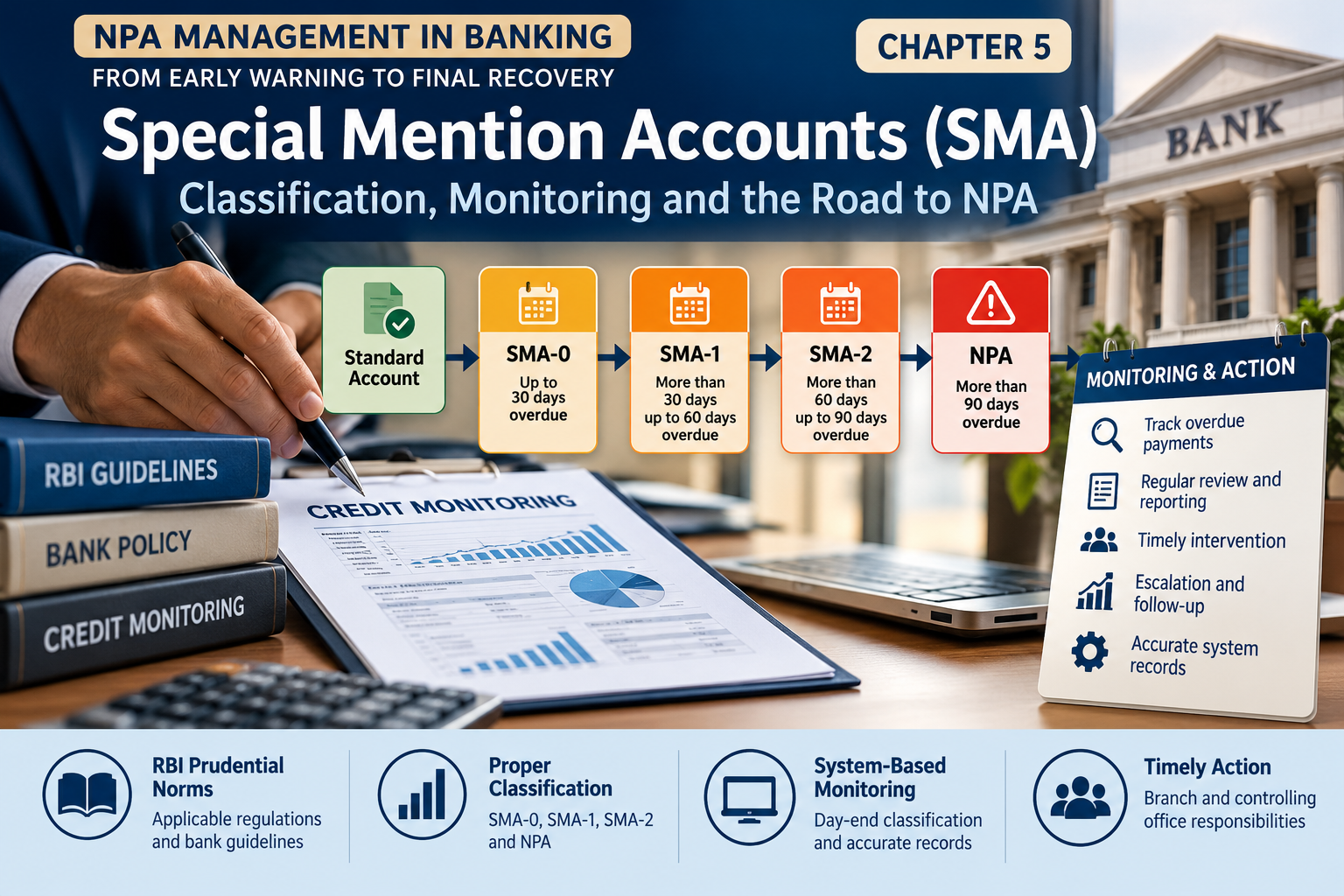
Chapter 5: Special Mention Accounts (SMA) — Classification, Monitoring and the Road to NPA
NPA Management in Banking – From Early Warning to Final Recovery | LegalWisdomHub
By Ashok Kakkar — Former Banker | Advocate | Insolvency Professional
Introduction
In the earlier chapters of this series, we looked at how a banker monitors a standard account, recognises early warning signals and responds when an account begins to show stress. This chapter takes the next step: the formal classification and monitoring of stressed accounts through the Special Mention Account (SMA) framework.
In my years in banking, I found that many accounts that eventually became Non-Performing Assets (NPAs) showed signs of repayment stress before crossing the NPA threshold. The SMA framework gives the bank a structured way to identify and track such stress, so that the account receives appropriate attention in time.
An SMA tag is not merely a system-generated label. It should prompt accurate reporting, review and meaningful follow-up. An account that appears repeatedly in an SMA report without any effective action has been classified, but not properly managed.
1. What Is a Special Mention Account?
A Special Mention Account is a loan account identified for closer attention because a payment is overdue or other specified indicators suggest stress. The framework is intended to identify incipient stress early enough for the lender to examine the account and consider appropriate measures.
SMA classification must be distinguished from asset classification as Standard, Sub-standard, Doubtful or Loss. SMA is an early-stress identification and monitoring framework; it does not, by itself, mean that an account is an NPA. An account classified as SMA may continue to be treated as a standard asset for asset-classification purposes until the applicable NPA recognition criteria are met.
This distinction matters in communication with borrowers and in internal reporting. A bank should neither describe an account as an NPA merely because it is SMA, nor treat SMA status as a reason to delay action.
2. SMA Categories and Overdue Periods
For loans other than revolving facilities, the SMA categories are based on the period for which principal, interest or any other amount due is wholly or partly overdue. The broad categories are set out below.
| Category | Overdue period | Practical significance |
| SMA-0 | Up to 30 days | Initial overdue stage; early review and follow-up. |
| SMA-1 | More than 30 days and up to 60 days | The overdue position has persisted; closer monitoring is required. |
| SMA-2 | More than 60 days and up to 90 days | Serious warning stage requiring prompt review and escalation. |
3. From a Standard Account to SMA and NPA
Suppose a term-loan instalment falls due on a specified date and is not paid in full. The unpaid amount becomes overdue in accordance with the applicable rules. As the overdue period increases, the account may move through the relevant SMA stages. For a term loan, interest or an instalment of principal remaining overdue for a period of more than 90 days will ordinarily meet the NPA recognition criterion, subject to applicable regulatory provisions and facility-specific treatment.
Classification follows the actual overdue position and the applicable regulatory test. It does not depend on when a branch officer notices the problem, contacts the borrower or records a remark in the file. A promise to pay does not, by itself, regularise an account. Any payment received must be properly credited and appropriated, and the resulting account position must be verified under the bank’s prescribed process.
SMA-2 is a critical monitoring stage, but it is not itself an NPA. Equally, the bank should not wait for SMA-2 before reviewing an account that is already irregular at SMA-0 or SMA-1.
4. Confirming the Due Date and Days Past Due
Accurate classification begins with accurate data. The branch should verify the contractual due date, the amount payable, the credits received and the manner in which payments have been appropriated under the loan terms and the bank’s systems. Classification should follow the applicable RBI directions and the bank’s prescribed system-based and day-end processes. Staff should not rely solely on manual registers or informal explanations where the system indicates an overdue position. Any discrepancy should be investigated, reconciled and documented promptly.
Common sources of error include an incorrect or outdated instalment schedule, delayed or misposted credits, incorrect interest application, repayment terms amended through a sanction or restructuring but not updated in the system, and differences between loan documents and core banking records.
Such errors can lead to incorrect SMA reporting or conceal genuine stress. Where a discrepancy is found, the branch should reconcile the account promptly, retain an audit trail and ensure that every correction is authorised and reflected in the system. A correction must never be used to conceal an overdue amount or postpone a classification that is otherwise required.
5. Cash Credit and Overdraft Accounts
Cash credit (CC) and overdraft (OD) facilities require a different assessment from term loans. Under the commonly applied framework, SMA-1 and SMA-2 classification for these revolving facilities is linked to the prescribed period for which the outstanding balance remains continuously in excess of the sanctioned limit or drawing power, as applicable under the relevant directions. Banks may also monitor shorter-duration irregularities through internal early-warning systems. The precise criteria and terminology should be checked against the latest RBI directions applicable to the lender and facility.
| Category | Continuous excess period |
| SMA-1 | More than 30 days and up to 60 days |
| SMA-2 | More than 60 days and up to 90 days |
Separately, a CC/OD account may be classified as an NPA if it meets the applicable ‘out of order’ criteria. These criteria involve the account’s outstanding balance in relation to the sanctioned limit or drawing power, the continuity and adequacy of credits, and the servicing of interest over the prescribed period. Because the exact tests, exceptions and calculation requirements must be applied as written in the current regulatory framework, readers should consult the latest RBI directions and their bank’s approved instructions before applying the criteria to a live account.
For CC/OD accounts, the branch should review drawing power, the currency of stock and book-debt statements, the sanctioned limit, credits and debits, interest servicing and the duration of any excess. A temporary excess should be examined on the actual facts and rules; it should neither be ignored nor classified by assumption. Repeated ad hoc extensions should not replace a proper assessment of account conduct.
A CC account that appears to remain within limits on paper but is kept regular through repeated end-of-period adjustments deserves closer examination. The branch should assess whether the credits reflect genuine business receipts and whether the account is operating in accordance with the sanctioned terms.
6. What the Branch Should Do After SMA Classification
Chapter 4 discussed corrective action when an account shows stress. This section focuses more narrowly on what SMA classification should trigger within the bank’s formal monitoring process.
The branch should confirm the classification and overdue position, identify the cause of the irregularity and ensure that the account is reported to the officials responsible for monitoring stressed assets. Depending on the facts and bank policy, the branch may contact the borrower, obtain a realistic repayment commitment, review current business and cash-flow information, check security and insurance, and decide whether escalation is required.
The response should be proportionate. A short delay caused by a verifiable operational problem may call for reconciliation and follow-up. Repeated missed instalments, persistent excesses, missing stock statements or an inability to provide a credible repayment plan may require more intensive scrutiny. Restructuring, additional finance, compromise or recovery measures must be considered only through the bank’s authorised process and applicable regulatory framework.
The record should identify what was discussed, what information was obtained, what commitment was made, who is responsible for follow-up, the target date and whether the commitment was met. A note stating only ‘borrower contacted’ is of limited value if the account remains irregular.
7. Role of the Controlling Office and Credit Monitoring Team
The branch is closest to the borrower and daily account operations. The controlling office and credit-monitoring team provide an additional layer of review and challenge. Their role may include reviewing SMA reports, identifying accounts that remain in the same stage or deteriorate, challenging unsupported explanations, tracking covenant breaches and ensuring that escalation takes place under bank policy. Where applicable, banks must also comply with RBI-prescribed regulatory reporting requirements, including reporting to the Central Repository of Information on Large Credits (CRILC). The exposure thresholds, reporting categories, formats and frequency should be verified from the latest RBI directions applicable to the lender and borrower.
Useful review questions include: Is the overdue position accurate and reconciled? Has the borrower’s explanation been verified? Is the repayment commitment realistic in light of cash flows? Are stock statements current and drawing power correctly computed? Has the security position changed? Is there any indication of diversion of funds or deterioration in the business? Has the branch taken the action required by policy?
The objective is not reporting for its own sake. It is to fix responsibility and prevent an account from remaining on a monitoring list without meaningful action.
8. Common Errors in SMA Classification and Monitoring
- Relying only on manual tracking: system data is not reconciled with the repayment schedule and account entries.
- Ignoring small overdue amounts: assuming that a small amount does not matter without applying the relevant rules.
- Misreading the facility: applying term-loan logic mechanically to a cash credit or overdraft account.
- Accepting unsupported explanations: treating a borrower’s assurance as proof that the account has been regularised.
- Delaying escalation: waiting for the next stage before addressing an existing irregularity.
- Recording activity but not outcomes: noting a call or visit without documenting findings and follow-up.
- Overlooking the wider picture: treating each facility in isolation without considering other facilities of the borrower or the position of other lenders where applicable.
9. A Practical Case Study
Consider a term loan to a small manufacturing unit. An instalment falls due on 10 January and remains unpaid. The branch checks the repayment schedule, verifies that no qualifying payment has been received and confirms the overdue position.
As the overdue period increases, the account enters the relevant SMA stage under the applicable rules. The borrower explains that a major customer has delayed payment. The branch asks for supporting details, checks recent credits and assesses whether the promised payment date is credible. The controlling office monitors the account and requires escalation if the overdue position persists.
If the relevant amount remains overdue for more than 90 days and no specific exception applies, the NPA recognition criterion for a term loan will ordinarily be met. The bank cannot postpone classification merely because the borrower has promised to pay, a recovery notice is being prepared or the matter is being discussed with the controlling office.
If payment is received, the bank must verify the resulting account position and apply the prescribed rules. The reason for the default should not be forgotten: a borrower who pays once under pressure but has not resolved the underlying cash-flow problem may become irregular again.
The following table is illustrative only. The precise classification date depends on the due date, payment treatment, applicable rules and the bank’s prescribed day-end process.
| Illustrative stage | Position |
| Due date | 10 January — instalment falls due and remains unpaid. |
| SMA-0 | Overdue for up to 30 days. |
| SMA-1 | Overdue for more than 30 days and up to 60 days. |
| SMA-2 | Overdue for more than 60 days and up to 90 days. |
| NPA recognition | For a term loan, the applicable criterion is ordinarily met when principal/interest remains overdue for more than 90 days. |
10. SMA Is Not the Same as NPA
SMA classification is intended to identify and monitor stress before NPA recognition. NPA classification, once required under the applicable norms, has consequences for income recognition, provisioning, regulatory reporting and recovery strategy. The bank must apply the relevant rules to the actual account position and should not delay classification merely because regularisation is expected or recovery discussions are underway.
Income recognition and provisioning treatment must also follow the applicable prudential requirements. The precise treatment may depend on the lender, borrower and facility, so readers should refer to the latest RBI directions and their bank’s approved instructions rather than infer a uniform treatment from this general article. Recovery, restructuring or resolution discussions can proceed alongside accurate classification; they cannot take its place.
Conclusion
The SMA framework connects day-to-day account monitoring with the bank’s formal process for recognising and managing credit stress. Its value lies not only in assigning the correct category, but also in ensuring timely attention and clear responsibility for follow-up.
The practical discipline required of a banker is straightforward: verify the overdue position, apply the correct rule for the facility, ensure accurate system reporting, document meaningful action and escalate unresolved stress promptly. Proper SMA monitoring cannot guarantee that every account will be saved, but it reduces the risk that warning signs are ignored or formal classification is delayed.
What Comes Next?
In the next chapter, we will examine NPA classification in greater detail, including the applicable recognition criteria, the assessment of overdue and “out of order” accounts, the consequences of NPA classification, and common errors that can lead to incorrect classification.
References
- Reserve Bank of India (RBI), applicable Master Directions and circulars on Income Recognition, Asset Classification and Provisioning (IRACP), as amended from time to time.
- Reserve Bank of India (RBI), applicable directions on the Prudential Framework for Resolution of Stressed Assets, as amended from time to time.
- Reserve Bank of India (RBI), applicable instructions on the Central Repository of Information on Large Credits (CRILC) and regulatory reporting, as amended from time to time.
- The lending bank’s current credit-monitoring policy, asset-classification instructions, operating circulars and system procedures.
Disclaimer
This article is intended for general educational and informational purposes only. It provides a practical overview of Special Mention Accounts (SMA), their classification and monitoring in the banking sector. It should not be treated as a substitute for the applicable RBI directions, circulars, amendments or the lending bank’s approved policies and operating instructions. Readers should refer to the latest applicable regulatory requirements and bank-specific procedures before taking any action in an individual case
.Key Words-Special Mention Account, SMA classification, SMA-0, SMA-1, SMA-2, Non-Performing Asset (NPA), NPA management in banking, RBI asset classification norms, RBI prudential norms, stressed assets management, credit risk management, income recognition and asset classification,