
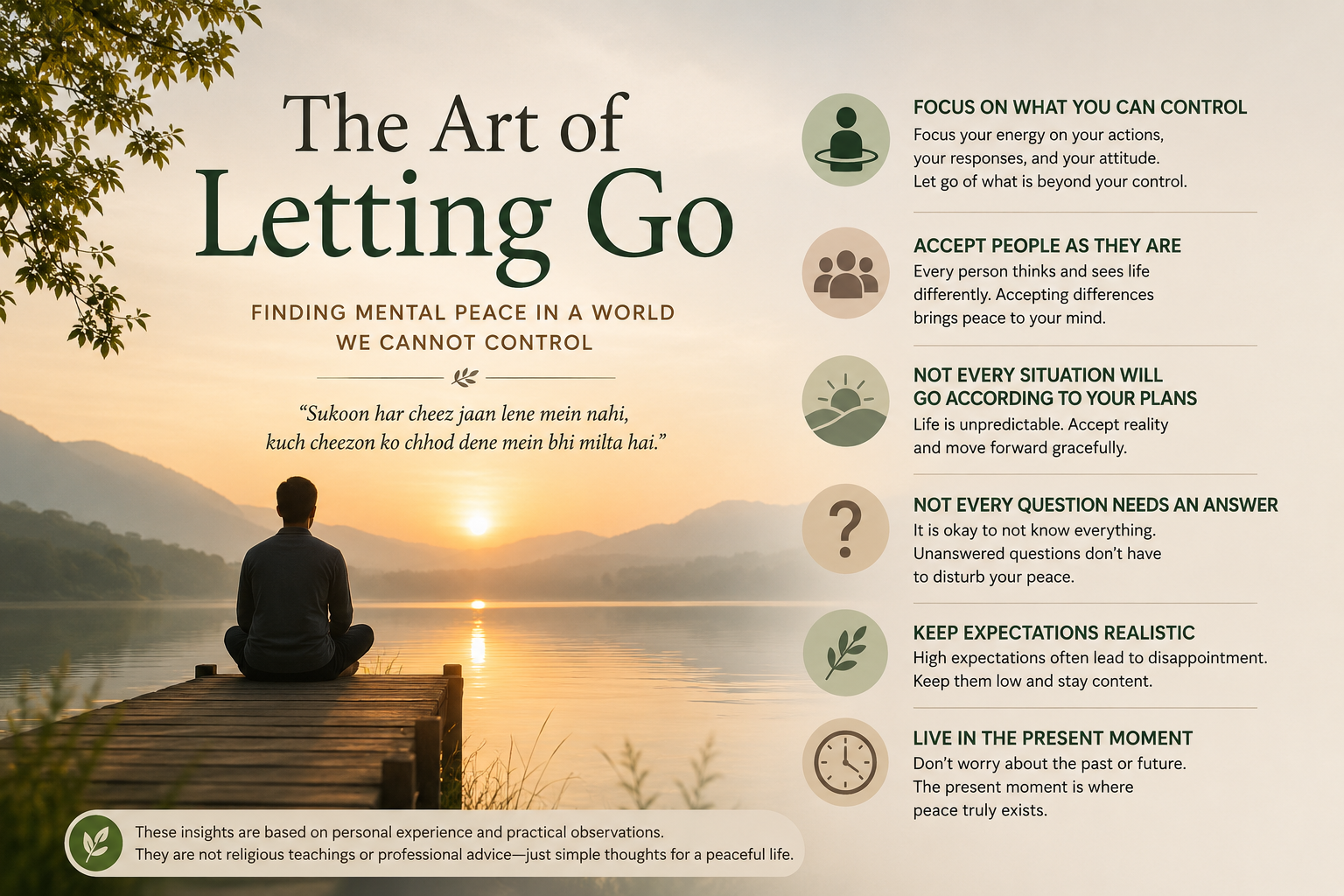
“Finding Stillness in a World We Cannot Control.“
The Quiet Power of Letting Go
“Finding Stillness in a World We Cannot Control.“
By Ashok Kakkar
Introduction
Mental peace is something almost everyone seeks, yet many of us unknowingly make it difficult to achieve. We spend considerable time thinking about what happened, worrying about what may happen, trying to understand why people behave differently from us, and attempting to control situations that are not actually within our control.
We often believe that if we can understand everything, solve every problem and anticipate every possibility, we will finally feel peaceful. But life does not work that way.
One of the most important lessons about mental peace is that we do not have to know, understand or control everything. Sometimes peace begins when we recognise our limitations and learn to let go.
The thoughts discussed in this article are based on practical observations and personal experience. They are not intended as religious teachings or philosophical doctrines. They are simply an attempt to look at everyday life from the perspective of maintaining inner balance.
1. The Burden of Trying to Control Everything
A major source of mental disturbance is our desire to control events. We want our plans to succeed, people to behave according to our expectations, circumstances to develop in a particular way, and the future to remain predictable. When reality does not follow our plans, frustration naturally follows.
But there are many things over which we have little or no control. We cannot control what another person thinks. We cannot change what has already happened. We cannot completely predict the future. We cannot ensure that every plan will succeed. The continuous attempt to control these things consumes mental energy without necessarily changing the outcome.
A better approach is to ask a simple question: “Is this within my control?” If the answer is yes, we should concentrate on our actions and responses. If the answer is no, we should gradually learn to accept the situation rather than repeatedly fighting it in our mind. This distinction can bring considerable relief.
2. Accepting That People Think Differently
Another common cause of mental unrest is our expectation that others should think like us. We may believe that our way of looking at a situation is correct and expect others to understand it in the same way. When they do not, we become disappointed or irritated.
But every individual has a different background, experience, temperament and way of interpreting events. People will not always agree with us. They may make decisions that we would not make. They may have priorities that are different from ours.
Acceptance does not mean that we must agree with everyone. It simply means recognising that difference is a natural part of human life. We can disagree without becoming disturbed, and we can express our views without insisting that everyone must adopt them. Learning this distinction can save a great deal of unnecessary mental energy.
3. Not Every Situation Will Go According to Our Plans
We make plans because planning is necessary. But expecting life to follow those plans exactly is another matter. Unexpected events are part of life. A professional opportunity may not materialise. A relationship may change. A project may fail. Someone may make a decision that affects us. Circumstances may develop in a completely unexpected direction.
Our first reaction is often to ask, “Why did this happen?” Sometimes that question is useful — it may help us learn from an experience and take corrective action. But sometimes there is no satisfactory answer. Continuously asking “why” after an event that cannot be changed may only keep the mind trapped in the past.
Acceptance does not mean giving up. It means recognising reality first and then deciding what can reasonably be done.
4. It Is Not Necessary to Have an Answer to Every Question
Modern life gives us access to an enormous amount of information, and we have become accustomed to finding answers quickly. Yet some questions in life may never have satisfactory answers — why did someone behave in a particular manner, why did an opportunity disappear, why did something that appeared promising fail, what exactly will happen tomorrow.
We may spend hours trying to find answers to such questions. Sometimes the search provides clarity; at other times it creates more anxiety. Mental peace requires the maturity to recognise that some questions can remain unanswered. Not knowing everything is not necessarily a weakness. Sometimes saying, “I do not know, and I can live with that,” is a sign of emotional strength. The objective should not always be to satisfy our curiosity — sometimes the better objective is to protect our peace of mind.
5. Focus on What Is in Your Hands
A useful way of dealing with mental pressure is to divide life into two broad areas. The first consists of things that are within our control — our actions, decisions, responses, attitude and the way we use our time. The second consists of things beyond our control — other people’s opinions, past events, unexpected circumstances and uncertain future outcomes.
Our energy should primarily be directed towards the first category. If a problem can be addressed, take appropriate action. If a mistake can be corrected, correct it. If a decision is required, make the best decision possible with the information available. But if something is genuinely beyond our control, repeatedly worrying about it will not necessarily improve the situation.
This simple shift — from “What can I control?” rather than “Why can’t I control this?” — can change the way we deal with everyday difficulties.
6. Keep Expectations Realistic
Expectations are a natural part of human relationships and professional life. However, excessive expectations can become a significant source of disappointment. We sometimes expect people to behave exactly as we would behave. We expect circumstances to cooperate with our plans. We expect appreciation, recognition or results because we have worked hard. Reality, however, may be different.
Keeping expectations realistic does not mean becoming negative or losing ambition. It means understanding that outcomes depend on many factors. When expectations are reasonable, disappointment becomes easier to handle, and we continue to do our best without making our happiness completely dependent upon a particular result.
7. Stop Worrying About Problems That Have Not Happened
The human mind has a remarkable ability to create future problems. We imagine what could go wrong, what someone might say, what might happen tomorrow, or how a particular situation could develop. Some planning is sensible, but excessive anticipation turns possibility into anxiety.
A useful question is: “Is there something I can do about this today?” If there is, take the necessary action. If there is nothing that can be done at present, it may be better to put the matter aside until action actually becomes possible. There is little value in suffering today for a problem that may never occur tomorrow.
8. The Importance of Living in the Present
Much of our mental disturbance comes from moving between the past and the future. The past brings regret — “I should have done this differently.” The future brings anxiety — “What if this happens?” But neither can be changed or experienced directly at this moment.
The present is where our actions actually exist. Living in the present does not mean ignoring the past or refusing to plan for the future. It means giving appropriate attention to what can be done now. The past can teach us, the future can be planned for, but peace can only be experienced in the present.
Conclusion: Sometimes Peace Comes from Letting Go
Mental peace is not necessarily achieved by acquiring more knowledge, solving every problem or controlling every circumstance. Sometimes it comes from releasing the things that we cannot control.
Letting go does not mean weakness, and it does not mean indifference. It means understanding where our responsibility ends. We should act where action is possible, learn where learning is necessary, accept where acceptance is required, and leave behind what cannot be changed.
“Sukoon har cheez jaan lene mein nahi, kuch cheezon ko chhod dene mein bhi milta hai.”
True peace may not come from knowing everything. It may come from having the wisdom to understand that everything does not need to be known, everything does not need to be explained, and everything does not need to be controlled.
Sometimes, the greatest act of self-care is simply to let go.
Disclaimer
The views expressed are based on personal experience and practical observations, shared for general reflection and knowledge-sharing. They are not intended as medical, psychological, therapeutic, religious or professional advice, nor as a substitute for professional guidance where required.
#MentalPeace #ArtOfLettingGo #InnerPeace #Acceptance #PresentMoment #StopOverthinking #MindfulLiving #SelfReflection #PeaceOfMind #PersonalGrowth