
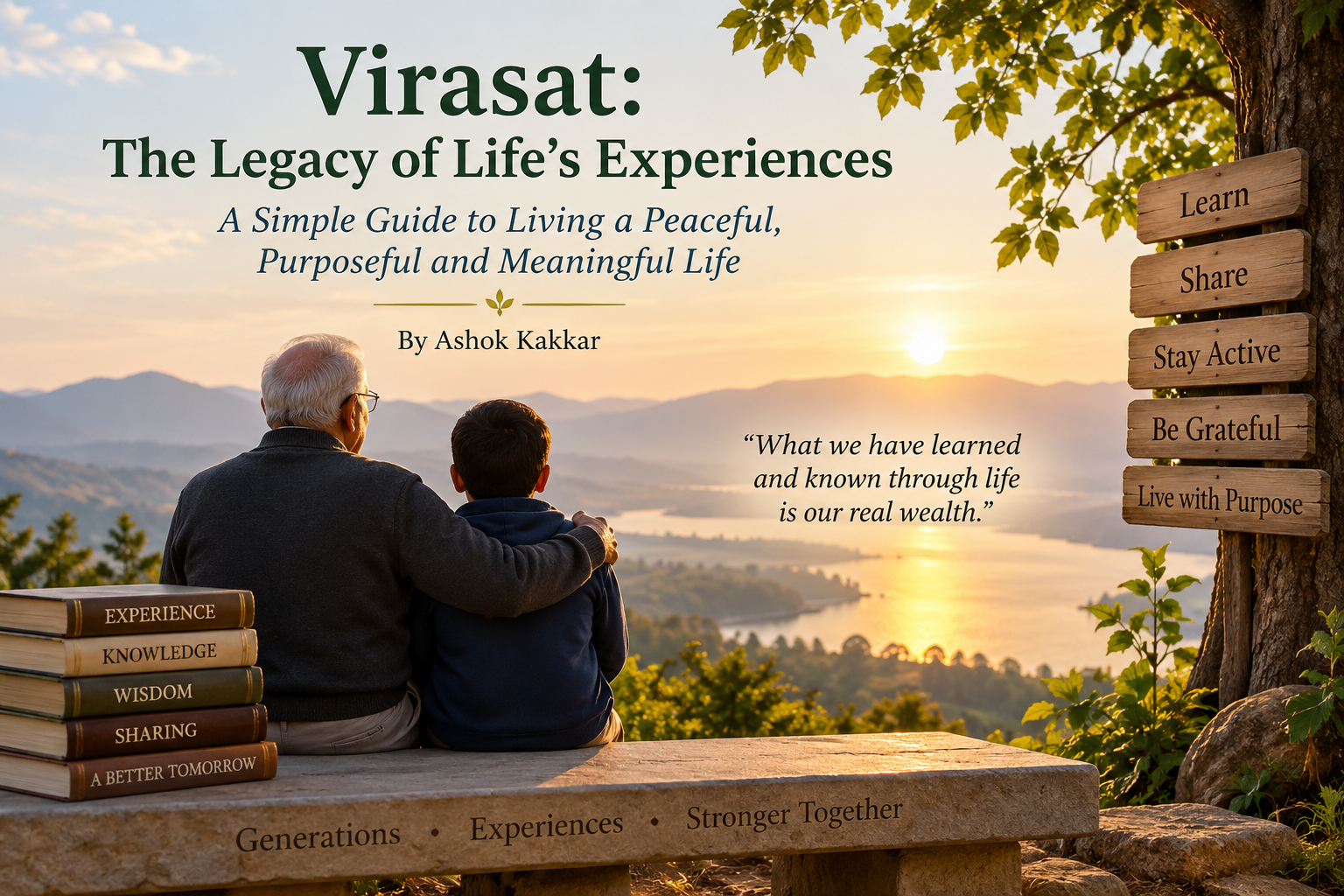
Virasat: The Legacy of Life’s Experiences.
A Simple Guide to Living a Peaceful, Purposeful and Meaningful Life
“What we have learned and known through life is our real wealth.”
By Ashok Kakkar
1. Background and Introduction
As we move through life, our understanding of wealth gradually changes. In our younger years, we naturally concentrate on education, career, family responsibilities, financial security and building a comfortable life. These are important achievements. But with the passage of time, many of us begin to understand that there is another kind of wealth—one that cannot be measured in money.
It is the wealth of experience, knowledge, understanding and the lessons we have gathered during our journey through life. This wealth does not sit locked in a bank account or a property document. It remains within us. Unlike material wealth, it does not become smaller when it is shared; in many cases, its value grows when we pass our experience on to others.
The central thought behind this article is simple: age is a journey, not a full stop. Growing older does not mean that our useful role in life has ended. It can be another stage in which we continue learning, remain reasonably active, enjoy our relationships, share what we have learned and contribute in whatever way is possible.
These are not rules for living, nor are they presented as a formal theory or philosophy. They are simple observations drawn from personal experience and everyday social life, shared with friends, readers and well-wishers.
2. The Wealth That Grows When We Share It
We generally associate wealth with money, property, savings and other material possessions. These are important for security and comfort. Yet there is another form of wealth that we accumulate throughout our lives—our experience.
Every success teaches us something. Every difficulty leaves a lesson. Every relationship gives us understanding. Even our mistakes can teach us something that success sometimes cannot.
Our personal wealth can therefore be seen in three simple ways: what we have experienced, what we have learned, and how wisely we use what we have learned.
Material wealth can be spent, divided or lost. Experience is different. We can share a lesson with one person or with many people without losing anything ourselves. This is why experience can become a true virasat—a legacy that moves from experience to understanding, and from understanding to wisdom and useful contribution.
3. Ten Simple Thoughts for a Peaceful and Meaningful Life
1. Accept Age as a Journey, Not a Stop
One of the biggest changes that comes with age is our perception of ourselves. After retirement, or when family responsibilities become lighter, some of us may begin to feel that our useful role has come to an end. I believe this is an unnecessary way of looking at life.
Retirement from employment is not retirement from life. Age may change what we are able to do, but it does not have to end our curiosity, relationships, learning or desire to contribute. We can continue to discover, participate and enjoy life in ways that suit our circumstances. Growing older need not be treated as a signal to stop growing.
2. Keep the Body Active and the Mind Engaged
A peaceful and enjoyable life is easier when we take reasonable care of ourselves and remain engaged with the world around us. This does not require complicated routines or any special formula.
Simple everyday activities—walking where possible, taking part in household or social activities, meeting friends, reading, writing, talking to others or simply remaining interested in what is happening around us—can give structure and meaning to our days. The objective is not to compete with our younger years. It is simply to remain as active as our own circumstances allow.
3. Continue Learning Throughout Life
There is no age at which learning has to stop. Learning after retirement does not necessarily mean joining a course or pursuing another degree. It can be something very ordinary.
We can learn to use a new digital application, read about a subject that interests us, develop a hobby, understand a new development in society, or simply listen to a younger person’s point of view. Sometimes the most useful attitude is to say, “I don’t know; let me learn.” Remaining open to learning keeps life interesting.
4. Turn Experience into Useful Wisdom
Experience becomes more valuable when we reflect upon it. With the passage of time, we often become better able to distinguish what is important from what is temporary.
That understanding can be shared with others. There is a real difference between giving orders and sharing experience. Instead of saying, “You must do this,” we can say, “This is what happened in my experience; perhaps it may be useful to you.” In this way, our experience becomes guidance without becoming an instruction imposed on someone else.
5. Share Your Experience with the Next Generation
Young people bring energy, fresh ideas and a different way of looking at the world. Older people bring years of experience. Both have something valuable to offer.
We do not need to give long lectures. A short story about something that happened in our own life may sometimes be more meaningful than a long speech. Sharing experiences about patience, trust, relationships, work, responsibility and dealing with difficulties can help younger people make their own choices with greater understanding.
Our role is not to tell the next generation how to live their lives. It is to make our experience available to them when they wish to learn from it.
6. Practise Gratitude
As life progresses, it is natural to think about what we have lost or what we could not achieve. But we can also ask a different question: what have I received?
Family, friends, opportunities, relationships, memories and countless ordinary moments have all shaped our lives. Gratitude does not mean pretending that everything has been perfect. It simply means appreciating what we have while accepting that every life contains its share of difficulties.
A grateful outlook can help us notice the good that is still present in our everyday lives.
7. Continue to Contribute
A meaningful life is not measured only by what we receive. It also has something to do with what we are able to give.
Contribution does not have to mean a major project or a large financial contribution. It may be guiding a younger person, helping a neighbour, sharing useful knowledge, supporting a friend, participating in a community activity or simply listening to someone who needs company.
Even a small contribution may be important to another person. The feeling that “I still have something useful to give” can itself bring meaning to the later years of life.
8. Maintain Positive Relationships
As we grow older, relationships become increasingly important. Money can provide comfort, but it cannot replace companionship.
We should make time for family, friends, neighbours and meaningful conversations. At the same time, experience teaches us that not every disagreement needs to become a dispute. Sometimes peace is more valuable than proving that we are right.
Maintaining relationships does not mean agreeing with everyone. It means learning when to speak, when to listen and when to let a small disagreement pass.
9. Enjoy the Present
It is easy to spend too much time thinking about the past or worrying about the future. Our past should give us experience, not regret. Our future should give us hope, not unnecessary anxiety.
The present is where we actually live. A meaningful life does not always require extraordinary achievements. Sometimes an ordinary conversation with a friend, time with family, reading a book or a quiet cup of tea can become one of our most valuable memories.
We should not postpone happiness indefinitely. The simple moments available to us today also deserve to be enjoyed.
10. Build Your Own Legacy
When we think of inheritance, we usually think of property, savings and material assets. But there is another inheritance that can be far more lasting: good values, good conduct, knowledge, kindness, memories and lessons learned from life.
Material inheritance may eventually be divided among people. Experience, however, can be shared with many people at the same time. This is why virasat is not only what we leave behind. It is also what we share while we are still here.
If something we learned during our journey helps another person, that experience has already begun to live beyond us.
4. A Simple Daily Approach
These thoughts need not become a strict programme. They can simply become a way of looking at an ordinary day. Each day, we can try to:
Learn something: Read, listen, observe or discover something new.
Stay reasonably active: Keep ourselves moving and involved according to our own capacity.
Talk to someone: Maintain meaningful human relationships.
Think positively: Do not allow one disappointment to define the whole day.
Share something: Give someone the benefit of an experience we have gained.
Be grateful: Recognise something good that life has given us.
Do something useful: Even a small contribution can make the day meaningful.
Enjoy the day: Do not postpone happiness indefinitely.
5. What Should We Leave Behind?
A peaceful later stage of life also requires knowing what we may be better off leaving behind. We can try to move away from:
- constantly comparing ourselves with others;
- living only in the past;
- feeling that our useful life has ended;
- unnecessary arguments and conflicts;
- excessive worry about matters beyond our control;
- refusing to learn from younger people;
- keeping all our useful experiences to ourselves; and
- measuring our worth only through money or possessions.
The aim is not to change everything about ourselves. It is simply to make the remaining journey more peaceful, meaningful and useful.
6. The Five Ideas at the Heart of Virasat
Experience is Wealth — What we learn through life is a valuable form of wealth.
Age is a Journey — Growing older does not mean that learning and living have to stop.
Stay Active — Keep the body reasonably active and the mind meaningfully engaged.
Share What You Know — Experience becomes more valuable when it helps someone else.
Live with Gratitude and Purpose — Enjoy what we have and continue contributing to the people around us.
7. A Message to My Readers
Dear friends,
At this stage of life, I increasingly feel that our greatest wealth is not what we have accumulated outside ourselves, but what we have accumulated within ourselves.
Our experiences, our knowledge, our mistakes, our successes and the lessons learned from our journey are all part of our personal wealth. We should not keep this wealth locked within ourselves.
Let us continue to learn. Let us remain active. Let us enjoy our relationships. Let us be grateful for what life has given us. And, most importantly, let us share whatever useful experience we have gained with those who may benefit from it.
We do not have to change the world. If our experience can make one person’s journey a little easier, then that experience has found its purpose.
That, to me, is the real meaning of Virasat.
8. Conclusion — Let the Journey Continue
Growing older is inevitable, but how we live those years remains, to a considerable extent, within our own hands. We can look at age as a decline, or as another chapter of life. We can stop learning, or remain curious. We can keep our experiences to ourselves, or share them. We can dwell only on what we have lost, or appreciate what remains.
The choice is often a matter of attitude.
“Age is not a full stop. It is another stage of the journey.”
Our experience is our wealth. Our wisdom is our legacy. Our relationships are our strength. Our gratitude gives us peace. And whatever useful experience we can share with others gives continuing meaning to our journey.
Let us therefore keep learning, sharing and contributing. That may be the most beautiful virasat we can leave for the generations that follow.
9. Disclaimer
This article is based entirely on my personal life experiences and simple social thoughts, shared with friends, readers and well-wishers. It is intended only as a personal sharing of reflections on living a peaceful, meaningful and purposeful life. It does not represent or promote any religious, sectarian or ideological viewpoint, and is not intended to constitute medical, scientific, philosophical, legal or professional advice. Readers may consider these thoughts in the context of their own circumstances and personal experiences.
— Ashok Kakkar
#Virasat,#Life Experiences ,#Life Lessons, Meaningful Life, Senior Citizens, # Lifelong Learning, Wisdom and Experience, Peaceful Living,