
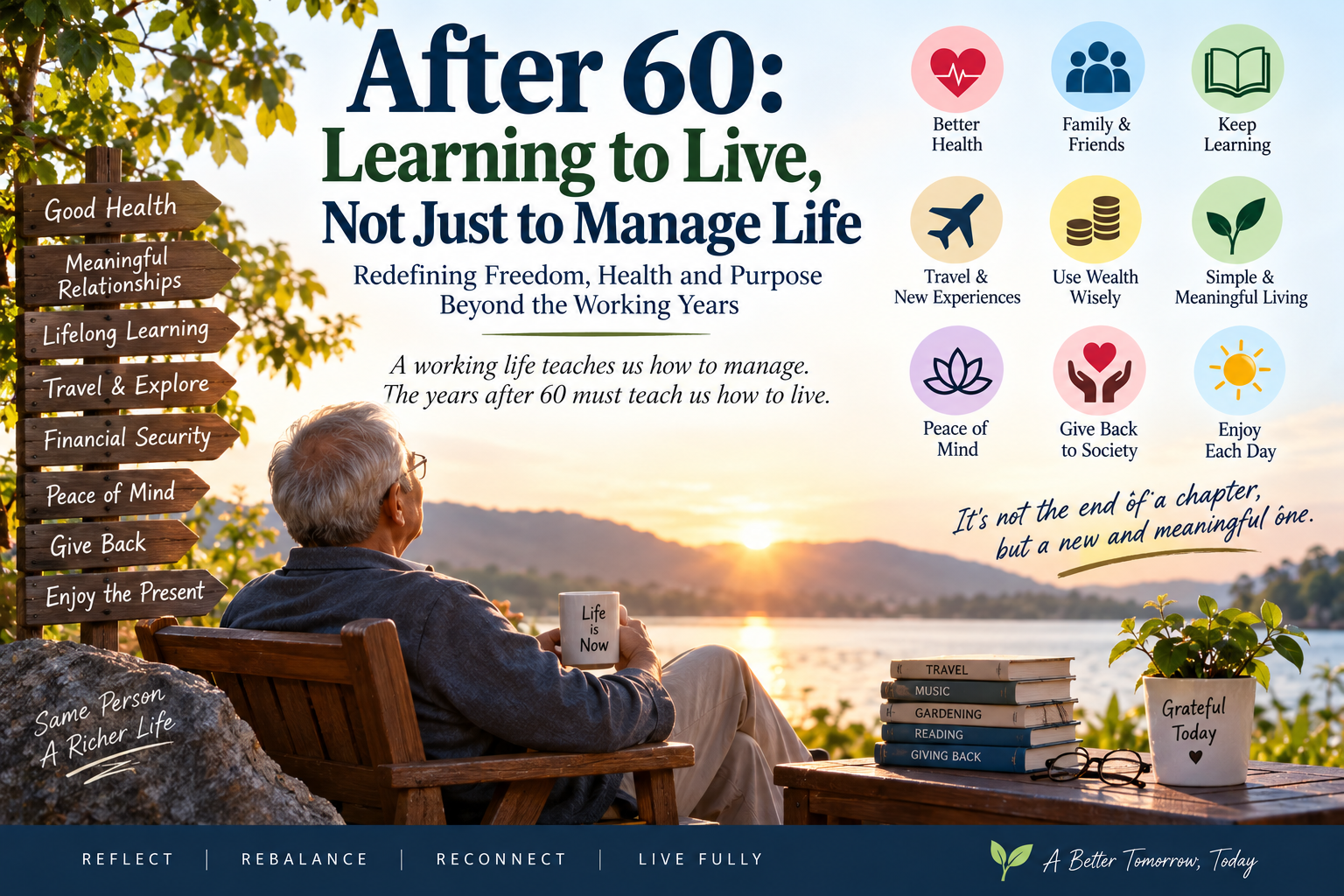
After 60: Learning to Live, Not Just to Manage Life
Redefining Freedom, Health, and Purpose Beyond the Working Years
A working life teaches us how to manage. The years after 60 must teach us how to live.
Ashok Kakkar, Advocate, Insolvency Professional, Former Banker, M.Com, LLB, LLM, CAIIB
Background
For most people who have spent four to five decades building a career, a business, or a family, the years before 60 are lived almost entirely in what may be called “management mode.” Life is organised around alarms, deadlines, targets, and the quiet pressure of being the person others depend on. This discipline is not wasted effort; it is what creates financial security and social standing. But it also creates habits of mind that do not automatically switch off once the working chapter ends. Crossing 60, and later 70, is not simply a change of routine. It is often an unacknowledged identity crisis. When the title, the desk, and the daily targets are no longer there, the question that quietly surfaces is: who am I now, apart from what I managed? This article looks at that transition, not as a problem to be solved, but as a stage of life to be understood, prepared for, and lived well.
1. The Weight of a Productive Life: A Retrospective
The decades before 60 are built on a relentless operational rhythm — punctuality, targets, appraisals, and the constant responsibility of being the dependable anchor at work and at home. This accumulation phase is necessary; it builds the financial and social infrastructure that later life rests on. But the very habits that made a person effective at work — rigid planning, constant self-correction, measuring every day against a target — do not simply disappear at retirement. Many retirees struggle not because they lack money or time, but because they cannot switch off the internal “manager,” and end up treating retirement itself as another project to be optimised rather than a life to be lived.
2. Redefining Freedom: From Rigidity to Rhythm
The real shift required after 60 is from rules to rhythms. Working life is governed by external alarms, fixed timetables, professional exactness, and accountability to bosses and clients. Retirement offers a different possibility — waking when rested rather than when the clock demands it, changing plans without guilt, choosing an unhurried conversation over a to-do list, and acting from preference rather than compulsion. The danger, however, is replacing the external boss with an internal one — a self-imposed taskmaster that keeps demanding measurement, correction, and productivity even when no one else is asking for it. Genuine freedom lies in recognising and gently retiring that inner supervisor.
3. Health as the Primary Infrastructure for Independence
If flexibility is the goal of this stage, health is the engine that makes it possible. After 60, health care is not a restriction to be tolerated; it is a high-yield investment in independence. This means treating regular check-ups and medication adherence as non-negotiable, not optional. It means recognising that a daily walk, some yoga, or a few minutes of quiet meditation is not indulgence but maintenance — the price of being able to travel, play with grandchildren, or simply move through a day without assistance. It also means accepting biological reality without obsessing over it: taking reasonable care while refusing to let “ageing” become the whole of one’s identity or a permanent source of anxiety.
4. Purposeful Engagement: The Joy of Utility-Free Learning
Through the working years, almost all learning is utilitarian — acquired to solve a problem, earn a promotion, or protect one’s position. After 60, the far more nourishing shift is toward learning done purely for its own sake. This can take many forms: reading and writing for pleasure rather than deadlines; picking up music, painting, or a craft; mentoring, teaching, or volunteering to share decades of accumulated knowledge without the pressure of a paycheck; or simply gardening and quiet reflection to stay connected to something larger than oneself. Even sharing professional experience — through writing, informal teaching, or guiding younger professionals — can be reframed this way: not as an obligation to remain “useful,” but as a source of genuine satisfaction in its own right. The question worth retiring at this stage is “what is the use of this at my age?” In its place belongs a better one: “does this nourish my mind?”
5. Wealth, Legacy, and the Currency of Memories
The philosophy of wealth after 60 must move from accumulation to utilisation. Wealth is a tool for security and enjoyment, not an identity to defend or a scorecard to announce. There is a quiet psychological burden in constantly recounting past achievements or making financial status the centre of family conversation — a truly secure person lets wealth speak for itself. A harder but important discipline is keeping relationships non-transactional: a child’s love and attention should never be made conditional on eventual inheritance. What ultimately remains after wealth is distributed is not the balance sheet, but shared laughter and attentive listening — the currency that actually outlasts a bank balance.
6. Practical Preparation: Documentation and Financial Clarity
Having worked across banking, law, and insolvency for over four decades, one habit is worth carrying into this stage rather than discarding: quiet, orderly documentation. Wills, nominations in bank accounts, insurance policies and demat holdings, powers of attorney for medical and financial decisions, and a simple, accessible record of assets and liabilities are not morbid preoccupations — they are acts of care toward one’s family. Disputes and hardship after a person’s passing arise far more often from missing documentation than from any lack of love. Setting this in order early, calmly and without drama, is one of the most practical gifts a person can leave behind, and it frees the mind to focus on living rather than worrying. It is worth reviewing this documentation periodically — nominations lag behind changed circumstances more often than people realise, and a nomination or will drafted decades ago may no longer reflect one’s current wishes or family situation.
7. Nurturing Connection Over Comparison
The final transition is from building a life to enjoying the life that has been built. It requires letting go of comparison — one’s own peace matters far more than matching a peer’s lifestyle, travel, or achievements. It requires prioritising people over possessions, since social capital, not accumulated assets, is the most valuable resource of the later years. And it requires accepting that plans can and should change, that pivoting is a sign of independence rather than failure. Saving for the future remains wise, but it should never come at the cost of hoarding the present. Physical assets can be passed on to the next generation; time spent together cannot be recovered once it has passed.
Conclusion
The first part of life is, of necessity, about building — a career, a family, a reputation, a financial cushion. The years after 60 call for a different discipline altogether: the discipline of enjoying what has already been built. This does not happen automatically simply because the working chapter has ended. It requires a conscious, almost deliberate, unlearning of rigidity, an honest reframing of health and wealth, a willingness to learn without utility, and the quiet housekeeping of documentation that protects the people we love. Done well, this stage is not a decline from a productive life but its natural and, in many ways, its most meaningful continuation.
Message to Readers
If you are approaching, or have already crossed, 60, give yourself permission to retire the inner manager along with the outer job. Review your documentation — your will, your nominations, your medical directives — not out of anxiety, but as an act of care for those who depend on you. Protect your health as you once protected your career targets. Learn something for no reason other than joy. And above all, spend time with the people who matter, because that is the one asset that truly cannot be re-earned later. If this reflection resonates with your own experience or that of your family, I would be glad to hear your thoughts.
Disclaimer: The views expressed in this article are based on general professional observation and personal reflection on life transitions after 60. They are not medical, financial, legal, or religious advice. Every individual’s health, financial position, and family circumstances are different, and readers are encouraged to adapt these reflections to their own situation and to consult qualified professionals — medical, financial, or legal — before making significant personal decisions.
#LifeAfter60 #Retirement Life #Healthy Aging #Personal Reflections #Mindful Living #Family Relationships #Lifelong Learning #Joy Of Living