
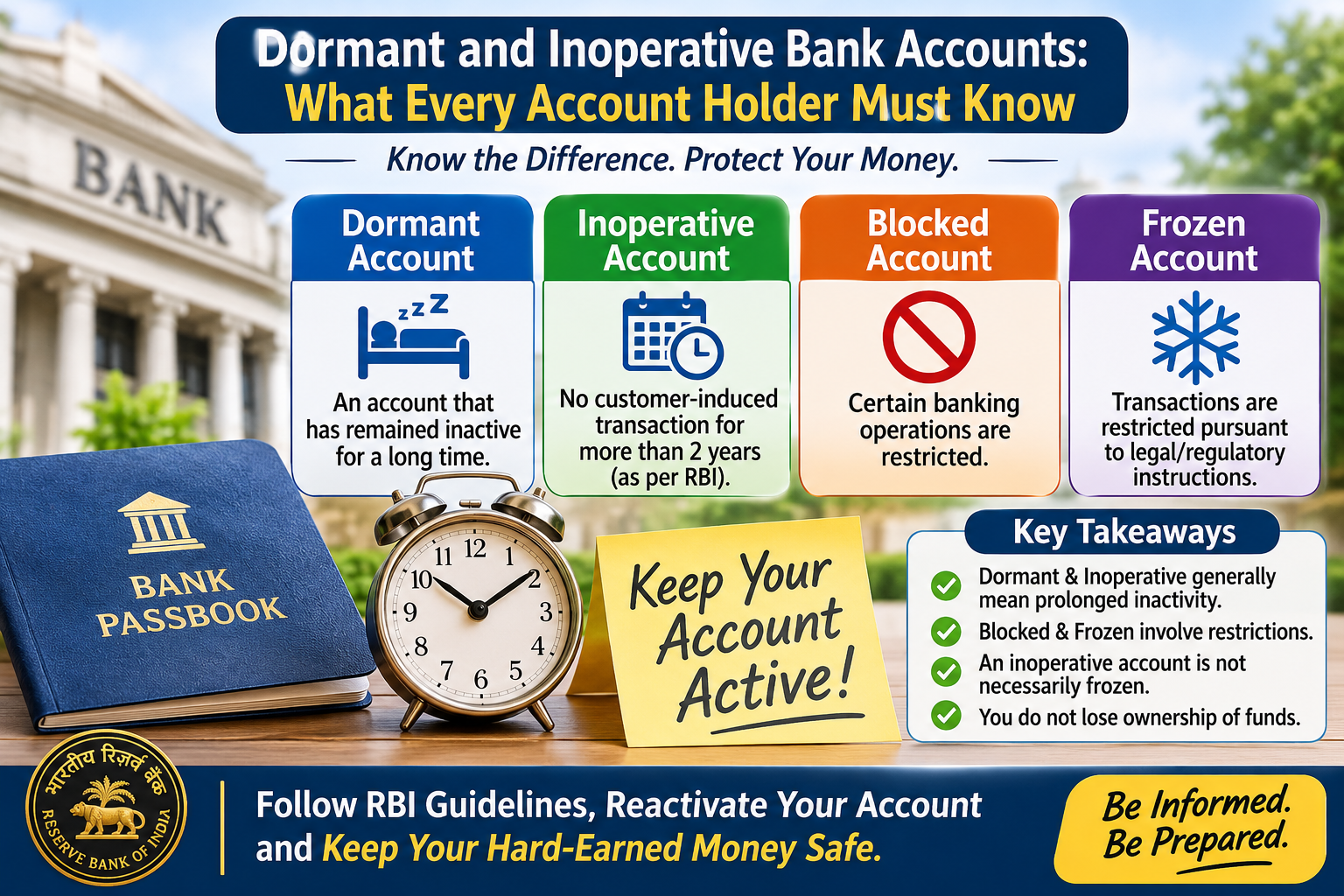
Dormant and Inoperative Bank Accounts: What Every Account Holder Must Know
Guidelines on Classification, Reactivation, Interest, Service Charges and Unclaimed Deposits
An account you stop using does not stop existing. Know the rules before your money goes quiet.
By Ashok Kakkar Advocate, Insolvency Professional and Former Banker | M.Com, LLB, LLM, CAIIB
Introduction
Most of us open more than one bank account in a lifetime. There may be a salary account with a former employer, a savings account near an old residence, a current account for a business that has since closed, or an account opened to receive a scholarship or a government benefit. Over the years some of these accounts go unused. The passbook is misplaced, the registered mobile number changes, the family moves to another city, and the account is eventually forgotten.
What happens to the money in such an account? Can the bank stop withdrawals? Does the balance continue to earn interest? Is there a charge for reactivation? And what if the money has already been transferred to the Reserve Bank of India’s Depositor Education and Awareness (DEA) Fund?
The Reserve Bank of India (RBI) has issued instructions to banks on inoperative accounts and unclaimed deposits. They are supported by the DEA Fund Scheme, 2014, and the RBI’s Know Your Customer (KYC) Directions, as updated from time to time. Their purpose is to protect customers from fraud, to return unclaimed money to its owners and to make reactivation simple. This article explains the principal rules and practical steps for account holders, nominees and legal heirs. It follows the RBI framework in general terms and does not reproduce clause numbers or bank-specific procedures.
Points for Discussion
1. What Do “Dormant” and “Inoperative” Mean?
In everyday banking language the two words are used interchangeably. The RBI framework, however, speaks of an inoperative account. A savings or current account is treated as inoperative when there has been no customer-induced transaction in it for more than two years.
The word “dormant” is commonly used in banking practice for an account that has remained unused for a long time. It is not a separate, universally defined RBI category with its own consequences. In this article the “dormant stage” simply means the first year of silence, when the bank reviews the account and warns the holder.
An inoperative account is not a closed account. The money remains in the account, and the account can be reactivated after the prescribed verification.
2. Which Banks and Accounts Are Covered?
The instructions apply to all commercial banks, including public sector banks, private sector banks, foreign banks, small finance banks and regional rural banks, and to co-operative banks. The core timelines and customer protections are the same for every bank. The classification rules concern mainly savings and current accounts, while the rules on unclaimed deposits also reach term deposits and other balances that remain unclaimed for the prescribed period.
Classification is done account by account, not customer by customer. If a person holds three savings accounts with the same bank, regular use of one does not stop the other two from becoming inoperative. Account holders should therefore keep a record of every account, including those opened in earlier jobs or at previous places of residence.
3. When Does an Account Become Inoperative?
The process is best understood as a sequence of stages. Only the two-year test and the ten-year transfer are formal RBI thresholds; the one-year stage is a review and intimation stage.
Stage 1: No customer-induced transaction for more than one year. Banks review such accounts at least once a year and inform the holder in writing, by letter, email or SMS to the registered contact details. The message states that the account has not been operated, that it will become inoperative if there is no operation during the next year, and that fresh KYC will then be needed to reactivate it. If letters return undelivered or there is no response, the bank must enquire about the whereabouts of the holder or, if the holder has died, of the nominee or legal heirs.
Stage 2: Opportunity to respond. If the holder responds and explains the reasons for non-operation, the bank continues to treat the account as operative for one more year and advises the holder to operate it within that time.
Stage 3: Classification as inoperative. If no qualifying customer-induced transaction takes place for more than two years, the account is classified as inoperative. The bank records this status in its system and segregates the account as a precautionary measure to prevent possible misuse or fraud. The bank also makes periodic efforts to contact the account holder, generally on a quarterly basis, through SMS, email or other available communication channels, to inform them about the account’s status and the need for reactivation.
Stage 4: Transfer to the DEA Fund. A separate rule applies to unclaimed deposits. A credit balance that has not been operated or claimed for ten years or more must be transferred by the bank to the DEA Fund maintained by the RBI. This ten-year period is quite different from the two-year test for inoperative classification.
Accounts receiving government benefits. Accounts opened to receive scholarships and Direct Benefit Transfer (DBT) are treated differently. Banks must segregate them so that they are not classified as inoperative merely because the beneficiary has not operated them for two years. Even so, beneficiaries should keep their KYC current.
4. Which Transactions Count as Customer-Induced?
This is among the most important parts of the framework, because not every entry in a statement counts.
Financial transactions initiated by the holder, or done at the holder’s instance by the bank or a third party, qualify. These include cash deposits and withdrawals at a branch or ATM, electronic transfers such as NEFT, RTGS, IMPS and UPI, internet banking transactions, cheque clearing, demand drafts, debit card transactions, and standing instructions, NACH mandates and auto-renewal instructions given by the customer. Specified credits such as term deposit interest or proceeds, dividends, DBT credits and refunds (for example income tax or e-commerce refunds) also qualify.
Some non-financial activity can qualify too, but only where the request is made through an ATM, internet banking or mobile banking with two-factor authentication and an audit trail, or where there is a successful log-in to the bank’s internet or mobile banking application. Examples are an authenticated balance enquiry, a request for a cheque book or card, a change in transaction limit and registration of a nomination. KYC updation done face to face or through the bank’s digital channels is also treated as a customer-induced transaction.
What does not count are entries initiated by the bank itself, such as service charges, fees, penalties, tax deducted and the savings interest credited by the bank. An account showing only interest credits and charge debits for two years will still become inoperative. The practical lesson is simple: never rely on bank-generated entries to keep an account alive.
5. Why Do Banks Classify Accounts as Inoperative?
The main purpose is protection. An account unused for years may carry outdated contact details, an old signature or a mobile number that no longer belongs to the holder. Because the owner is not watching it, unauthorised activity is harder to detect.
The RBI therefore requires several safeguards. No debit is permitted in an inoperative account until the customer has activated it through the prescribed procedure. Activation needs approval by a second officer, with system logs maintained. Transactions in a reactivated account are monitored by the branch’s controlling authorities for at least six months, without the knowledge of the customer or the dealing staff. Balances in inoperative accounts, unclaimed deposits and reactivated accounts are subject to concurrent audit, and banks must prevent unauthorised access to the data of such accounts. A bank may also apply a cooling-off period after reactivation, with limits on the number and amount of transactions, as for a new account.
Banks often suspend facilities such as debit cards, internet banking and cheque books in inoperative accounts under their own risk policies, which is the bank’s decision and not a fixed RBI rule. Classification as inoperative does not mean the customer has lost ownership of the money. It is a protective measure and should never become an unnecessary obstacle to legitimate access.
6. Does an Inoperative Account Continue to Earn Interest?
Yes. Interest on a savings account must be credited regularly, whether or not the account is operated. The holder does not lose savings interest merely because the account lies unused. Since interest is a bank-induced entry, however, it does not by itself revive the account.
Term deposits need separate consideration. Interest depends on the terms of the deposit and its treatment after maturity. If a fixed deposit matures and the proceeds remain unclaimed, the position may differ from that of a savings account, and the holder should ask the bank how the deposit has been treated and what interest, if any, applies. Tax is a separate matter: inactivity does not make interest tax-free, and tax may be deducted at source as applicable.
7. Can the Bank Charge for an Inoperative Account?
The RBI has given account holders two clear protections. A bank cannot levy penal charges for non-maintenance of minimum balance in an account classified as inoperative, and it cannot charge a customer for activating an inoperative account.
These protections matter most where an account has been unused for years and the balance is small. A charge for reactivation is, however, different from charges for other services the customer actually avails, which remain governed by the bank’s published schedule of charges. If an activation fee or a penal minimum-balance charge appears, the customer should ask for a written explanation and refer to the RBI instructions.
8. How Can You Reactivate an Inoperative Account?
Reactivation is generally straightforward once the bank has verified the customer’s identity and completed the required checks.
Step 1: Locate the account details. Keep the account number, passbook, an old statement or a cheque book ready. If the number is not available, ask the bank how the account can be traced from other identification details.
Step 2: Prepare the KYC documents. Keep ready, as applicable and subject to the bank’s current requirements, proof of identity and address, PAN or Form 60, a recent photograph if required, and your current mobile number and email address. This is a preparation list, not a universal list of mandatory documents.
Step 3: Choose the mode. Under the RBI’s revised framework, banks must make KYC updation for activation available at all branches, including non-home branches. They must also offer the Video Customer Identification Process (V-CIP) on request, where the bank has that facility, and the June 2025 amendment permits the use of the bank’s Business Correspondent where applicable. Confirm the options before visiting.
Step 4: Submit the request. Complete the bank’s form or submit a written request with the documents, and retain an acknowledgement or reference number.
Step 5: Complete verification. The bank carries out customer identification, due diligence and risk categorisation under the KYC Directions. Where an account is frozen by a court, tribunal or enforcement agency, the freeze must be dealt with according to the order and the law.
Step 6: Check the timeline. A complete application must be processed within three working days of receipt. If there is a delay, ask the branch for the reason and keep the reply in writing.
Step 7: Obtain confirmation. The bank must automatically inform you by SMS and registered email that the inoperative status has been removed, along with the steps to report any unauthorised access. Check the balance and recent entries, and ask how to restore a debit card, cheque book or digital banking access. Temporary transaction limits are not unusual.
9. Before Visiting the Bank: A Quick Checklist
A little preparation saves repeated visits. Locate the account number or an old statement, keep identity and address documents ready along with PAN or Form 60, and confirm that your mobile number and email address are current. Ask whether you can apply at a non-home branch or through V-CIP, and whether the bank needs a prescribed form. Submit the request, retain the acknowledgement, and after reactivation check the balance and report any unexplained entry promptly. If the account belonged to a deceased family member, the process is different, and the nominee or legal heir should ask for the bank’s deceased-depositor claim procedure.
10. What Happens When Money Is Transferred to the DEA Fund?
Under the DEA Fund Scheme, banks must transfer eligible credit balances that have remained unoperated or unclaimed for ten years or more to the DEA Fund. This does not mean the money is forfeited. It remains claimable by the rightful depositor, nominee or legal heir, subject to verification. The claim is made to the bank, which pays the claimant and then obtains reimbursement from the RBI. There is no time limit for making the claim.
To search for forgotten deposits, the RBI has launched the UDGAM portal (Unclaimed Deposits, Gateway to Access information). Enter the requested details, search by holder and bank, note any matching record, and approach the concerned bank with the claim form, KYC documents and other evidence it requires. UDGAM is only a search facility and does not release money. Not every bank or record may be covered, so if nothing appears, contact the bank directly.
Where the account holder has died, the nominee or legal heir can approach the bank. A death certificate, identity documents, nomination records and proof of relationship or legal-heir documents are usually needed, depending on whether a valid nomination exists and the nature of the claim. The absence of an old passbook does not mean the money cannot be traced.
11. Are All Accounts Treated in the Same Way?
No. Savings and current accounts become inoperative after more than two years without customer-induced transactions. A term deposit does not ordinarily go through the same classification during its tenure, and an auto-renewal mandate given by the customer counts as customer-induced activity. A matured deposit whose proceeds remain unclaimed may, however, become an unclaimed deposit under the applicable rules. Recurring and other deposits depend on their terms, and the position should be confirmed with the bank. Loan and credit accounts are borrowing arrangements and are not covered by the deposit classification rules in the same manner. Post Office accounts are governed by the Department of Posts and should not automatically be treated as bank accounts under the RBI framework.
12. Why KYC Updation Matters
KYC runs through almost every provision discussed above. It is needed to reactivate an inoperative account and to claim an unclaimed deposit, and it is required periodically even for active accounts. Under the RBI’s KYC Directions as applicable , banks update KYC on a risk basis: at least every two years for high-risk customers, every eight years for medium-risk customers and every ten years for low-risk customers, with simplified procedures available to eligible customers. The RBI has also noted that many accounts are restricted because periodic KYC is pending, and has asked banks to simplify the process.
KYC updation done face to face or through internet or mobile banking is itself a customer-induced transaction, so it can help keep an account operative. Where nothing has changed, many banks accept a self-declaration through digital channels. Where your name, address or other particulars have changed, fresh documents are needed. A correct mobile number and email address are essential, because the bank’s warnings and its confirmation of reactivation reach you only through them.
13. How to Avoid an Inoperative Account
Prevention is simpler than reactivation. Maintain a list of all your accounts and deposits, and keep the bank informed of changes in address, mobile number and email. Make a genuine customer-induced transaction at least once a year; although the formal test is two years, the bank’s review begins after one. Review old term deposits to confirm whether they have matured, renewed or remain unpaid. Register a nominee in every account and review it after major life events. If you no longer need an account, close it formally after transferring the balance instead of leaving it unattended.
14. What If the Bank Does Not Reactivate the Account?
If a complete application is not processed in time, or the bank refuses without a clear explanation, first ask the branch manager for the reason in writing. If the matter remains unresolved, use the bank’s grievance redressal channel and preserve the acknowledgement, correspondence and account records. If the bank does not resolve the complaint satisfactorily within the applicable period, consider approaching the RBI under the Integrated Ombudsman Scheme, where the complaint is maintainable. First identify the exact cause, since an incomplete KYC, a legal freeze or an ownership dispute needs a different solution from an ordinary delay.
Conclusion
The RBI framework on inoperative accounts and unclaimed deposits has three objectives: to protect account holders from fraud, to help banks trace their customers and to return money to its rightful owners. An inoperative account is not a closed account. Savings interest continues to be credited, banks cannot charge for reactivation, and an amount transferred to the DEA Fund remains claimable by the depositor, nominee or legal heir, subject to verification.
At the same time, account holders should not ignore old accounts. Outdated contact details, incomplete KYC and missing records create avoidable inconvenience. A little attention today can save considerable effort tomorrow.
Message to Readers
Your money remains yours. Keep a record of all your bank accounts and deposits and tell a trusted family member where it is kept, without sharing passwords or PINs. Check old accounts and term deposits periodically, keep your KYC, mobile number, email and address current, and never depend on interest credits or bank charges to keep an account operative. If an account has become inoperative, reactivate it through the prescribed process, which is free of charge. Search for forgotten deposits, including those of departed family members, through UDGAM and the bank’s website, and register a nominee in every account.
Official resources: Reserve Bank of India, https://www.rbi.org.in/ | UDGAM portal, https://udgam.rbi.org.in/unclaimed-deposits/
Disclaimer
This article is intended solely for general public awareness and education. It does not constitute legal, financial or professional advice and is not a substitute for the applicable RBI directions, statutory provisions or the policies and procedures of the concerned bank. Regulatory requirements and bank procedures may change from time to time. Readers should consult official RBI publications and contact their bank for guidance applicable to their individual circumstances.
Ashok Kakkar
Keywords: Inoperative Bank Accounts, Dormant Accounts, RBI Guidelines, Customer-Induced Transactions, Bank Account Reactivation, KYC Compliance, Savings Account, Current Account, Unclaimed Deposits, DEA Fund, UDGAM Portal, Banking Awareness, Account Holder Protection, Fraud Prevention, Financial Awareness.