
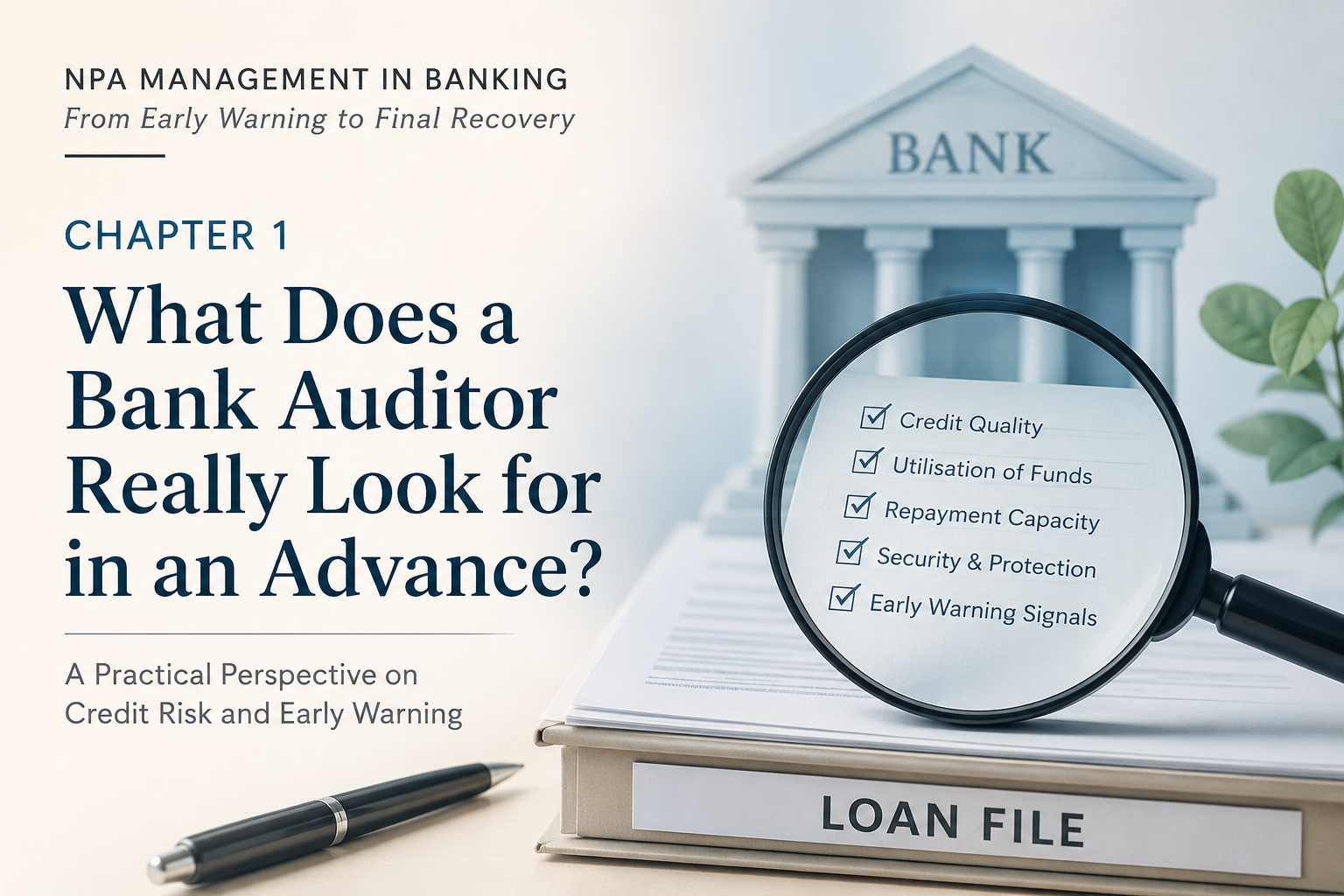
A Practical Perspective on Credit Risk and Early Warning
| This is the first chapter of a practical series examining the complete journey of stressed advances—from credit monitoring and early warning signals to NPA classification, resolution, recovery, SARFAESI, DRT, IBC/CIRP and liquidation. The series is based substantially on professional experience and focuses on the practical issues that arise at different stages of the credit and recovery cycle. |
Introduction
When a bank auditor examines an advance, the exercise should not be reduced to checking whether the loan file contains all the required documents.
A credit file may appear complete on paper and yet the underlying account may be weak, improperly monitored, inadequately secured or already showing signs of financial stress. The real question is much broader:
Does the advance represent a genuine and properly managed credit exposure, and is the bank adequately protected against the risk of loss?
This requires the auditor to look beyond the sanction letter and examine the quality of the credit, utilisation of funds, conduct of the account, financial position of the borrower, security, repayment capacity and emerging warning signals.
An account that eventually becomes an NPA usually does not become problematic overnight. The signs of weakness often appear first in the conduct of the account, movement of funds, cash flows, turnover, receivables, stock or repayment behaviour.
The auditor therefore has an important role in identifying whether an account is merely documentarily compliant or is also economically and operationally healthy.
1. What Is the Auditor Really Trying to Establish?
While auditing an advance, the auditor should broadly seek answers to five fundamental questions:
1. Was the advance properly sanctioned?
Was the credit decision within the delegated authority and supported by adequate appraisal?
2. Was the money used for the sanctioned purpose?
Can the utilisation of funds be reasonably established?
3. Is the borrower capable of repayment?
Is the business generating sufficient cash flow to service its bank obligations?
4. Is the bank adequately protected?
Are the primary and collateral securities available, adequately valued and legally enforceable?
5. Is the account showing signs of deterioration?
Are there irregularities, early warning signals or other circumstances requiring closer attention?
These five questions provide a more meaningful audit framework than simply asking whether the required documents are available, and they run through everything that follows in this chapter. If the answer to any one of them is unsatisfactory, the account deserves closer examination and appropriate follow-up.
2. File Audit Versus Credit Audit
This distinction is important.
A conventional file-oriented approach asks whether the sanction letter, loan documents, stock statements, valuation report and insurance policy are on record. These checks are necessary, but they do not by themselves establish whether the credit is healthy.
A credit-oriented approach asks whether the credit decision was sound, whether the borrower is still viable, whether the business is generating cash, whether the finance is being used properly, whether the security is still adequate, whether the account is genuinely regular, and whether warning signals are being identified and acted upon.
Both approaches are necessary, but the second provides the real credit perspective.
A loan file can be complete while the underlying advance is deteriorating.
That is the central theme of this chapter.
3. Sanction and Credit Appraisal
The first step is to understand why the bank sanctioned the facility and on what basis. Depending on the nature and scope of the audit, the auditor may examine the nature and purpose of the facility, the amount and type sanctioned, repayment schedule, interest and applicable charges, drawing-power or other operating conditions, primary and collateral security, guarantees, financial covenants, margin requirements, end-use conditions, review and renewal requirements, and deviations from normal lending policy.
The authority approving the facility should also be examined with reference to the applicable delegation of powers, and the original appraisal tested against realistic assumptions regarding turnover, cash generation and repayment capacity. The ultimate test of the appraisal is whether the projected cash flows provide a reasonable basis for servicing the proposed debt.
Deviations require attention.
A deviation does not necessarily mean that an advance is improper — banking involves commercial judgment, and genuine circumstances may justify a departure from normal parameters. But an unexplained or inadequately approved deviation may indicate weakness in the credit process. The auditor should distinguish between approved commercial judgment and uncontrolled deviation from credit discipline.
4. Documentation — More Than a File-Checking Exercise
Documentation is essential to credit risk protection, but the audit should not stop after confirming that documents have been obtained. The auditor should consider whether required loan documents have been executed, security documents correspond with the sanctioned facility, guarantees have been obtained where stipulated, mortgage or other security has actually been created, applicable charges and registrations with the Central Registry (CERSAI) have been duly completed wherever applicable, insurance is valid and adequate, and periodic renewal of documents has been undertaken.
A particularly important distinction is between “document available” and “security enforceable.” A document may be physically present in the loan file but still contain deficiencies affecting the bank’s legal protection. The purpose of documentation is not merely to complete the loan file — it is to preserve the bank’s rights and ability to enforce its security when required.
5. End-Use of Funds — Where Did the Money Actually Go?
One of the most important areas in credit audit is end-use of funds. The fact that money was disbursed does not establish that it was used for the purpose for which it was sanctioned.
Depending upon the facility, the auditor may examine bank statements, payments to suppliers, invoices, stock purchases, capital expenditure, receivables and other relevant transactions. Particular attention may be required where there are transfers to related entities, unusual fund movements, circular transactions, accommodation entries, large cash withdrawals, funding of unrelated activities, or fresh finance being used to service existing overdue obligations.
The objective is not to treat every unusual transaction as evidence of wrongdoing. The transaction should be examined in the context of the borrower’s normal business activity and the purpose for which the facility was sanctioned. The practical question is:
Can the bank’s disbursement be reasonably connected with the business transaction or purpose for which the finance was sanctioned?
6. Working-Capital Finance — Drawing Power and Stock Statements
For cash-credit and other working-capital facilities, the auditor should pay particular attention to the relationship between the sanctioned limit, drawing power and actual business activity. Stock statements and book debts should not be examined merely as documents submitted to the bank — their commercial reasonableness matters too, covering stock levels and valuation, book debts, ageing of receivables, eligible and excluded stock, margin requirements, drawing-power calculations, timeliness of stock statements, and slow-moving or obsolete inventory.
The auditor should ask:
Does the reported stock and receivable position make commercial sense when compared with the borrower’s turnover and business activity?
A substantial increase in stock accompanied by declining sales may require closer examination. Similarly, rising receivables without corresponding improvement in turnover or collections may indicate emerging stress.
7. Account Conduct — Perhaps the Most Important Evidence
The transaction history of an account can sometimes tell the auditor more than the loan file. The auditor should examine the pattern of credits and debits, account turnover, cheque returns, interest servicing, instalment payments, excess drawings, temporary overdrafts, ad-hoc limits, regularisation of excesses, and unusual credits around reporting dates.
One of the most important questions is:
Are the credits coming from genuine business operations, or are they merely being introduced to keep the account technically regular?
A borrower may make occasional payments into the account. What matters is the pattern, source and sustainability of recovery, rather than an isolated credit. The distinction between genuine regularisation and temporary or accommodation credits is therefore central to assessing whether an account is actually improving.
8. Financial Health — Is the Business Actually Capable of Repayment?
Financial statements should not be examined in isolation. The auditor should consider the trend in sales and turnover, profitability, operating cash flow, receivables, inventory, payables, the working-capital cycle, leverage, interest coverage and cash generation. A useful comparison is current performance against previous performance, sanctioned projections and debt-servicing requirements.
The question should not simply be whether the borrower has submitted the financial statements. It should be what those statements tell us about the borrower’s ability to service bank debt. A borrower may report accounting profits while facing serious cash-flow difficulties because receivables are not being realised — for credit purposes, cash flow can therefore be more revealing than accounting profit.
9. Security and Collateral — Is the Bank Really Protected?
Security protects against credit loss only if it is available, adequately valued and legally enforceable. For primary security, the auditor should consider existence, quantity and quality, valuation, insurance and periodic verification; for collateral security, title and ownership, valuation, encumbrances, creation and registration of charge, insurance where relevant, and physical condition.
The auditor should also remain alert to erosion in security value. A property valued several years ago cannot automatically be assumed to have the same realisable value today, and machinery, stock and receivables may deteriorate or become difficult to realise. The relevant question is:
If the borrower defaults today, what can the bank realistically realise from the available security?
The existence of security is therefore not enough; its realisability is equally important.
10. Early Warning Signals — Look Beyond the Balance Sheet
An effective audit should remain alert to signs of deterioration: declining turnover, persistent excess drawings, frequent cheque returns, delayed interest servicing, increasing receivables, falling inventory turnover, frequent requests for ad-hoc facilities, declining profitability, delayed statutory payments, non-submission of financial information, management changes, promoter disputes or litigation, and sudden movement of funds to related entities.
An individual signal may not establish that an account is heading towards NPA. However, multiple signals appearing together should trigger closer examination, and their significance should be assessed in the context of the overall account rather than in isolation.
This is where audit can add real value — identifying deterioration before the account becomes a serious recovery problem. The detailed treatment of early warning signals, SMA (Special Mention Account) staging and preventive action will follow in subsequent chapters of this series.
11. Renewal and Review — Not a Routine Exercise
Credit should not become a permanent facility merely because the borrower continues to operate the account. The auditor should consider whether review or renewal was carried out on time, current financial information was obtained, stock and receivables were properly considered, existing irregularities were addressed, sanction conditions were complied with, and earlier weaknesses were followed up.
A renewal exercise should represent a fresh assessment of credit risk, rather than merely an administrative continuation of the existing facility.
12. NPA Classification and Evergreening — A Brief Audit Perspective
An advance audit should also consider whether the account has been correctly classified. The auditor should examine the underlying facts — actual due dates, overdue amounts, repayment history, interest servicing and drawing-power position — rather than simply accepting the classification appearing in the banking system.
The objective is not to “make an account NPA.” It is to ensure that the bank’s classification reflects the actual position of the account. The auditor should also examine whether income recognition and provisioning have been appropriately dealt with in accordance with the applicable regulatory framework.
Evergreening requires particular caution.
Possible indicators include fresh finance being used to clear existing overdue obligations, transfers between connected accounts, accommodation credits, temporary finance used to regularise an account, renewal of facilities without addressing the underlying repayment problem, and artificial improvement in account conduct around reporting dates. The key question is:
Has the underlying financial problem actually been resolved, or has the default merely been postponed?
The auditor should examine the substance of the transaction rather than merely its accounting appearance. Detailed treatment of NPA classification, provisioning, evergreening and the actions required after NPA classification will be taken up in later chapters.
13. What Should an Auditor Report?
The auditor’s role is not to take over the credit function of the bank. Where audit procedures identify material irregularities, weaknesses or warning signals, these should be appropriately documented and reported in accordance with the scope of the audit and the bank’s reporting framework — irregular drawings, inadequate security, documentation deficiencies, non-compliance with sanction conditions, delayed review, diversion concerns, unusual transactions, inadequate monitoring, potential classification issues, provisioning concerns, or possible serious irregularities.
A useful audit observation should not merely state what is wrong. It should explain why it matters and what risk it creates for the bank. That is what makes the audit useful to credit management.
Key Takeaway
The objective of an advance audit is not merely to verify whether the loan file is complete. It is to understand whether the credit remains genuine, properly utilised, adequately secured, capable of repayment and free from significant warning signals.
Early identification of weakness gives the bank greater opportunity to take appropriate corrective action before the account becomes a serious recovery problem.
Conclusion — Look Beyond the Loan File
The most important lesson in auditing advances is simple: a loan file can be complete while the advance can still be unhealthy.
The auditor should look beyond documents and balances and try to understand the economic reality of the account. Is there a genuine business? Is the borrower generating sufficient cash? Is the bank’s money being used for the sanctioned purpose? Is the security still available and adequate? Are repayments coming from genuine business operations? Are warning signals being identified and acted upon?
And, most importantly: is the account moving towards stress even though it still appears regular in the bank’s books?
A good advance audit does not merely identify what has gone wrong. It can help identify what may go wrong next. That is where audit becomes valuable to credit management.
What Comes Next?
The next chapter will move from the auditor’s perspective to the bank’s continuing responsibility for monitoring a standard account:
Chapter 2 — How Should a Bank Monitor a Standard Account?
It will examine post-sanction monitoring, financial information, account conduct, stock and receivables, security monitoring, review and renewal, and the practical steps that can help identify deterioration before an account reaches SMA or NPA status.
Disclaimer
This series is intended solely for general knowledge-sharing and is based substantially on professional experience. It is not intended to address or provide advice on any specific case and should not be construed as legal, financial, audit or professional advice. Each case should be examined independently with reference to applicable RBI directions, laws, regulations, bank policies and the specific facts and circumstances of the case.
Thank you, Ashok Kakkar Sir, for sharing such useful and valuable content. It will be very helpful to us during the course of the audit.
Thank you for sharing such knowledgeable and insightful content.
Thanks Dear
[…] “What Does a Bank Auditor Really Look for in an Advance?” […]