
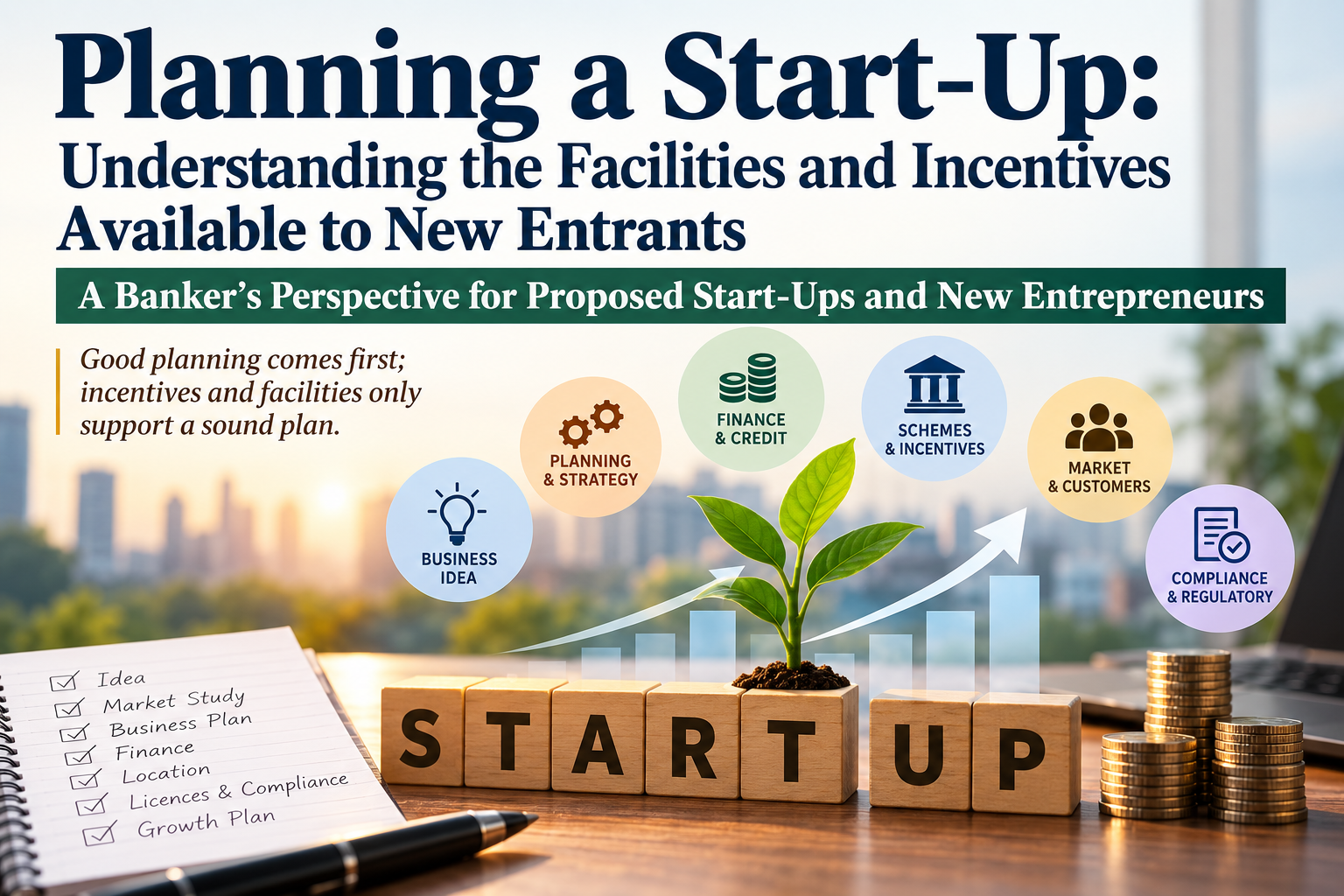
Planning a Start-Up: Understanding the Facilities and Incentives Available to New Entrants
A Banker’s Perspective for Proposed Start-Ups and New Entrepreneurs
Good planning comes first; incentives and facilities only support a sound plan.
Ashok Kakkar, Advocate, Insolvency Professional, Former Banker, M.Com, LLB, LLM, CAIIB
Background
Over the last few years, starting a new business has become an attractive option for many young persons, professionals, retired persons and even working people who wish to build something of their own. Government agencies, banks, financial institutions and industry bodies have introduced various facilities and incentives to encourage new entrepreneurs.
At the same time, many aspiring entrepreneurs are unsure where to begin. Some concentrate only on the concessions available and neglect the basic planning of the business. Others are unaware that useful support exists and do not make use of it. During my years in banking, I have seen both situations: promising ideas that failed for lack of planning, and well-planned ventures that grew steadily because the promoters understood their business, their finances and the support available to them.
Introduction
This article is written for proposed start-ups, interested persons and new entrants. It is not a legal guide or a reference book on government schemes. It does not explain the detailed rules, procedures or eligibility conditions of any scheme, because these are declared by the authorities concerned and may be amended from time to time.
The purpose is to present, in simple language and from a banker’s point of view, how a new business may be planned and what kinds of facilities and incentives are generally available. The reader is encouraged to refer to the latest official guidelines before taking any decision.
Points to Consider
1. Begin With the Idea, Not With the Incentive
Many new entrants begin by asking what concessions or benefits are available. From a banker’s viewpoint, this is the wrong starting point. Incentives can reduce the cost of starting a business, but they cannot create demand, skill or discipline. A sound idea that solves a real problem for identifiable customers must come first. Incentives should be treated as a supporting factor and never as the reason for starting the venture.
2. Decide the Nature of the Product or Service
The nature of the product or service shapes almost every later decision: the investment needed, the skills required, the licences to be obtained, the working capital cycle and the type of finance a bank may consider.
A manufacturing unit needs machinery, raw material and stock. A service business depends mainly on people and receivables. A trading business depends on inventory and credit terms. A technology-based business may have few physical assets but heavy development expenditure. The promoter should therefore be clear whether the product is new or already available in the market, what makes it different, and why a customer would prefer it.
3. Plan the Capacity and the Scale of Operations
Capacity should be planned on realistic demand and not on enthusiasm. Installing a large capacity at the beginning raises fixed costs, interest burden and repayment obligations, while actual sales may take considerable time to build.
A practical approach is to start with a capacity the market can reasonably absorb, with scope for expansion once the business has proved itself. Banks generally prefer a project that reaches its break-even point within a reasonable period and does not depend on running at full capacity from the first year.
4. Choose the Location and Area With Care
Location influences cost, convenience and growth. The promoter may compare the place of installation on practical grounds: nearness to customers and raw material, availability of workers, power, water, transport and connectivity, and the cost and availability of premises.
Different areas and cities may also carry different facilities, and these differ from one State or region to another and from time to time. It is not necessary for every reader to study all of them. The better course is to shortlist the location on business logic first and then enquire from the concerned authorities what facilities are available there on that date.
5. Select the Right Constitution of the Business
The business may be run as a proprietorship, a partnership firm, a limited liability partnership or a company. Each differs in liability, compliance burden, ease of raising funds and continuity.
A small, single-person venture may begin simply, while a venture that plans to raise outside money or grow substantially may need a more structured form. Promoters should also note that some incentives and facilities are available only to certain types of entities, so the choice of constitution can affect eligibility. The decision should be taken after discussion with a Chartered Accountant, Company Secretary or Advocate, and not merely because another entrepreneur has chosen a particular form.
6. The Identity, Background and Track Record of the Promoters
A banker or investor looks at the promoters before looking at the project. Education, experience in the line of business, past dealings, financial discipline, integrity and personal commitment all matter.
A first-time entrepreneur without industry experience can strengthen the proposal by associating with experienced persons, appointing capable managers or taking training before starting. Clean personal credit history, regular tax filings and honest disclosure of existing liabilities build confidence. Where the venture is promoted by a firm or an existing company, the standing and financial position of that entity are also examined.
7. Understand the Sources of Finance
Funds for a new business generally come from a combination of sources. These may include the promoter’s own contribution, loans from banks and financial institutions, support from relatives or friends, outside investors, and in some cases grants or funding linked to government programmes.
Every source has its own cost, conditions and expectations. Promoters should avoid depending on a single source and should not borrow more than the business can service. A sensible mix of own funds and borrowed funds, with a margin for unexpected delays, is usually safer. The promoter’s own contribution is important because it shows commitment and reduces the burden on the business.
8. A General Picture of Incentives and Facilities
Governments at the Central and State levels, along with agencies and institutions, have from time to time offered various forms of support to new businesses. In general, such support may relate to the following areas:
(a) Recognition and registration facilities that give a new business an identity within the start-up or small business framework.
(b) Tax-related benefits or simplifications for eligible entities.
(c) Credit support, such as collateral-free lending or guarantee cover for eligible borrowers through banks and financial institutions.
(d) Interest or capital assistance under specific schemes.
(e) Support for filing of patents, trademarks and other intellectual property.
(f) Easier compliance and self-certification in certain areas.
(g) Incubation, mentoring, training and networking support.
(h) Land, industrial area, power or infrastructure facilities in notified areas.
(i) Opportunities in public procurement and market access.
(j) Specific schemes such as MUDRA, credit guarantee support such as CGTMSE, Startup India/DPIIT-related benefits, and State-specific subsidies or incentives, subject to the applicable eligibility conditions.
This list is only illustrative. Which of these exist, who is eligible, the amount of benefit and the conditions attached are decided by the authorities concerned and may be revised or withdrawn. Readers must therefore refer to the latest official guidelines, notifications and portals before relying on any of them.
9. Eligibility, Conditions and Timing
Incentives are not automatic. They usually depend on the type of entity, its age, size, nature of activity, location and compliance status, and often require an application or approval before or within a stated time.
A common mistake is to start the business, make purchases or commit expenditure and only afterwards discover that a benefit required prior registration or approval. A new entrant should therefore enquire about eligibility and timing at the planning stage itself.
10. Human Resources and Team Building
People make a business work. The promoter should decide at the outset how many persons are needed, with what skills, and at what cost. Early recruitment of too many people adds to fixed costs, while too few can affect quality and delivery.
Even a small business should know who is responsible for operations, accounts, sales and compliance. The business should not depend on one individual alone. Fair terms of employment, proper records and basic training help retain good staff and avoid disputes later.
11. Marketing and Reaching the Customer
A good product does not sell itself. The promoter should identify the target customers, understand why they would buy, decide the price and select the channels through which the product will reach them. These may include direct contact, distributors, retailers, trade associations, exhibitions, a website and social media.
Marketing expenses should be included in the project cost and the working capital estimate. It is also wise to test the market on a small scale before building large capacity, so that real customer response guides further investment.
12. Working Capital and Cash Flow
Many promoters plan carefully for machinery and premises but underestimate working capital. Raw material, wages, rent and other expenses must be paid before customers pay. If customers delay payments, even a profitable business can face a cash shortage.
A realistic estimate of the time between spending money and receiving money should be made. In my experience, inadequate working capital and poor cash flow planning are among the most common reasons why promising ventures struggle in the early years.
13. Registrations, Licences and Compliance
Depending on the activity, the business may require tax registrations, local authority licences, labour-related registrations, environmental clearances, food or product-quality approvals, or permissions for trade across borders. The requirements vary by activity, State and size.
Compliance is a continuing responsibility and not a one-time exercise. Delay in filing returns, payment of dues or renewal of licences can lead to penalties and may also cost the business its eligibility for certain benefits and its standing with the bank.
14. What a Banker Looks For
When a new business approaches a bank, the questions asked are simple. Who are the promoters and what is their experience? Is there a real demand for the product? Is the project cost reasonable? How much are the promoters investing themselves? Will the cash flow be sufficient to repay the loan? What happens if the business does not perform as expected?
The bank will also consider the security available and whether the proposal is eligible for credit guarantee support, such as CGTMSE, wherever applicable.
A proposal supported by a clear project report, realistic projections, proper documents and an honest presentation of risks is far more likely to receive serious consideration. Incentives and guarantee support, where available, may assist in the process, but the bank’s decision will still rest on viability and repayment capacity.
15. Keep Yourself Updated and Take Professional Advice
Because policies and schemes change from time to time, the promoter should make it a habit to check the latest position from official sources, such as the portals and notifications of the concerned Central and State departments, industry and trade bodies, and the nearest bank branch or lead bank office.
Professionals such as Chartered Accountants, Company Secretaries, Advocates and financial consultants can help in choosing the constitution, preparing the project report, understanding eligibility and completing the formalities. Their fees should be seen as a part of the cost of starting the business correctly.
Conclusion
A new business is built on a sound idea, realistic planning, adequate finance, capable people and steady discipline. The facilities and incentives offered by governments and institutions can lower the cost of starting and ease some of the early difficulties, but they cannot replace good business judgement.
The promoter who understands the product, plans capacity and location sensibly, chooses a suitable constitution, arranges the right mix of finance, builds a dependable team and pays attention to marketing and cash flow stands on firm ground. Such a promoter is also better placed to make proper use of the support that is available.
Message to Readers
If you are thinking of starting a business, do not hurry and do not rely on hearsay. First plan the business, then enquire about the support available. Always check the latest official guidelines, because what was available last year may have changed. Keep your own funds in reserve, protect your cash flow, maintain honest records and keep a good relationship with your banker. Seek professional advice where needed, and remember that a business should be started not only to begin but to last.
Disclaimer
This article is intended only for general information and educational purpose and does not constitute legal, financial, tax or professional advice. Government policies, schemes, incentives, facilities and eligibility conditions are declared by the authorities concerned and may be changed, modified or withdrawn from time to time, and may differ by entity, activity and location. Readers should refer to the latest official guidelines and consult qualified professionals before taking any decision based on their own circumstances.