
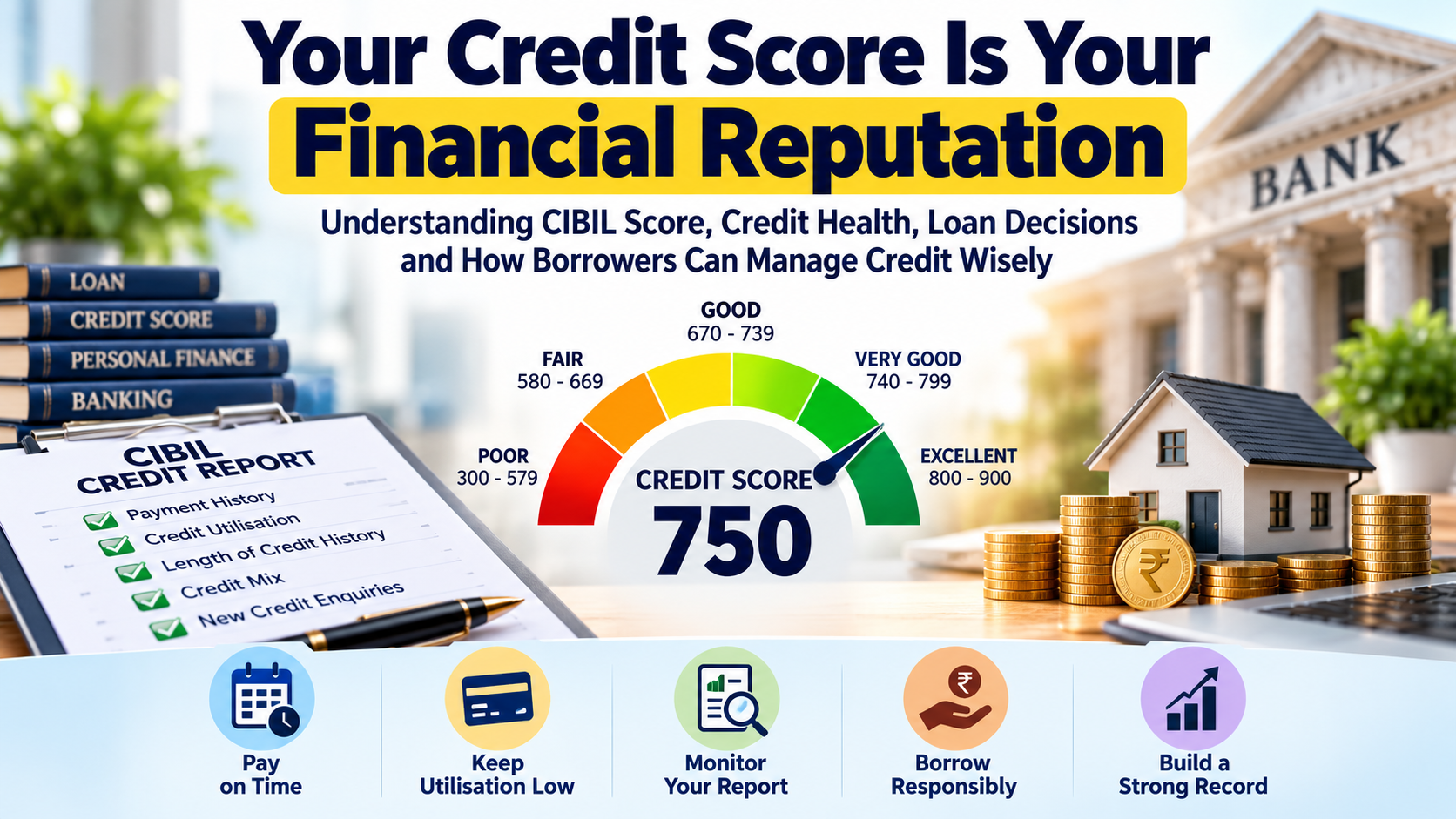
Your Credit Score Is Your Financial Reputation
Understanding CIBIL Score, Credit Health, Loan Decisions and How Borrowers Can Manage Credit Wisely
By Ashok Kakkar
Advocate | Insolvency Professional | Former Banker | M.Com | LL.B | LL.M | CAIIB
Introduction
A credit score is not a judgment on a person’s character. It is a record of financial behaviour.
A person may have a modest income but maintain a strong credit record through disciplined repayment. Another may earn substantially more but face credit difficulties because of delayed payments, excessive borrowing or poor financial management.
In today’s credit-driven economy, a borrower’s credit history has become an important part of the lending process. Before approving a loan or credit facility, a lender wants to understand how the borrower has handled credit in the past and what that history indicates about the proposed borrowing.
Credit information systems help lenders answer this question and also give borrowers an opportunity to build a financial reputation over time. During my more than four decades of experience in banking and subsequent legal and insolvency practice, I have seen how credit behaviour can influence lending decisions, recovery situations and the financial choices available to borrowers.
This article explains the subject in simple language for borrowers, bankers, students, professionals and members of the public.
1. What Is a Credit Information System?
A credit information system collects and maintains information about how individuals and businesses use and repay borrowed money. When a person takes a home loan, vehicle loan, personal loan or credit card, information relating to that borrowing becomes part of the person’s credit history.
The information may include the type of facility, sanctioned amount or credit limit, outstanding amount, repayment history, overdue amounts, account status, credit enquiries and whether the person is an individual borrower, joint borrower or guarantor.
When a person applies for fresh credit, the lender may examine this information through a credit information company. For lenders, this assists in assessing credit risk. For borrowers, it creates a record of financial behaviour that can support future access to credit.
2. CIBIL and Credit Scores
CIBIL is commonly used in India as a general expression for an individual’s credit score, although technically it is associated with one particular credit information company. India has multiple credit information companies, including TransUnion CIBIL, Experian, Equifax and CRIF High Mark.
The credit information system operates within the applicable legal and regulatory framework. Since regulatory requirements and procedures can change, readers should refer to the latest applicable RBI directions, laws and the current procedures of the concerned credit information company.
For the ordinary borrower, the important point is simple: borrowing and repayment behaviour creates a financial record, and that record can influence future lending decisions.
A CIBIL score for an individual is generally expressed on a scale of 300 to 900. A higher score generally indicates a stronger credit history, but no score guarantees approval of every loan. Different lenders have different products, credit policies, risk appetites and internal assessment systems.
As a broad practical understanding, a score around 750 or above is generally viewed positively, while a lower score may result in additional scrutiny or difficulty in obtaining certain forms of unsecured credit. A person with no established credit history should also not confuse ‘No History’ with a poor credit record.
The key point is that the score is an indicator—not the entire credit decision.
3. What Influences Your Credit Score?
Credit information companies do not publicly disclose their complete scoring algorithms. However, certain broad aspects of credit behaviour are commonly associated with credit-score performance.
Payment history
Regular and timely payment of EMIs and credit-card dues helps establish a positive repayment record. Delayed payments, defaults and prolonged overdue accounts can adversely affect the credit profile. Paying every obligation on time remains one of the most important habits for maintaining credit health.
Credit utilisation
Credit utilisation refers mainly to the extent to which available revolving credit, such as a credit-card limit, is being used. Consistently high utilisation may indicate dependence on credit and can affect the credit profile. Credit should be used because there is a genuine requirement, not merely to demonstrate usage.
Length of credit history
A longer and well-managed credit history gives lenders more information about financial behaviour. Therefore, closing an old account is not automatically beneficial. Such decisions should be based on the overall financial circumstances rather than an assumption that closure will improve the score.
Credit mix and new enquiries
A credit profile may contain secured facilities such as home, vehicle or gold loans and loans against eligible securities, as well as unsecured facilities such as personal loans and credit cards. A naturally developed and responsibly managed profile may be viewed positively, but nobody should borrow merely to create a particular credit mix.
Similarly, frequent applications to multiple lenders within a short period can result in several credit enquiries. Borrowers should compare products carefully, but avoid making unnecessary applications. Checking one’s own credit report is different from a lender’s enquiry.
4. What Builds—or Damages—Credit Health?
Good credit is generally the result of ordinary financial discipline rather than sophisticated techniques.
Build your profile
Pay every EMI and card due on time. Use reminders or automatic payment facilities where appropriate and maintain sufficient funds for scheduled payments.
Keep credit-card utilisation under control and avoid borrowing simply because credit is available.
Monitor your credit report periodically, particularly before applying for a major loan. Keep lender records and contact details updated so that important communications reach you.
Common causes of deterioration
Missed or delayed payments, excessive card utilisation, multiple unnecessary credit applications, persistent dependence on minimum card payments, seriously overdue accounts, settlements for less than the contractual liability, incorrect information, unauthorised accounts or enquiries, and failure to monitor obligations as a guarantor or joint borrower can all create difficulties.
Sometimes a problem begins with a surprisingly small amount. A forgotten card charge or unpaid fee may eventually appear as an overdue entry. The lesson is simple: do not ignore small dues merely because the amount is small.
5. Settlement, Write-Off and Guarantee: Areas of Caution
A borrower facing financial difficulty may negotiate with a lender to pay less than the total outstanding liability. An account reported as ‘Settled’ is not the same as an account reported as ‘Closed’ after full repayment. A borrower should therefore understand the possible long-term credit implications before agreeing to a settlement.
A write-off is an accounting or recovery-related action by the lender. It does not necessarily mean that the borrower’s liability has disappeared and should not automatically be understood as forgiveness of the debt.
Becoming a guarantor is also a serious financial responsibility. A person may never have personally used the borrowed money, yet a guaranteed facility can affect the guarantor’s financial and credit position. Before giving a guarantee, understand the amount guaranteed, the nature of the facility, the borrower’s repayment capacity, the extent of your own liability and the consequences of default.
A guarantee should never be treated as merely a formality.
6. How Banks Use Credit Information
A bank does not normally decide a loan solely by looking at the credit score. A typical assessment may include the loan application and KYC, credit-information review, income and repayment capacity, existing liabilities, security where applicable, banking conduct and the lender’s internal credit assessment.
For some small retail products, much of the process may be automated. For larger home, business or corporate loans, the assessment can be considerably more detailed.
Income, cash flow, existing debt, employment or business stability, age and repayment period, banking conduct, nature of business, security offered and the overall financial position may all be relevant.
A good credit score can strengthen a loan application, but it cannot substitute for repayment capacity.
7. Read Your Credit Report—Not Just Your Score
Many borrowers look only at the three-digit score. That is not enough. A credit report should be examined for personal information, existing and closed accounts, outstanding and overdue amounts, repayment history, account and ownership status, credit enquiries and accounts that the borrower does not recognise.
Particular attention should be given to accounts never opened, loans already closed but still shown as active, incorrect repayment entries, duplicate accounts and enquiries that were not authorised.
If an error is found, identify exactly what is wrong and collect supporting documents such as loan-closure documents, bank statements, payment records, identity documents and relevant correspondence.
The matter can then be raised through the appropriate dispute or grievance mechanism of the concerned credit information company and/or lender. Procedures and timelines may change, so readers should follow the current process prescribed by the concerned company, lender and applicable regulatory framework.
Keep copies of complaints, documents, emails, reference numbers and responses. Good documentation can make resolution easier.
8. Building or Recovering Credit
A person who has never borrowed may have little or no credit history. That is not the same as having a bad credit record. A new borrower should borrow cautiously, use credit only when genuinely required, keep utilisation under control, pay on time, avoid multiple applications and build history gradually.
A low score also does not mean that improvement is impossible. The first step is to understand the reason for the low score. A practical approach is to stop unnecessary borrowing, obtain and examine the credit report, correct genuine errors, clear genuine overdue amounts where financially possible, reduce excessive utilisation and maintain consistent payment discipline.
Recovery takes time. There is no legitimate service that can simply erase accurate negative credit history for a fee.
A low score may make unsecured borrowing more difficult, but depending on circumstances a borrower may consider suitable secured facilities or other regulated sources of finance. The first question should always be: ‘Can I realistically repay this borrowing?’
Borrowers should be extremely cautious about promises of guaranteed loans, instant approval irrespective of credit history, guaranteed removal of negative entries or credit-score repair for large upfront fees. Always verify the lender and terms through reliable official sources.
9. Common Myths About Credit Scores
Checking your own credit report is different from a lender’s enquiry.
A high income does not automatically produce a high credit score; credit behaviour matters.
Closing an old credit card does not automatically improve a score.
No legitimate agent can simply erase accurate negative credit history for a fee.
No credit history is not the same as an excellent credit history.
CIBIL does not alone decide whether a loan will be sanctioned; lenders consider several factors.
A family member’s poor credit score does not automatically become yours, although joint borrowing and guarantees create shared financial exposure.
Payment of an overdue amount may not result in an immediate visible change because information is updated through reporting processes.
10. Ten Practical Rules for Better Credit Health
- Never ignore a due date.
- Borrow only when there is a genuine need.
- Keep credit-card utilisation under control.
- Avoid unnecessary applications to multiple lenders.
- Monitor your credit report periodically.
- Investigate unfamiliar accounts or enquiries promptly.
- Think carefully before becoming a guarantor.
- Understand the consequences before accepting a settlement.
- Keep proper records of loan closures and important communications.
- Remember that credit health is a long-term habit, not a short-term exercise.
Conclusion
The development of credit information systems has changed the relationship between lenders and borrowers. Banks can examine a wider record of credit behaviour and combine that information with their own assessment of income, repayment capacity, security and overall risk.
For borrowers, this creates both a responsibility and an opportunity. The responsibility is to manage credit carefully. The opportunity is that responsible financial behaviour can create a credit reputation that supports future borrowing.
Do not wait for a loan rejection to discover your credit position. Check your credit report. Understand your existing obligations. Correct genuine errors. Pay on time. Avoid unnecessary borrowing. And think carefully before becoming responsible for someone else’s debt.
Your credit score is not a verdict on your worth. It is a record of financial behaviour—and every month gives you another opportunity to write that record more carefully.
A Note for Readers
This article is intended to create awareness about credit information, credit scores and practical credit-management habits. It is intended for borrowers, bankers, students, professionals and members of the public who want to understand the subject before making important financial decisions.
For any specific matter, readers should refer to the latest applicable laws, RBI directions, official information issued by the concerned credit information company and the lender’s current policies and procedures.
Disclaimer
This article is intended for general awareness and educational purposes only. It does not constitute legal, financial, credit, banking or regulatory advice. Credit-scoring methods, reporting procedures, RBI directions and lender policies may change from time to time. Readers should refer to the latest applicable rules and official sources before taking any specific action. The views expressed are the author’s personal views based on professional experience.
Key Words. #Credit Score #CIBIL Score #Credit Health #Credit Report #Loan Sanction #Banking #Personal Finance #Financial Discipline #Credit Management #Borrower Awareness #Banking Wisdom #Banking Education #CIBIL #Loan Management