
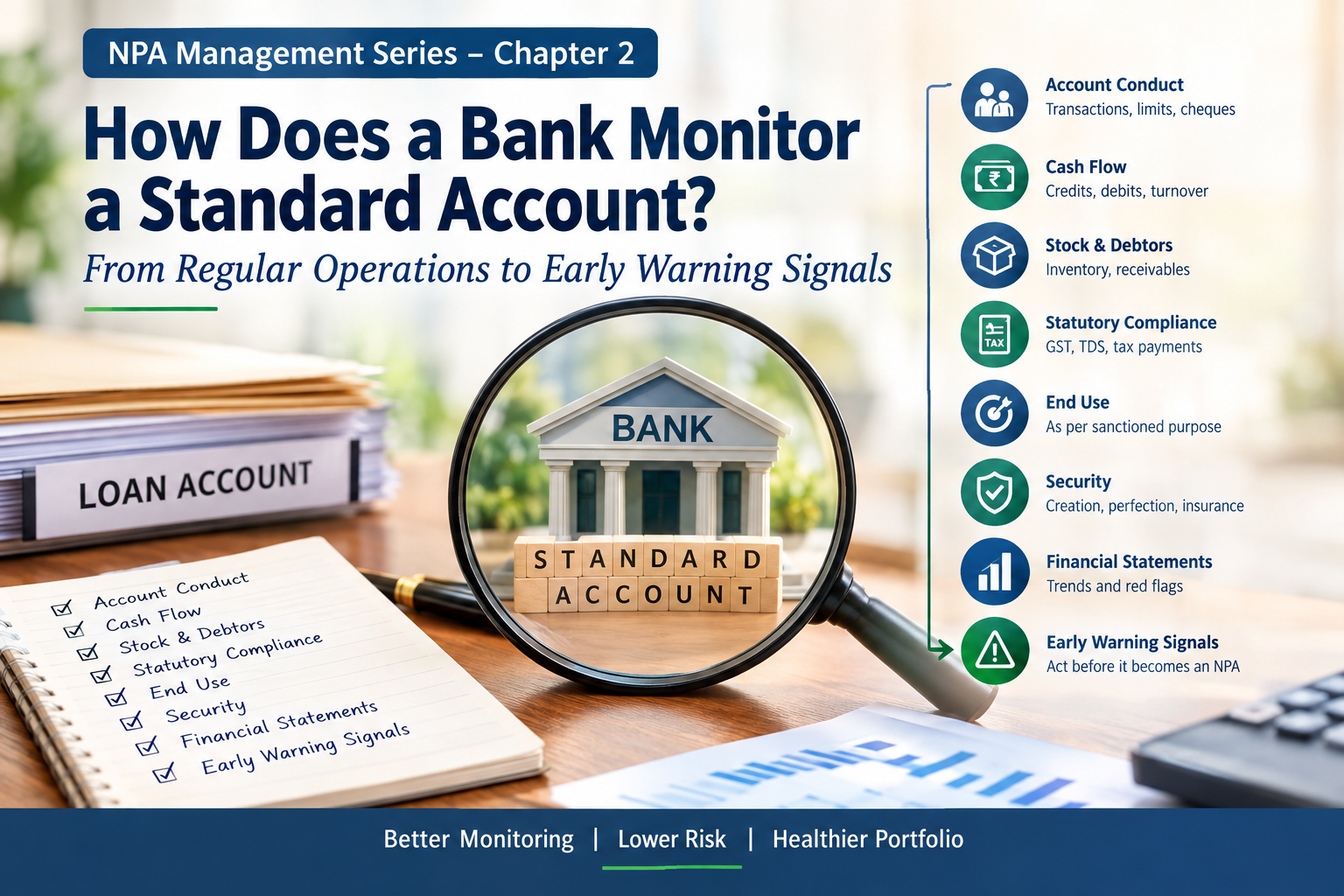
How Does a Bank Monitor a Standard Account?
From Regular Operations to Early Warning Signals
NPA Management in Banking: Chapter 2
A sanctioned loan is the beginning of the banker’s responsibility, not the end of it.
Ashok Kakkar
Advocate, Insolvency Professional, Former Banker, M.Com, LLB, LLM, CAIIB
Background
In Chapter 1, we looked at an advance through the eyes of a bank auditor and what he really looks for when he opens a loan file. This chapter moves one step further. Once the loan is sanctioned and the funds are released, the question is no longer how the proposal was appraised, but how the account is watched day after day.
When a borrower repays on time and the account operates smoothly, it is called a standard account. Many people assume the bank has little to do with such an account beyond collecting instalments and renewing limits every year. In practice, the opposite is true. The best time to protect a loan is while it is still performing.
Over my years in banking, I have seen that very few NPAs turned bad overnight. The warning signs were usually visible months earlier: in the way the account was operated, in the stock statements, in the borrower’s statutory payments, or in the borrower’s own conversation. What differed from case to case was whether someone noticed and acted in time.
NPA prevention does not begin when an account becomes irregular. It begins while the account is still Standard.
1. A Standard Account Is Not Necessarily a Healthy Account
A standard account is one in which the borrower services interest and instalments regularly, operates within the sanctioned limits, complies with the terms of sanction, and shows no apparent weakness in the business. It is a performing asset in the books of the bank.
But being standard does not mean being risk-free or healthy. It only means that the risk has not yet shown itself. Every account that later became non-performing was standard at some point.
An account may carry weaknesses that are not visible to the naked eye. Interest may be paid on the due date, yet the money may be coming from fresh borrowing, from another account or from a family member. Regular payment is therefore a necessary sign of health but never a sufficient one. A banker must study the account from different angles and at different times, because an account does not go straight from Standard to NPA. It passes through stages of stress, and each stage leaves traces. The later chapters of this series follow that journey. This chapter deals with the stage before it begins.
2. Why Monitoring Matters
A bank lends public money. Depositors have entrusted their savings to the bank, and the bank is answerable for how that money is deployed and recovered. A loan that is sanctioned and then forgotten can drift into trouble without anyone realising it.
Monitoring protects the depositors’ funds by detecting weakness early. It protects the bank’s balance sheet by limiting the need for provisioning and write-offs. And it often protects the borrower too, because a bank that notices stress early can help with a timely solution, whereas one that notices late has fewer options and less goodwill. The objective is not merely to detect default. It is to detect deterioration early enough to prevent default.
3. Monitoring Begins at Sanction
Monitoring does not start after the first problem. It begins at the time of sanction. The sanction letter lays down the limit, purpose, margin, rate of interest, repayment schedule, security and conditions. These terms become the baseline against which the account is measured throughout its life.
Before the first disbursement, the bank ensures that documents are properly executed and stamped, that charges on the securities are created and registered, that guarantees are in place, that the required insurance is taken, and that pre-disbursement conditions are met. A loan released with incomplete documentation or unclear conditions is difficult to monitor, however diligent the branch may be later. Weak documentation at the start often becomes a weak position in recovery at the end.
4. Conduct of the Account: The First Signal
The bank account often tells its story before the financial statements do. Branch officials watch whether the account stays within the sanctioned limit and drawing power, how often the limit is fully used, whether credits are in line with the declared turnover, whether cheques are returned, and whether the pattern of transactions has suddenly changed.
An account that sits continuously at the top of the limit, or shows frequent small overdrawings, may be telling the bank that the borrower is short of funds. A sharp fall in credits while debits continue unchanged suggests that either sales have dropped or business is being routed through another bank.
Frequent requests for temporary accommodation need particular attention. A genuine, one-time need can be met, and even an enhancement may be justified. But repeated requests usually point to a financial crunch, and the banker must find out whether the reason is a real business need or something else.
It is also not enough to see that transactions are happening. The nature of the transactions matters more. What kinds of transactions are rotating in the account? Where did the borrower’s margin contribution come from? Where did the bank’s funds go after disbursement? Are there transfers between related, group or family accounts? Cash withdrawals from a cash credit account should be watched closely, and their utilisation understood and recorded.
In my experience, the account statement is often the most honest report on the health of a business. Balance sheets are prepared after the year ends, and stock statements are prepared by the borrower, but the conduct of the account is a real-time record that is difficult to dress up.
5. Interest Servicing, Turnover and Cash Flow
Regular servicing of interest and instalments is the clearest sign of a healthy account, and banks track due dates carefully. A single delay may have an innocent explanation. A pattern of delay calls for a conversation, while the answer is still a matter of cash flow and not yet a matter of recovery.
Equally important is the source of the payment. Where interest is being serviced through fresh borrowings or temporary limits, the account remains technically regular, but the regularity is not supported by cash generated in the business.
Turnover should be compared with what was projected at sanction. If a business projected sales of ₹10 crore and consistently achieves much less, the shortfall must be understood. It may be temporary, or it may mean loss of customers, rising competition, falling demand or business being diverted to another entity.
Profit and cash are not the same. A business may report profits and still be unable to meet its obligations because its money is locked in receivables, inventory or other ventures. The banker should ask whether the business generates enough cash for its expenses, interest and instalments. A standard account can be technically regular but economically stressed, and that distinction is at the heart of good monitoring.
6. Stock, Book Debts and Drawing Power: Verify, Do Not Merely Receive
In working capital accounts, the drawing power depends on stock and book debts. A banker who merely receives the statement and files it has not monitored anything. An inflated statement means an inflated drawing power, and the bank ends up lending against security that may not exist in the stated value.
Stock should be verified physically, and its ownership established from the books of account and purchase records. The banker should see whether the stock is saleable, perishable and moving. Old and obsolete stock should be separated, and neither accepted as security nor allowed to support drawing power.
The paid stock concept matters. Where goods are bought on credit, the amount due to creditors should be deducted from the stock value, and unpaid stock should not support drawing power. Otherwise the bank may be financing the supplier’s money and not the borrower’s own.
Book debts need the same care. Their age and periodicity must follow the terms of sanction and be verified from the books, and random entries in the debtors’ accounts can be checked. A rise in stock while sales are falling may indicate unsold goods, and rising receivables may indicate difficulty in collection. The quality and convertibility of an asset matter more than its reported value.
7. Inspections and Site Visits
Statements on paper must be backed by verification on the ground. Branch officials visit the borrower’s premises periodically, and larger accounts also go through external stock audits by independent professionals.
During a visit, the bank confirms that the stock is available and properly stored, that machinery is installed and working, that the unit operates at a reasonable level of activity, and that charged assets have not been sold, shifted or encumbered elsewhere. A visit is also a chance to meet the borrower and sense whether the business is growing, steady or under strain.
A visit report should be more than a formality. A careful note on what was seen, what was not seen and what was explained is a valuable record. Sometimes the difference between a healthy account and a warning signal can be seen rather than calculated.
8. End-Use of Funds: Following the Money
Whether the bank’s money is used for the sanctioned purpose is one of the basic questions of monitoring. Visiting the site and seeing the asset is not enough.
A careful banker also verifies ownership and cost through the borrower’s books of account, and compares the invoices and payments with the quotation and the supplier selected at the time of sanction. Any variation should be examined and put on record, in the interest of the safety of the bank’s finance.
For term loans, the bank also watches whether the project is progressing as planned, whether the promoter is bringing in his own contribution on time, and whether cost or time overruns are developing. Once the unit starts operating, projected and actual production and sales are compared.
Diversion is a particular risk where there are group concerns or related-party dealings. Funds sanctioned for business may move to unrelated investments, personal assets, another entity’s liabilities or group companies. This is why transaction patterns, financial statements and supporting documents must be looked at together.
9. Security and Insurance
Security that existed at sanction must remain effective. The banker should confirm that charges and mortgages are properly created and registered, including registration of charges with the Registrar of Companies where applicable, that title and security documents are in safe custody, that guarantees remain valid, that no further charge has been created without permission, and that the value of the security is still adequate.
The important distinction is between security that exists on paper and security that remains enforceable and sufficient.
Insurance deserves the same attention. It is sometimes treated as routine, but it is not. The banker should check its validity, adequacy, correct description of assets, the bank’s interest clause and timely renewal. An uninsured loss can turn a sound account into a doubtful one in a single night. Security is a protection against credit risk, not a substitute for monitoring the borrower.
10. Cross-Checking With Independent Sources
A prudent banker does not rely on the borrower’s word alone. Turnover shown to the bank is compared with the turnover reported for tax purposes, the bank statements and the financial results. Purchases and sales are compared for consistency.
Where sources tell different stories, the difference must be understood and explained. The borrower’s credit information report, which shows dealings with other lenders, can also reveal stress not visible in the bank’s own books: delays with other banks, new borrowings or a fall in credit score.
11. Financial Statements: Stronger or Weaker?
Financial statements are to be examined, not merely collected. They should be compared with the projections made at sanction, with the quarterly information received from the borrower, and with the previous year’s figures. Wherever there is a variance, the reason should be sought, recorded and carried into the next renewal or enhancement proposal. Ratio analysis supports this exercise.
The direction of movement matters as much as any single figure. A business whose annual profit goes from ₹1 crore to ₹80 lakh, ₹50 lakh and ₹20 lakh presents a very different picture from one that goes from ₹20 lakh to ₹40 lakh, ₹65 lakh and ₹90 lakh. A fall in sales alone may not indicate stress. But falling sales, rising receivables, thinning margins and growing borrowing together deserve a closer look.
The real question is not “Have we obtained the financial statements?” but “What did we understand from them, and what did we do about it?”
12. Sanction Terms and Statutory Compliance
Sanction terms are not meant to become irrelevant after disbursement. The first step is to get the terms accepted. After that, each term should be examined for compliance. These may include creation of security, documentation, submission of stock and book debt statements, financial statements, audit and tax audit reports, financial ratios, promoter contribution, restrictions on further borrowing and maintenance of margins.
Statutory compliance belongs here too. The banker should see that returns are filed on time, whether for income tax, GST or, where applicable, FEMA reporting, and that registrations and licences are valid, including pollution control and other clearances. A borrower who is irregular with statutory obligations is often irregular with much else.
A deviation should not be filed away. The banker should understand why it occurred, whether it is temporary or structural, and what corrective action is needed.
13. Renewal and Review: A Fresh Assessment
Every limit is sanctioned for a defined period and reviewed, generally once a year. The review should give the sanctioning authority a true status report, so that it can decide whether to continue, reduce, curtail, withdraw or enhance the limits.
For this, the review should be done like the appraisal of a new account: updated financials, current compliance, a comparison of actual and projected figures, and a fresh assessment of drawing power, security, documents (including limitation) and repayment capacity. The question to answer is whether the basis on which the bank originally sanctioned the credit remains valid. A review done mechanically, merely to extend the limit, defeats its purpose. It should be a fresh credit assessment based on current facts, not a repetition of the previous year’s proposal.
Banks also assign an internal credit rating to each borrower and revise it periodically. A downward movement in the rating is an important signal and often leads to closer attention or a reassessment of the exposure.
14. Monitoring of Deviations: Small Exceptions, Big Problems
Credit deterioration rarely announces itself in one dramatic event. More often, several small changes appear over time: turnover begins to decline, receivables rise, stock remains unsold, margins reduce, cheques come back, interest servicing becomes irregular, temporary limits are requested again and again, statements are delayed, and borrowing increases.
Each of these may look manageable alone. Together they may point to a deteriorating account. Patterns are more important than isolated events. The banker should look for changes, not only for defaults. Earlier, turnover was regular; now credits are declining. Earlier, receivables were within normal limits; now their ageing is increasing. The account may still be Standard, but its risk profile has already changed.
Not every deviation means that the account will turn into an NPA, but every material unexplained deviation deserves attention. A temporary deviation should be understood and regularised. A repeated deviation calls for investigation of the underlying reason. A persistent deviation means the credit risk must be reassessed. An unexplained or serious deviation should be escalated, with corrective measures taken.
15. From Monitoring to Early Warning
Alongside these routines, banks watch for early warning signals, the small changes that show stress before an account actually defaults. A sudden fall in sales, delay in statutory dues, diversion of funds, frequent requests for additional limits, non-submission of statements and unexplained changes in management are familiar examples.
An early warning signal is not an NPA, and it is not a verdict on the borrower. The purpose of monitoring is to identify deterioration before the account reaches the stage of NPA. Under the regulatory framework, accounts showing early stress are placed in progressively more serious categories of special mention (SMA-0, SMA-1 and SMA-2), depending on how long payments remain overdue. This gives the bank a structured opportunity to intervene while revival is still realistic.
When a signal appears, the bank should obtain the borrower’s explanation, verify the facts rather than merely record the explanation, intensify monitoring, inspect where warranted, review the drawing power and security, examine end-use again, assess whether the business is still viable, and escalate to the appropriate authority. Warning signals and SMA stages deserve fuller treatment, and we shall take them up in the next chapters.
16. Independent Checks and the Role of the Controlling Office
Apart from the branch’s own supervision, banks maintain independent layers of checking. Credit audit examines whether the sanction process, documentation, compliance and post-sanction follow-up have been properly carried out, particularly for larger accounts. Concurrent audit, conducted on an ongoing basis at larger branches, looks at day-to-day transactions and compliance. Periodic inspection and statutory audit add further layers. A branch working closely with a borrower may overlook what a fresh pair of eyes will notice, and a pattern of repeated audit observations on the same account should itself be treated as a warning.
Monitoring is a shared responsibility. The branch, being closest to the borrower, is the first line of defence. The controlling office receives periodic reports, reviews larger accounts and supports the branch with guidance and decisions beyond its powers. The system depends on honest reporting. If a branch hides stress to avoid its consequences, or the controlling office does not insist on timely and accurate returns, the system loses its purpose. Experience shows that accounts rarely recover when bad news travels slowly.
17. The Auditor’s Lens and the Importance of Documentation
This is where Chapter 2 connects with Chapter 1. An auditor is not satisfied with the answers “the account is Standard” or “the annual review has been completed.” He is more likely to say: “You have classified the account as Standard. Show me what you have done to establish that it is actually being conducted satisfactorily.”
He will ask what the turnover and cash flow were, whether stock statements were submitted and critically examined, what the ageing of receivables showed, whether sanction conditions were complied with, whether site visits were made and what they revealed, whether end-use was verified, whether insurance and security were adequate, what warning signals were noticed, and what action followed. He looks for evidence of monitoring, not merely the existence of a monitoring policy.
That is why documentation is the forgotten part of monitoring. A good file holds review notes, inspection reports, stock and financial statements, account analysis, correspondence with the borrower, follow-up on irregularities and evidence of corrective action. Many accounts that later turned bad were not unmonitored. They were monitored without being recorded, so no one could show what had been noticed and what had been done.
18. A Practical Illustration
Consider an imaginary trading firm with a cash credit limit. For three years the interest was paid on the due date and the account stayed Standard.
In the first year, turnover through the account fell by about a fifth, and the branch put it down to seasonality. In the second year, the firm began asking for a temporary excess every quarter, and each was granted. Stock statements started arriving late, and the stock reported was higher even though sales had dropped. Debtors grew older, and a few large ones were related concerns. Cheques began to bounce now and then. A sum was moved to a family account and returned just before the interest date. Tax returns were filed late.
No single event was alarming, and the account stayed regular. Yet the story was clear to anyone who put the events together. Turnover was falling. The bank’s money was financing the business. Stock and debtors were not converting into cash. The borrower was finding ways to look regular.
Had the branch checked the stock physically, verified the debtors, noted the family-account transfers and acted on the second request for excess, it could have reduced the drawing power, discussed the position with the borrower and escalated early. When the account finally slipped, every auditor asked the same question: what did you do when the first signals appeared?
19. Five Practical Questions a Banker Should Ask
A banker does not need hundreds of indicators to understand an account. Five practical questions are a useful starting point:
- Is the business operating as expected?
- Is money actually flowing through the bank account?
- Is the business generating enough cash to service the debt?
- Are stock, receivables and securities supporting the exposure?
- What has changed since the original sanction?
If the answers remain satisfactory, the account is likely to remain healthy. If they begin to change, the banker should investigate before the problem becomes a default.
20. The Borrower’s Part in Monitoring
Monitoring is often seen as something the bank does to the borrower. A healthier view is that it is something the bank and the borrower do together. A borrower who submits statements on time, shares information openly, tells the bank of significant developments and approaches the banker early when difficulty arises will usually find the bank willing to help.
A borrower who becomes unreachable, delays submissions or gives repeated vague explanations makes the banker’s job harder and the outcome worse for both. Trust, built through regular and honest communication, is the strongest monitoring tool there is.
Conclusion
Monitoring a standard account is not one activity but a chain of activities: the conduct of the account, the servicing of dues, the verification of stock and security, the periodic review, the rating and the audit. Each link supports the others. If one link is weak, the chain may still hold for a while, but the risk grows quietly.
Good monitoring connects many pieces of information: account conduct, turnover, cash flow, stock, receivables, financial statements, end-use, security and business conditions. No single indicator tells the whole story. The real skill lies in connecting the signals and understanding the direction in which the account is moving.
The purpose of all this is not to suspect the borrower. It is to protect the depositors’ money entrusted to the bank, and to help a good borrower while help can still make a difference. A Standard account should never be treated as a “no problem” account merely because repayments are currently regular. Credit monitoring is not about finding a problem after it becomes a default. It is about recognising the problem while there is still time to do something about it.
And that is why NPA prevention begins while the account is still Standard.
Message to Readers
For borrowers: be regular with your statements, honest in your communication, and early in approaching your banker when trouble begins. A borrower who speaks up early is far easier to help than one who goes silent.
For bankers and students of banking: monitoring is a discipline of attention. The numbers matter, but so does the habit of asking why they look the way they do.
For professionals who advise borrowers or lenders: understanding how monitoring works will help you read an account’s story before it becomes a dispute.
Coming Next
Chapter 3: Early Warning Signals: What Tells a Banker That an Account Is Beginning to Deteriorate? In the next chapter, we will examine the practical warning signs that may appear in an otherwise Standard account, and how a banker can tell a temporary difficulty from genuine credit deterioration.
Disclaimer: This article is based on the author’s practical banking experience and is meant for general educational and awareness purposes only. It is not legal, financial or professional advice. Practices vary from bank to bank, and regulatory requirements change from time to time. Readers are advised to refer to the current RBI master circulars and directions, and to consult a qualified professional for specific situations.
Keywords: Bank Credit Monitoring, Standard Account Monitoring, NPA Management, Early Warning Signals, Credit Risk Management, Loan Monitoring, Working Capital Monitoring, Bank Loan Management, SMA Accounts, Banking Practices