
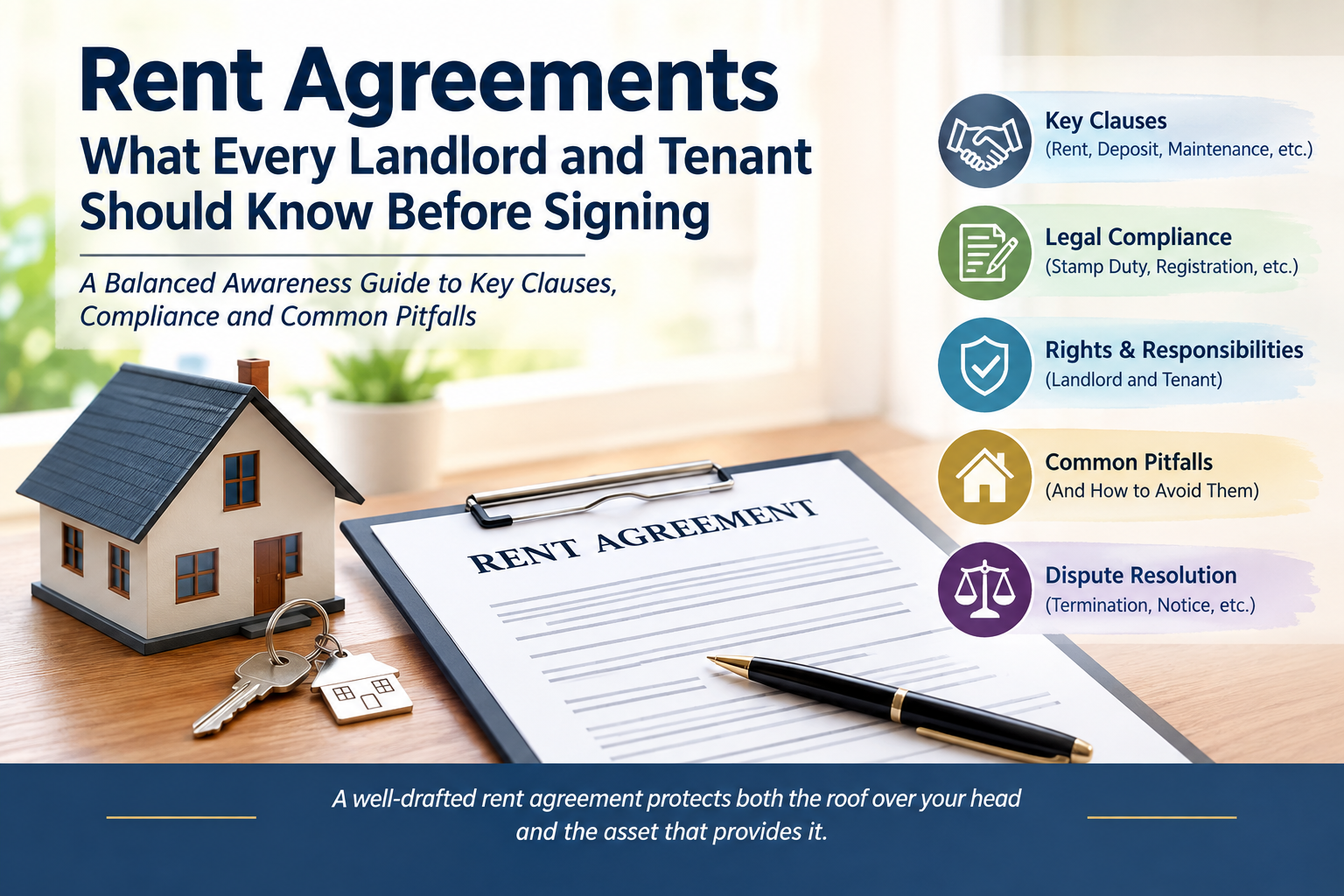
Rent Agreements: What Every Landlord and Tenant Should Know Before Signing
A Balanced Awareness Guide to Key Clauses, Compliance, and Common Pitfalls
“A rent agreement is not a formality signed in haste — it is a bilateral contract that should protect both the roof over one’s head and the asset that provides it.”
Ashok Kakkar, Advocate, Insolvency Professional, Former Banker, M.Com, LL.B., LL.M. and CAIIB
Background
Renting a home or commercial premises is one of the most common legal transactions entered into by individuals and businesses. Yet it is often treated as a routine formality. Landlords keen to let out a property and tenants anxious to secure suitable premises may sign a standard-format agreement without examining its clauses carefully. A rent or leave-and-licence arrangement creates contractual rights and obligations, and the precise legal position depends on the nature of the arrangement and the law applicable to the property.
In practice, disputes often arise not from the headline terms of rent and tenure, but from matters left vague or unrecorded — such as the timing of security-deposit refund, responsibility for repairs, early exit during a lock-in period, or the condition of the premises at handover. A carefully drafted and understood agreement can reduce such misunderstandings. This article sets out practical points for general awareness before a rent agreement is executed.
1. Verify Identity, Title and Authority
Before signing, the tenant should satisfy themselves that the person executing the agreement is the owner or is otherwise duly authorised to let out the property. Where an agent or attorney acts for the owner, appropriate authority should be checked. The landlord should also verify the tenant’s identity and, where relevant, complete any tenant-verification or registration formalities applicable locally.
2. Put Material Terms in Writing
Important terms should be clearly recorded in the agreement rather than left to oral assurances. These include rent, security deposit, maintenance responsibilities, lock-in period, notice period, permitted use, renewal, utilities and consequences of default.
3. Security Deposit: Amount, Refund and Deductions
The agreement should clearly state the amount of the security deposit and the period within which the balance is to be refunded after the tenant vacates and settles legitimate dues. It should also specify permissible deductions, such as unpaid rent, outstanding utility charges attributable to the tenant, or documented costs of repairing damage beyond normal wear and tear. The agreed contractual terms should be clear rather than relying on informal understanding.
4. Rent, Escalation and Mode of Payment
The agreement should state the rent, due date and responsibility for maintenance, parking and other charges. If rent escalation is agreed for renewal or a continuing period, the method or rate should be expressly stated. Payments should preferably be made through traceable banking channels such as NEFT, RTGS or UPI, with appropriate records retained by both parties.
5. Lock-in Period and Exit Exceptions
A lock-in period may be agreed by the parties, but the agreement should clearly state its duration and consequences of early termination. Where appropriate, it may also provide for exceptions arising from specified circumstances, such as relocation or a serious unresolved defect in the premises, together with the applicable notice requirements.
6. Notice Period for Termination
The agreement should specify the notice period and the permitted method of serving notice. Depending on the arrangement, notice may be provided by an agreed written or electronic mode, subject to the terms of the agreement and applicable law.
7. Division of Maintenance and Repair Responsibility
The agreement should distinguish between structural or major repairs and routine day-to-day maintenance. Responsibilities should be stated clearly so that matters such as seepage, concealed electrical or plumbing defects, appliance repairs and minor upkeep do not become sources of dispute.
8. Joint Inspection, Inventory and Condition Record
Before possession is handed over, both parties should consider conducting a joint inspection and recording the condition of the premises, fixtures, fittings and appliances. A signed inventory or condition schedule, supported where appropriate by dated photographs or videos shared with both parties, can provide useful evidence regarding the condition at the beginning of the tenancy.
9. Utility Meter Readings and Society Charges
Electricity, water, piped gas and other relevant meter readings should preferably be recorded at handover and again when the premises are vacated. The agreement should also clarify responsibility for society maintenance, amenity charges and other recurring expenses.
10. Stamp Duty and Registration
Rent agreements are subject to stamp-duty requirements under the applicable law of the relevant State or Union Territory. Registration requirements also depend on the nature and duration of the arrangement and the applicable law. In particular, leases from year to year, for a term exceeding one year, or reserving a yearly rent are generally subject to compulsory registration under the Registration Act, subject to the applicable legal framework. Parties should verify the prevailing stamp duty, registration requirements and local tenancy provisions before execution.
11. Restrictions on Subletting and Permitted Use
The agreement should clearly state whether subletting, assignment or sharing of the premises is permitted. It should also specify the permitted use — residential, commercial or otherwise — and the consequences of a material breach, subject to applicable law.
12. Tax Considerations: HRA and TDS on Rent
For salaried employees, House Rent Allowance (HRA) exemption may be available subject to the applicable conditions under the old tax regime; the exemption is not available under the new tax regime. Supporting documents such as rent receipts and the rent agreement may be relevant where the exemption is claimed. Separately, tenants paying rent above the applicable threshold may have TDS obligations. Since the tax framework and prescribed forms have changed from 1 April 2026 under the Income-tax Act, 2025, readers should verify the current threshold, rate, provision and prescribed form with the Income Tax Department before acting.
13. Termination, Default and Recovery of Possession
The agreement should clearly specify circumstances that may constitute default, such as persistent non-payment of rent, unauthorised subletting or other material breach. Where appropriate, it may provide for notice and an opportunity to remedy a remediable default. Termination of an agreement does not by itself authorise forcible recovery of possession. The procedure for obtaining possession depends on the nature of the tenancy, the contractual terms and the applicable State tenancy, rent-control or other law.
14. Dispute Resolution Mechanism
The parties may consider providing an appropriate mechanism for resolving disputes, such as negotiation, mediation, arbitration or recourse to the competent court, as legally permissible. The suitability and enforceability of an arbitration clause may depend on the nature of the tenancy and the applicable law. Any agreed mechanism should be drafted clearly, including relevant jurisdictional details where appropriate.
15. Budgeting for the Move
Tenants should consider the overall cost of taking possession, including the security deposit, brokerage where applicable, shifting expenses and initial setup costs. Landlords should also factor in possible vacancy periods, routine maintenance and costs associated with preparing the premises for a new occupant. Clear financial planning can reduce avoidable disagreements.
Conclusion
A rent agreement, properly understood and negotiated, is intended to record the rights and responsibilities of both landlord and tenant. The landlord’s interests may include timely payment of rent, protection of the property and a clear contractual process for dealing with default. The tenant’s interests may include proper use and enjoyment of the premises, clarity regarding repairs and charges, and timely settlement of the security deposit at the end of the arrangement.
Many disputes can be reduced by taking simple precautions at the beginning: verify the parties and authority, record material terms, document the condition of the premises, maintain payment records, clarify maintenance and utility responsibilities, and understand the applicable legal requirements before signing.
Message to Readers
A rent agreement should not be signed merely because it is a standard form. Both landlord and tenant should read the document carefully, understand the important clauses and ensure that the written terms reflect their actual understanding. Where the arrangement involves significant value, unusual terms or legal uncertainty, professional advice before signing can help avoid disputes later.
Disclaimer
This article is intended only for general awareness and educational purposes and does not constitute legal, financial or tax advice. Rent and tenancy requirements vary with the nature and location of the property and applicable law, and may change from time to time. Readers should verify the current legal position and obtain appropriate professional advice before acting on any matter discussed in this article.
About the Author
Ashok Kakkar is an Advocate, Insolvency Professional and Banking Consultant, with professional experience in banking, credit management, recovery, insolvency and legal matters. He writes on practical aspects of banking, finance, insolvency and law for general awareness and knowledge sharing.
#Rent Agreement, #Rental Agreement India ,#Landlord and Tenant Rights, #Tenant Rights in India ,#Landlord Rights ,#Rent Agreement Clauses,# Stamp Duty and Registration,# Security Deposit,