
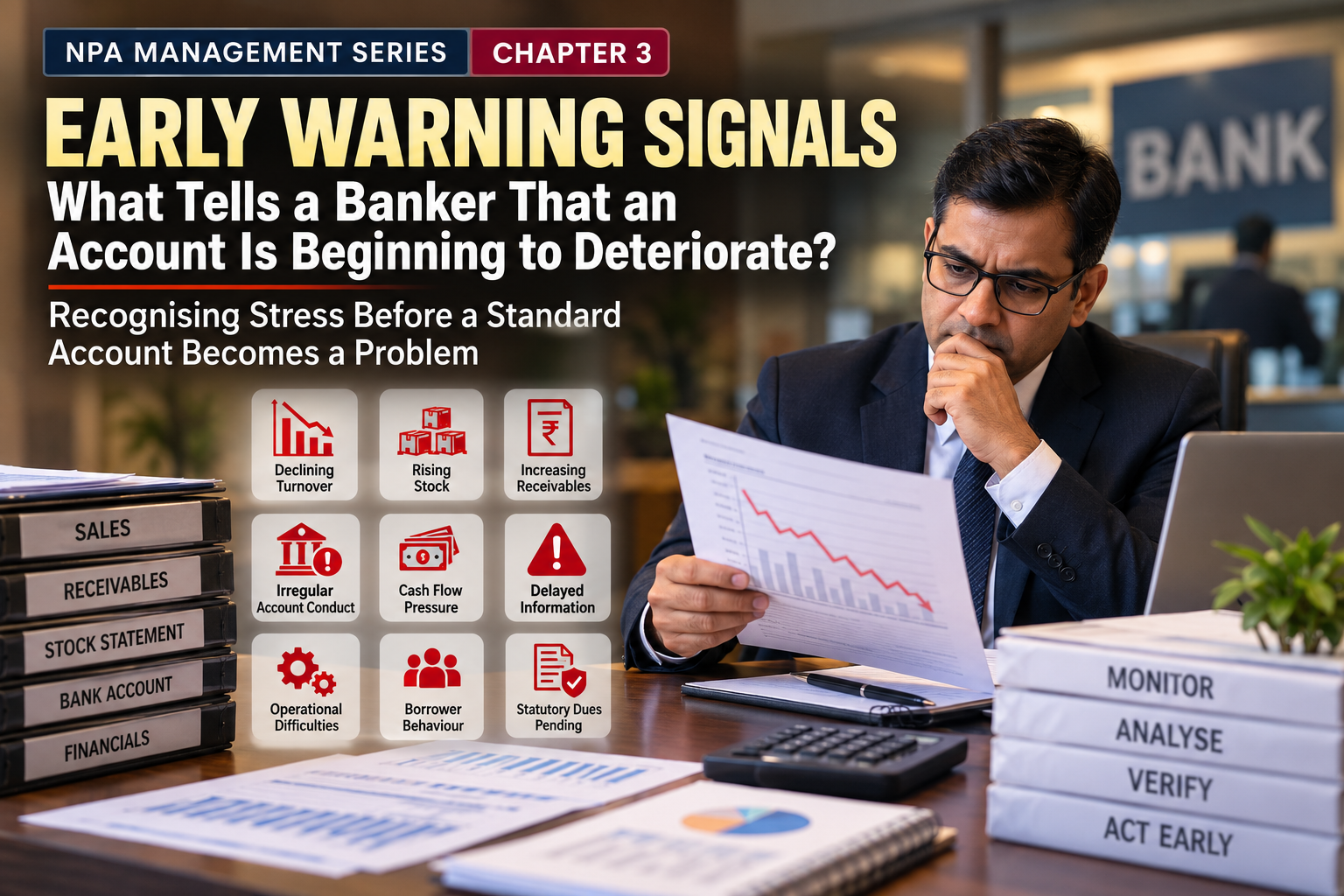
NPA MANAGEMENT SERIES — CHAPTER 3
Early Warning Signals: What Tells a Banker That an Account Is Beginning to Deteriorate?
Recognising Stress Before a Standard Account Becomes a Problem
“A warning signal is not a conclusion. It is a question that the banker—and the borrower—must answer in time.”
Ashok Kakkar | Advocate, Insolvency Professional, Former Banker | M.Com, LLB, LLM, CAIIB
Background
A loan account rarely becomes a problem overnight. In my years in banking, I have found that deterioration often begins quietly. Sales start slipping, receivables take longer to realise, stock begins to pile up, account turnover thins out, or the borrower finds it harder to meet commitments. At that stage, the account may still be Standard, interest may still be paid, and no NPA classification may yet appear. Yet the account may already be showing signs of stress.
That is why Early Warning Signals (EWS) matter. Their purpose is not to declare an account sick. They alert the banker that something has changed and needs to be understood—and remind the borrower that these signals deserve attention.
In the previous chapter, we examined how a bank monitors a Standard account. This chapter takes the next step: how the banker interprets what monitoring reveals, distinguishes temporary difficulty from genuine deterioration, and decides what action is appropriate. It is written for bankers, borrowers, entrepreneurs, auditors and students.
1. What Are Early Warning Signals?
Early Warning Signals (EWS) are indicators that a borrower’s financial position, business operations, repayment capacity or account conduct may be showing signs of stress. They may emerge from account transactions, financial statements, stock and receivables, business operations, borrower behaviour, external developments or information obtained from other sources.
The importance of early identification of stress is recognised in the Reserve Bank of India’s prudential framework, which requires banks to maintain effective systems for detecting distress and to recognise incipient stress in accordance with applicable regulatory norms. Banks also use their internal credit-monitoring policies and professional assessment to identify emerging risks.
An EWS does not necessarily mean that the borrower will default. Seasonal fluctuations, delayed collections or temporary business difficulties may have reasonable explanations. The real task of a banker is to examine the signal in the context of the borrower’s business, understand its underlying cause and assess whether it indicates temporary difficulty or a developing credit risk. An EWS indicator should not, by itself, be treated as an automatic basis for SMA or NPA classification.
2. Temporary Difficulty or Genuine Deterioration?
A banker must distinguish between a temporary difficulty and a sustained deterioration in the borrower’s financial position. A temporary difficulty may arise from a delayed payment by a customer, seasonal fluctuations or an unexpected expense. Genuine deterioration may result from internal weaknesses, external developments or a combination of both.
The distinction should be assessed through supporting information, the duration of the problem, its impact on cash flow and repayment capacity, the borrower’s response, and the likelihood of recovery. No single factor should determine the conclusion.
A temporary problem is more likely to be manageable where the cause is identifiable, the borrower provides a credible explanation supported by records, a realistic recovery timeline exists, and the business remains capable of generating cash. More serious deterioration may be indicated by falling margins, loss of customers, obsolete products, persistent cash shortages, rising debt, repeated broken promises or dependence on high-cost borrowing to keep the account regular.
This distinction cannot be made from one document or one visit. It requires judgement based on the overall pattern.
3. Signals from the Bank Account
The bank account is often an early source of information about changing financial behaviour. The banker should remain alert to declining credits and turnover, frequent cheque returns, repeated excesses over the limit, irregular servicing of interest or instalments, frequent requests for ad-hoc or temporary finance, unexplained withdrawals, unusual cash deposits close to due dates, and growing dependence on outside borrowings.
Particular attention is required when overdue amounts are repeatedly cleared just before an account reaches a classification threshold. This pattern may warrant closer examination, especially where payments are funded by fresh borrowing, accommodation entries or transfers from connected accounts. The banker should verify the source of funds and determine whether the underlying repayment difficulty has actually been resolved or merely postponed.
Similarly, if business proceeds are routed through another bank while the sanctioned facility remains fully utilised, the banker should examine the reasons and assess the implications for account conduct and credit risk. One isolated incident may have an innocent explanation; repeated irregularities deserve closer attention.
The key question is: Is the account being serviced from genuine business cash flow, or is it merely being kept technically regular?
4. Declining Turnover
Suppose a business was expected to generate annual sales of ₹10 crore, but actual turnover falls to ₹8 crore, then ₹6 crore and subsequently ₹4 crore. The decline cannot be ignored merely because the account has not yet become irregular.
Possible reasons include loss of customers, reduced demand, increased competition, loss of a major contract, shortage of working capital, operational problems, diversion of business or difficulties across the industry. The banker should compare actual performance with past performance and with the projections on which credit was sanctioned.
A decline may be temporary. A continuing decline, however, may indicate that the original assumptions supporting the sanction are weakening.
5. Stock and Receivables: Look Beyond the Numbers
Increasing stock may indicate a growing business, or it may mean that goods are not being sold. If inventory keeps increasing while sales remain stagnant, the banker should ask whether the stock is slow-moving, obsolete, overvalued or genuinely required. Stock statements showing the same or nearly the same figures month after month may warrant verification because actual stock normally changes with purchases and sales.
A significant mismatch between stock declared to the bank and the value covered by insurance should also be investigated. The banker should examine the valuation basis, policy coverage, adequacy of insurance and actual stock position rather than assuming that the discrepancy necessarily indicates misreporting.
Increasing receivables may reflect higher sales. But if receivables grow faster than sales, or old debts remain unpaid, the business may be facing collection problems. Debtors outstanding beyond normal credit terms should not automatically be treated as fully realisable for working-capital assessment. The quality and movement of an asset are often more important than its value on paper.
6. Drawing Power and Working-Capital Irregularities
In working-capital accounts, changes in drawing power are an important signal. The banker should watch for delayed stock statements, a sudden fall in drawing power, shortages of eligible stock or receivables, frequent excess drawings, inadequate margins and unexplained variations in stock.
Repeated difficulty in maintaining the required drawing power may indicate that the business is no longer generating the working capital originally contemplated. If the borrower repeatedly seeks temporary accommodation to bridge the gap, the banker should examine the underlying reason rather than treating the symptoms again and again.
7. Profit May Remain Positive While Stress Is Increasing
A common mistake is to assume that a business is healthy simply because it reports a profit. A bank is ultimately concerned with repayment capacity and cash generation. A borrower may show accounting profits while receivables remain unrealised, inventory keeps increasing, creditors are stretched, interest costs rise or cash is consumed elsewhere.
The banker should therefore examine profitability, cash flow and debt-servicing capacity together—not profitability alone. A continuing gap between accounting profit and actual cash generation deserves attention.
8. Non-Payment of Statutory and Other Dues
Persistent non-payment of statutory dues, such as GST, tax deducted at source, provident fund contributions or employee-related contributions, may indicate liquidity pressure or weaknesses in financial discipline. Depending on the circumstances, unpaid liabilities may also lead to notices, penalties, attachment proceedings or other consequences affecting the borrower’s operations and the bank’s risk position.
The banker should examine the amount involved, the period of default, the explanation offered and whether non-payment is isolated or part of a wider pattern of financial stress. Unpaid salaries, supplier complaints and utility arrears may provide further indications of pressure.
9. Behavioural Signals: What the Borrower Does Matters
Not all signals appear in financial statements. Sometimes borrower behaviour changes first. A promoter who avoids calls and meetings, provides incomplete or inconsistent information, repeatedly changes explanations, resists reasonable inspection or becomes defensive about routine questions may be signalling a problem that requires verification.
Other signals may include the sudden departure of key finance or production staff, frequent changes in signatories or partners, disputes among promoters, a guarantor questioning the liability, or visible discretionary spending while suppliers remain unpaid. These circumstances do not prove wrongdoing. They should, however, prompt the banker to ask further questions and verify the position independently.
10. Delayed Information Is Itself a Signal
Banks depend on timely information. Delays in financial statements, stock statements, tax returns, insurance policies, valuation reports or renewal documents may sometimes be administrative. Repeated delays, however, may point to operational difficulties, financial stress, management problems or reluctance to disclose the actual position.
The banker should distinguish between “the document is late” and “why is the document repeatedly late?” The second question is more important. Auditor remarks, doubts about business continuity and unexplained dealings with related parties should likewise not be brushed aside.
11. Diversion of Funds and Deviation from the Purpose
Funds sanctioned for working capital or a project should be used for the approved purpose and in accordance with the sanction terms. Transfers to group concerns, family members or unconnected parties, large unexplained cash withdrawals, purchase of assets unrelated to the business, or investment in speculative activities may be warning signs.
The banker should examine the end-use of funds through books of account, invoices and bank statements, and understand the nature and purpose of significant transactions. The borrower should keep the use of funds transparent and properly documented.
12. External Signals and the Position with Other Lenders
A borrower may face stress even when its own management has not changed. External factors include an industry slowdown, changes in government policy, regulatory restrictions, sharp increases in input costs, loss of a major market, technological disruption, legal disputes, natural calamities, supply-chain disruption and weakness in the financial position of major customers. A banker who understands the business environment may identify stress earlier than one who looks only at account figures.
A borrower may also have accounts with several banks and financial institutions, so one account should not be viewed in isolation. Overdue payments to another lender, increased borrowing, repeated restructuring requests, new charges on assets and deterioration in repayment behaviour elsewhere may indicate wider financial pressure. The banker should consider the borrower’s overall debt position, using reliable and lawfully available information.
13. Multiple Signals Matter More Than One Signal
One signal does not necessarily establish stress. Consider this sequence: sales fall by 10%, receivables increase, stock remains high, interest servicing becomes difficult, financial statements are delayed and the borrower begins requesting temporary accommodation. Any one of these developments may have an innocent explanation. When several appear together, however, the overall picture changes.
The banker should look for clusters and trends rather than isolated events. Early warning is about connecting the dots.
14. How a Banker Verifies a Signal
Spotting an anomaly is only the trigger. Verification helps determine the actual risk. The banker may compare turnover routed through the bank with sales reported in GST returns and financial statements, and compare purchases, sales and stock for consistency. Information about charges on assets, credit information reports and the borrower’s position with other lenders may also be relevant.
Physical verification can be equally important: checking whether stock registers match physical stock, whether raw materials are deteriorating and whether machinery is working. In appropriate cases, an independent stock audit or valuation review can help establish the condition and value of security. Confirmation from major debtors and sample reconciliation of ledgers may help test the quality of receivables.
The extent of verification should be proportionate to the exposure, the nature of the signal and the bank’s applicable procedures. The objective is to decide whether the signal reflects a temporary mismatch or genuine deterioration.
15. How the Bank Should Respond
Identification is only the first step. A practical response may follow these stages:
- Understand the reason by speaking to the borrower and obtaining a clear explanation.
- Verify the explanation; verbal assurance alone is not enough.
- Assess whether the problem is temporary or structural, because each may require a different response.
- Increase the frequency and depth of monitoring where warranted.
- Reassess repayment capacity, drawing power, security and overall indebtedness.
- Document the findings, decisions and action taken.
- Escalate serious cases to the appropriate controlling or senior authority.
Where deterioration is confirmed, the bank may need to reassess drawing power, exclude ineligible or non-realisable stock and receivables in accordance with applicable norms, reconsider further ad-hoc exposure, verify the routing of business proceeds and complete pending security documentation or charge formalities. Any action should be consistent with the sanction terms, applicable regulations and the bank’s policies.
The appearance of an EWS is not, by itself, a reason to abandon a borrower. If the business remains viable and the difficulty is temporary, timely intervention may help the borrower recover. The objective is informed credit management—not a reflex response to every signal.
16. What the Borrower Should Do
The borrower’s best protection is honesty and promptness. Inform the bank when a cash-flow problem first appears rather than waiting for the bank to write. Respond to communications, attend meetings, provide complete information and avoid adjustments made merely to escape classification.
Maintain reliable stock, debtor and accounting records; submit statements accurately and on time; cooperate with reasonable inspections; meet bank and statutory obligations as they fall due; and use funds only for the sanctioned purpose. A bank is better placed to assess possible solutions when a borrower explains difficulties early and truthfully.
17. From EWS to SMA and NPA
Early Warning Signals, Special Mention Account (SMA) classification and NPA classification are related but distinct concepts. EWS indicate possible deterioration and may appear before any repayment default. SMA and NPA classification, however, depend on the applicable regulatory requirements and the actual status of the account.
Timely corrective action may help prevent further deterioration, but the account’s classification must always be determined in accordance with the applicable norms. A warning signal should prompt investigation and action; it should not be confused with a formal asset classification.
If an account does become stressed, the bank’s response must be timely, documented and consistent with the relevant regulatory framework and internal policy. The earlier the underlying problem is identified, the greater the opportunity to protect the bank’s exposure and, where feasible, preserve a viable business.
18. A Practical EWS Checklist
When reviewing a potentially stressed account, the banker can ask six questions:
- Has turnover declined or account conduct deteriorated?
- Are stock and receivables genuine, current and realisable?
- Is the business generating sufficient cash to service its debt?
- Are there signs of diversion, rising indebtedness or delayed statutory payments?
- Is the borrower cooperating and providing reliable information?
- What corrective action, intensified monitoring or escalation is now required?
A checklist is not a substitute for credit judgement. It helps ensure that important questions are not overlooked.
Conclusion
The best time to manage a stressed loan is before it becomes an NPA. Early Warning Signals give both the banker and the borrower an opportunity to understand a developing problem and respond while options may still be available.
The signs may be financial, operational, behavioural or external. Some are small and easily overlooked; others may appear harmless when seen individually. The real skill lies in recognising the pattern and verifying what it means.
A good banker does not wait for the account to become irregular before becoming concerned. The banker asks: What has changed? Why has it changed? What should be done now, while there is still time?
That is the essence of effective early warning and preventive credit management.
A Message to Readers
To fellow bankers: Do not treat Early Warning Signals as system alerts to be closed. Speak to the borrower, verify the facts, record your findings and act early—with fairness and firmness.
To borrowers and entrepreneurs: Your bank is not your enemy. Share difficulties before they become defaults, meet commitments where possible and never mistake last-minute adjustments for genuine financial recovery.
To students and young professionals: Learn to read an account as a connected story, not as a collection of figures. The earlier you recognise the signals, the better equipped you will be to respond.
Disclaimer
This article is intended for general awareness and educational purposes and reflects the author’s professional experience. It does not constitute legal, financial, regulatory or professional advice. Banking practices, policies and regulatory requirements may change and may differ according to the institution and facility. Readers should consult the current applicable regulatory directions, the policies of their respective banks, the terms of the sanction and a qualified professional when dealing with specific situations.
Keywords: Early Warning Signals in Banking, NPA Management, Bank Loan Monitoring, Credit Risk Management, Borrower Financial Stress, Standard Account Monitoring, Early Detection of NPAs, SMA and NPA Classification, Loan Account Deterioration, Prevention of Non-Performing Assets.