
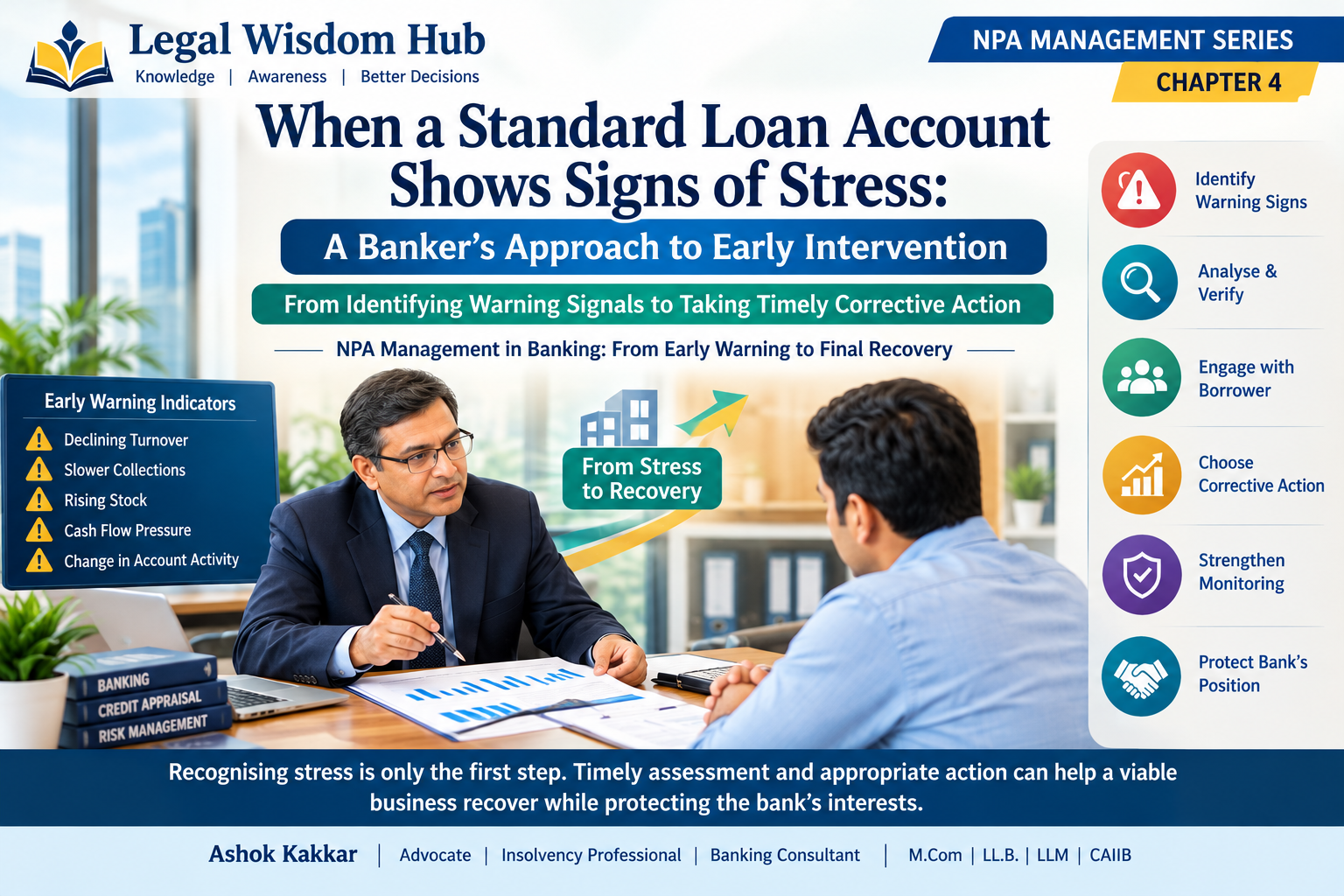
When a Standard Loan Account Shows Signs of Stress: A Banker’s Approach to Early Intervention
NPA Management in Banking – Chapter 4
From Identifying Warning Signals to Taking Timely Corrective Action
NPA Management in Banking: From Early Warning to Final Recovery
Ashok Kakkar
Advocate | Insolvency Professional | Banking Consultant
M.Com | LL.B. | LL.M. | CAIIB
Recognising stress is only the first step. Timely assessment and appropriate action can help a viable business recover while protecting the bank’s interests.
Background
In the previous chapters, we examined how a bank monitors a Standard account and how a banker recognises and interprets Early Warning Signals (EWS). The next question is practical: once a warning signal has been noticed, what should the banker do?
A warning may be recorded, discussed with the borrower and then left unattended until an overdue arises. That delay can reduce the options available to both the bank and the borrower. Early identification is useful only when it leads to verification, assessment and timely action.
Introduction
This chapter focuses mainly on the stage when stress is identified while the account is still classified as Standard. It explains how a banker can investigate the cause, test the borrower’s explanation, assess business viability, choose a proportionate response, strengthen monitoring and protect the bank’s position. It also considers what the borrower should do and when continued support may no longer be justified. These are practical considerations, not automatic requirements for every account; action must be consistent with the facts, sanction terms, bank policy, applicable law and regulatory directions.
What the Banker Should Do: Step by Step
1. Standard Does Not Mean Risk-Free
An account may remain classified as Standard even when warning signs suggest that its risk profile is changing. Turnover may be weakening, collections may be slowing, stock may be accumulating or business receipts may no longer be routed through the lending bank as expected. Such indicators do not, by themselves, establish that default will occur, but they deserve timely examination.
The period before a repayment default can offer valuable scope for corrective action. Stress can also be identified after an overdue has arisen. The banker should act on the evidence available and should not wait for a change in classification before investigating a credible warning.
2. Move from Routine Monitoring to Active Assessment
Once stress appears credible, the account may require closer attention than a routine review. The key question is not simply, “Is the account regular today?” but, “If the present position continues, will the business generate enough cash to meet its obligations over the coming months?” An isolated, explainable fluctuation may require clarification and follow-up; a pattern of deteriorating cash flow, unexplained transactions or repeated non-submission of information may call for a more detailed review.
3. Diagnose the Cause Before Choosing a Remedy
Stress can arise from operational difficulties, external conditions or concerns about management conduct. Operational causes may include slower collections, a longer working-capital cycle or the loss of a major customer. External causes may include a sector slowdown, supply disruption or squeezed margins. Behavioural concerns may include unexplained transfers to related parties, diversion of funds or reluctance to provide information.
The banker should examine cash flow against accounting profit, the working-capital cycle, the quality of stock and receivables, drawing power and the routing of business receipts. A rise in reported sales alongside a fall in credits to the lending account, for example, calls for verification of where sales proceeds are being received. The objective is to identify the underlying cause rather than assume every signal has the same explanation.
4. Meet the Borrower and Understand the Business
Where the initial review identifies material concerns, the banker should arrange a structured discussion with the borrower or promoter and record the important points. Where appropriate, the discussion should be supported by a visit to the business premises and involve persons who understand the business, not only the accountant.
Questions may cover the order position, changes in major customers or suppliers, delays in collections, cost pressures, expected cash flows and the steps management proposes to take. A visit may help explain matters that financial statements do not show clearly, such as idle machinery, slow-moving stock or disruption in dispatches.
The borrower’s responsiveness and transparency are relevant, but they do not by themselves prove viability or non-viability. Evasive answers or repeated delays warrant closer scrutiny; the decision must rest on verified facts, realistic cash-flow prospects and management’s ability to implement corrective steps.
5. Verify the Explanation Independently
Verbal assurances should not be the sole basis for continuing with the existing arrangement. Depending on the concern, the banker may compare the explanation with sales and purchase records, tax information, stock and debtor statements, order books, bank credits and other available records. A site visit, stock audit or valuation review may be appropriate where the exposure, discrepancies or security risks justify it.
The purpose is not to presume wrongdoing. It is to ensure that decisions are based on reliable information and that any material inconsistency is resolved or appropriately escalated.
6. Reassess Repayment Capacity and the Original Assumptions
Every credit facility rests on assumptions about sales, margins, collection periods, stock levels, working-capital needs and the borrower’s contribution. When stress emerges, actual performance should be compared with those assumptions. The repayment schedule, facility size or margin may no longer match the business’s current cash-flow cycle.
A realistic assessment should consider cash available for debt servicing, expected receipts, unavoidable operating expenses and the timing of liabilities. Reworking the figures may reveal whether the existing arrangement remains workable or whether a revised approach should be considered under the bank’s policies and applicable requirements.
7. Assess Whether the Business Is Viable
A temporary liquidity mismatch in an otherwise viable business is different from a structural problem that prevents the business from generating sufficient cash. The banker should consider whether the business retains a market and customer base, whether it can generate sustainable cash flow, whether management can execute a recovery plan, and whether the proposed corrective measures are realistic.
For a larger or more complex exposure, an independent techno-economic assessment may assist the decision. A positive assessment does not guarantee recovery, but it can support a reasoned decision about whether and how to help. Where the business is structurally unviable or the assumptions behind recovery are unsupported, additional funding may increase the bank’s exposure without solving the underlying problem.
8. Match the Response to the Nature of the Stress
The response should address the identified cause. A short-lived liquidity mismatch may justify considering a time-bound arrangement supported by a credible cash-flow forecast and defined repayment source. A change in the working-capital cycle may require reassessment of the requirement and facility structure. Suspected diversion, unreliable information or serious control failures may instead require tighter restrictions, formal escalation and further examination.
Any additional funding, change in repayment terms, restriction on drawing power or other remedial measure must be considered on the facts, within the sanction terms, the bank’s approved policies, applicable regulatory requirements and the required approval process. Support should not be used merely to postpone recognition of continuing default or conceal the actual financial position.
9. Apply Tighter Controls Where Justified
Depending on the risk and facility terms, tighter controls may include more frequent stock and debtor statements, recalculation of drawing power, closer scrutiny of large withdrawals, supporting documents for selected transactions or closer monitoring of business receipts. Old or ineligible stock and receivables should be treated in accordance with the applicable drawing-power methodology and bank policy.
Stopping ad-hoc facilities, restricting drawings or changing operating arrangements should not be automatic responses to every warning signal. Such action should be supported by the facts, contractual terms, the bank’s authority and necessary approvals. The borrower should be informed appropriately, and the decision and its rationale recorded.
10. Consider Cash-Flow Controls
Where the business remains viable but cash-flow visibility is weak, the bank may consider a properly documented arrangement to improve visibility over customer receipts and use of funds. A designated collection account or other cash-flow control may be useful in suitable cases, subject to the facility structure, borrower arrangements, contractual rights and applicable requirements.
Such arrangements should not be presented as a universal rule that the bank must always receive its dues before every operating expense. The objective is a transparent, workable mechanism that supports business operations while protecting the lender’s legitimate interests.
11. Increase the Frequency of Monitoring
A stressed account may require more frequent review than a healthy account. Depending on the risk, the bank may increase inspections, stock and debtor reviews, financial updates and analysis of account conduct. Physical verification, sample checking of receivables and comparison of statements with available records can help establish whether the reported position reflects reality.
Periodic updates on sales, collections, orders, stock and key liabilities can help assess whether the position is improving. The frequency and depth of monitoring should be proportionate to the exposure, risk indicators and bank policies.
12. Review and Protect the Security
The banker should review whether security documentation is complete, the bank’s interest is properly recorded, insurance remains adequate and valid, valuations are current enough for the purpose, and guarantees remain enforceable and relevant. Pending mortgage or charge formalities should be addressed promptly. The bank should also examine whether primary or collateral security is at risk of being transferred, diluted or further encumbered contrary to applicable terms.
Additional collateral or guarantees may be considered where justified, legally permissible and appropriately approved; they should not be an automatic requirement in every stressed account. Identifying documentation or security gaps early can reduce avoidable difficulty if recovery action later becomes necessary.
13. Examine Possible Diversion of Funds
Stress may increase pressure to use funds for purposes other than those sanctioned, but a transaction should not be labelled diversion without examination. Warning signs may include unexplained transfers to group entities, business receipts routed through other accounts, working-capital funds used for long-term investments, unusual cash withdrawals or inconsistent stock and invoice information.
Where concerns arise, the banker should seek an explanation, examine relevant records and escalate the matter under the bank’s procedures. Restrictions on further drawings or other protective action should be based on the facts, contractual rights, applicable requirements and appropriate authority. Serious discrepancies may warrant a specialised review.
14. Assess the Promoter’s Contribution and Commitment
The bank should assess whether the promoter is willing and able to take reasonable steps to support a viable business. Depending on the circumstances, these may include bringing in additional funds, reducing non-essential withdrawals, improving collections, contributing additional security or retaining funds in the business.
The form and extent of any expected contribution should be realistic, justified by the viability assessment and consistent with bank policy and approval processes. A promoter’s willingness to contribute is relevant evidence, but it is not a substitute for a sustainable business plan and credible cash-flow projections.
15. Obtain a Written Action Plan with Timelines
A corrective plan should specify what will be done, by whom, by when and with what expected result. It may cover collection of overdue receivables, sale of slow-moving stock, cost control, securing new orders, infusion of funds or disposal of non-core assets, as appropriate to the business.
The bank should set review dates and compare actual progress with commitments. Repeated failure to meet milestones should trigger reassessment rather than automatic extensions. The plan should be specific enough to allow the bank to determine whether risk is reducing.
16. Consider Remedial Support Carefully
Where the business is viable and the cause of stress can realistically be addressed, the bank may consider suitable remedial support, such as a revised working-capital arrangement or changes to repayment terms, where permitted. Any such step must comply with the applicable regulatory framework, bank policy, facility terms and required approvals.
Support should be linked to a reasoned viability assessment, a credible action plan and appropriate monitoring. The key question is whether the proposed measure addresses the actual cause of stress and provides a realistic path to servicing the debt. If not, it may only defer the problem.
17. Know When Rehabilitation Is No Longer Appropriate
Rehabilitation is not suitable for every stressed account. Persistent evidence of fund diversion, fabricated information, serious non-cooperation, weakening or unauthorised dealing with security, or a business with no realistic path to sustainable cash generation may indicate that continued support is not justified.
The bank should distinguish verified misconduct from an unresolved concern and consider the facts and the borrower’s response. Where support is no longer justified, the focus may shift towards protecting the bank’s position and preparing for recovery. Restricting undrawn facilities, issuing notices, escalating the account, informing other lenders where required and preserving security must be done in accordance with the contract, applicable law, regulatory requirements and internal approval procedures.
18. What the Banker Should Avoid
The banker should avoid granting additional credit merely to cover an overdue or make the account appear regular, accepting cosmetic adjustments that conceal the true position, relying only on verbal promises or delaying a decision without a clear reason. Equally, recalling an advance at the first sign of difficulty, without understanding the facts or considering applicable terms, may damage a potentially viable business.
The right approach is neither neglect nor panic. It is a proportionate, evidence-based and properly documented response, consistent with the bank’s policies and regulatory obligations.
19. Document, Review and Escalate
The account record should capture the warning signs identified, verification undertaken, the borrower’s explanation, viability assessment, decisions made, reasons for those decisions and review dates. A clear record supports continuity when responsibility changes and allows the bank to assess whether its actions are producing the intended result.
Where stress is significant or the exposure warrants it, the matter should be escalated promptly to the appropriate controlling or senior authority. Escalation should not be postponed simply because the account remains classified as Standard.
20. What the Borrower Should Do
The borrower can influence the outcome by informing the bank about difficulties early, providing complete and accurate information, responding promptly to queries and allowing reasonable inspections. Business receipts and borrowed funds should be handled in accordance with the facility terms. The borrower should prepare a practical plan covering collections, costs, orders, cash flow and any contribution that can realistically be made.
A borrower should not assume that the bank will provide additional funds or change repayment terms simply because difficulties have been explained. Early, transparent engagement gives the bank a better basis to assess possible solutions; concealment and unsupported assurances usually make that assessment harder.
21. From Early Stress to SMA and NPA
Early identification of stress creates an opportunity for corrective action, but it does not suspend regulatory requirements. Where repayment or interest becomes overdue, the account must be monitored and classified in accordance with the applicable RBI SMA and NPA norms. SMA classification follows prescribed criteria and is intended to identify accounts showing increasing levels of stress; NPA classification follows applicable asset-classification rules when the relevant conditions are met.
If the underlying problem remains unresolved, the scope for voluntary correction may narrow and the bank may face provisioning requirements, closer monitoring and recovery-related decisions. For the borrower, continued default can affect credit standing and future access to finance. Early action can preserve options, but it cannot replace compliance with regulatory timelines.
22. A Practical Action Checklist
When warning signs have been confirmed, the banker should ask:
- Have I identified and verified the underlying cause of stress?
- Have I met the borrower and recorded the discussion?
- Have I tested the explanation against reliable information?
- Is the business viable, and is the proposed recovery path realistic?
- Does the response address the actual cause of the problem?
- Are drawing power, stock, receivables and cash flows being assessed appropriately?
- Are the security, insurance and documentation position in order?
- Have possible diversion or other serious irregularities been examined?
- Is there a written action plan with measurable milestones and review dates?
- Is monitoring proportionate to the risk, and has the matter been escalated where required?
- Are decisions consistent with sanction terms, bank policy and applicable requirements?
Conclusion
An account showing stress is not necessarily a failed account; it is an account that requires informed attention. The banker should identify the cause, verify the facts, assess viability, choose a proportionate response, strengthen monitoring and protect the bank’s position. The banker must also recognise when continued support is not justified. Timely action can improve the prospects of recovery, but it cannot guarantee a successful outcome.
For borrowers, early disclosure, reliable information and a credible corrective plan are more useful than waiting for the bank to discover the problem. For bankers, noticing a warning is only the beginning; the quality and timeliness of the response matter just as much.
In the next chapter, we will examine Special Mention Accounts (SMA), the applicable classification stages and how an account may progress towards NPA status.
Message to Readers
To fellow bankers: when an account shows signs of stress, investigate the cause, verify the facts, document the decision and act in time. A proportionate response may help preserve a viable business and protect the bank’s funds.
To borrowers and entrepreneurs: approach your bank early, share accurate information and present a realistic plan. Cooperation cannot guarantee support, but it allows the problem to be assessed before options become more limited.
To students and young professionals: credit monitoring is not complete when a warning signal is noticed. It requires sound judgement, evidence-based action and timely follow-up.
Disclaimer: This article is written purely for general awareness and educational purposes, based on the author’s professional experience. It does not constitute legal, financial, regulatory or professional advice. Banking practices, policies and regulatory requirements differ from bank to bank and change from time to time. Readers are advised to refer to the current applicable regulatory guidelines, the policies of their respective banks and the terms of their sanction, and to consult a qualified professional for advice on specific situations.
keywords: NPA Management, Early Warning Signals, Stressed Bank Accounts, Credit Monitoring, Standard Loan Accounts, Working Capital Finance, Banking Risk Management, Loan Recovery, SMA and NPA Classification,