
Legal Heirs and a Deceased Borrower’s Loan: Rights, Liabilities and Bank Recovery
Are legal heirs liable for a deceased borrower’s bank loan? What the law says, what banks can recover and how families should respond
By Ashok Kakkar, Advocate, Former Banker & Insolvency Professional
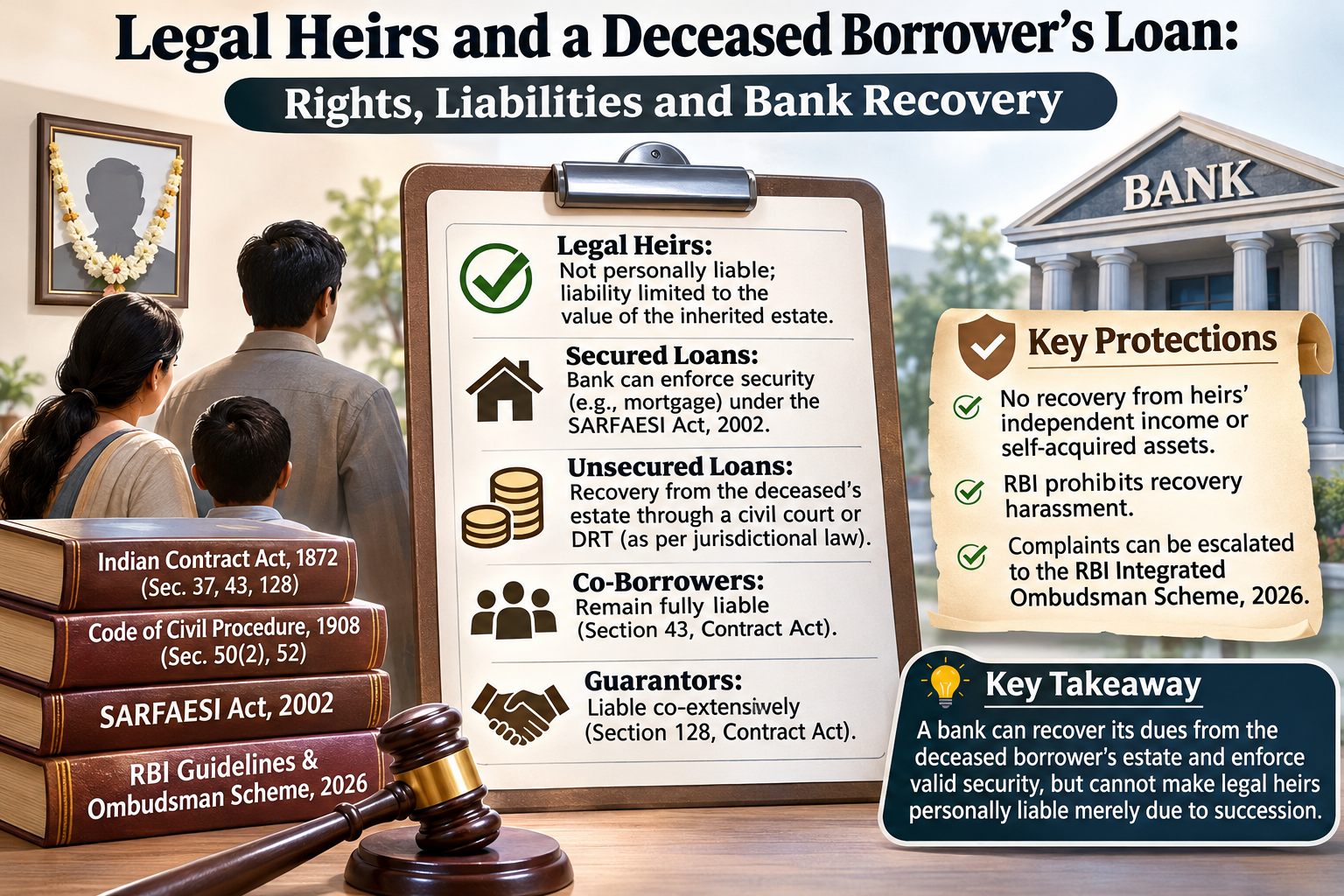
In brief: A bank loan does not disappear when the borrower dies, but it does not automatically become the personal debt of the family. Legal heirs are liable only to the extent of the estate they inherit. Co-borrowers and guarantors, however, remain personally liable under their own signatures, and the bank may enforce any security it holds. Recovery agents must follow the RBI’s fair practice norms even while the bank recovers its lawful dues.
Background
The death of a borrower is a moment of grief for the family. Very often, it is followed within weeks by a second shock: a letter from the bank, a telephone call from a recovery executive, or a notice demanding repayment of a loan that the family may not even have known about. The spouse, the children and other relatives are then left with an anxious question: are we now personally bound to repay this loan from our own income, savings and properties?
A widespread belief is that the debt of a deceased person automatically passes to the family. This is not the legal position in India. At the same time, it is equally incorrect to believe that the loan simply disappears with the death of the borrower. The law draws a careful line between two very different things: the estate that a person leaves behind, and the personal liability of the surviving family members. Banks have lawful rights against the first, but they do not automatically have rights against the second.
Having spent over four decades in banking, law and insolvency, I have seen families pay amounts they did not legally owe, simply because they were frightened, uninformed or pressurised. I have also seen genuine bank dues remain unrecovered because the family did not respond to lawful notices in time. This article explains the subject in a simple, structured manner, in numbered points, so that bank customers, their families, students and professionals can understand the rights and liabilities of every party involved.
1. The Basic Principle: The Borrower Dies, the Debt Does Not
A loan is a contractual obligation. When the borrower dies, the obligation does not vanish. The outstanding principal, interest and charges continue to exist as a claim against the person who has died, and that claim can be satisfied from whatever the person has left behind. In legal language, the debt becomes a charge on the estate of the deceased.
This is a sound and necessary principle. If every loan came to an end on the death of the borrower, lending itself would become unsafe and credit would become costly for everyone. But the principle has an important limit: the debt is to be recovered from the estate, and not from the personal wealth of those who happen to be the borrower’s relatives.
2. Who Is a Legal Heir, and What Is the Estate?
A legal heir is a person who succeeds to the property of the deceased under a will, if there is one, or under the law of succession applicable to the deceased, if there is none. A legal heir may be the spouse, a son, a daughter, a parent or another relative, depending on the personal law and the facts.
The estate means everything the deceased owned at the time of death and which is capable of being inherited. It includes bank balances, fixed deposits, shares and mutual funds, jewellery, vehicles, land, buildings and other movable and immovable assets, but certain items, such as jointly held assets that pass to the surviving holder or insurance proceeds payable to a nominee, may be treated differently depending on the law and the facts, as discussed later in this article. The estate is also the first source from which the debts of the deceased are to be met, before the heirs enjoy it.
It is therefore important to understand that being a legal heir is a right to receive property, subject to the debts of the deceased. It is not, by itself, an obligation to pay those debts from the heir’s own pocket.
3. Legal Heirs Are Not Automatically Personally Liable
The core protection available to legal heirs is found in the Code of Civil Procedure, 1908. Section 50(2) provides that where a decree is passed against a person who has died and is sought to be executed against his legal representative, the decree can be executed only against the property of the deceased that has come into the hands of the legal representative and has not been duly disposed of. In simple words, the heir answers for the debt only to the extent of the inherited property that remains with him or her. The court may also require the legal representative to produce accounts of the estate, so that the extent of the liability can be ascertained.
The Indian Contract Act, 1872, is also relevant. Section 37 provides that the parties to a contract must perform their promises, and that promises bind the representatives of a promisor who dies before performance, unless a contrary intention appears from the contract. The obligation under a loan agreement therefore does not end with the death of the borrower, and it binds the borrower’s legal representatives. The extent of that burden, however, is governed by the general law, including Section 50(2) of the Code of Civil Procedure discussed above: the representatives answer only out of the estate of the deceased that comes into their hands, and not out of their own separate property. Read together, the two provisions confirm that the obligation continues, but the liability of the heirs is limited to what they inherit.
Putting these provisions together, the position can be stated clearly. A spouse, son or daughter who has not signed the loan documents as a co-borrower or guarantor cannot be compelled to repay the deceased’s loan from his or her own salary, business income, savings or self-acquired property. The exposure is limited to the estate inherited from the deceased.
4. What “To the Extent of the Estate” Really Means
This limit works in both directions, and families should understand both. First, if the deceased left little or no property, the heirs are not required to make up the shortfall from their own resources. A bank cannot convert a poor estate into a personal debt of the family.
Second, the protection applies to property that has actually come into the hands of the heir. An heir who inherits assets and then disposes of them in a manner not permitted by law, for example by hurriedly transferring or hiding assets to defeat a legitimate claim, may be called upon to account for the property and may face consequences. The safe course for every heir is to deal with the estate transparently and, where a bank claim is pending, to take legal advice before distributing or selling inherited assets.
5. Rights of the Bank Against the Deceased Borrower’s Estate
The death of the borrower does not extinguish the bank’s right to recover its legitimate dues. The bank may proceed against the bank balances, investments, immovable properties and other assets forming part of the deceased’s estate, subject to the applicable law and procedure. The bank may also exercise its lawful rights of set-off or lien over deposits of the deceased held with the same bank, where such rights are available to it under the terms of the account and the law.
The recovery, however, must follow the due process of law. The bank must identify the correct legal representatives, give proper notice, and where court or tribunal proceedings are required, bring the legal heirs on record. It is not entitled to bypass the law merely because the borrower has died.
6. Recovery of Secured Loans Under the SARFAESI Act, 2002
Where the loan is secured by a mortgage of immovable property, hypothecation of vehicles, stock or machinery, or any other enforceable security interest, the bank has a stronger position. The death of the borrower does not destroy the security. The security remains attached to the asset, and the asset continues to be available to the bank for recovery of its dues.
In such cases the bank may invoke the Securitisation and Reconstruction of Financial Assets and Enforcement of Security Interest Act, 2002, commonly called the SARFAESI Act, subject to fulfilment of its conditions. The usual sequence begins with a demand notice under Section 13(2) giving the borrower, and in this situation the legal heirs, sixty days to discharge the liability. If the dues are not paid, the bank may take measures under Section 13(4), such as taking possession of the secured asset and selling it by a lawful process.
Heirs who inherit a mortgaged house or hypothecated asset must understand that they cannot keep the asset free of the bank’s charge. They may retain the asset by paying the dues, by negotiating a settlement with the bank, or by arranging a takeover of the loan. If they do not, the bank can lawfully realise the security. What the bank cannot ordinarily do is proceed against the heirs’ separate self-acquired properties merely because they are heirs. Any person aggrieved by measures taken under Section 13(4) can approach the Debts Recovery Tribunal by way of an application under Section 17 of the Act, within forty-five days of the measure taken, as the Act presently provides.
7. Recovery of Unsecured Loans
Unsecured loans such as personal loans, credit card dues and similar facilities have no specific asset behind them. After the death of the borrower, the bank may initiate proceedings against the estate of the deceased. Depending on the amount, the nature of the claim and the jurisdiction, such proceedings may be filed before a civil court or before the Debts Recovery Tribunal under the Recovery of Debts and Bankruptcy Act, 1993, where the claim is above the prescribed monetary limit.
In these proceedings the legal heirs are brought on record as the legal representatives of the deceased, not as independent debtors. A decree, if passed, can be executed only against the estate of the deceased in their hands. It is therefore wrong for a recovery agent to tell a family that their own salary account or personal house will be attached for an unsecured loan that only the deceased had taken.
In practice, recovery from an estate may take time. Unsecured accounts are therefore often examined for insurance cover or settled by compromise, and in some cases written off in accordance with the bank’s own policy. A family should not assume this, however, and should seek the bank’s position in writing.
8. Co-Borrowers Remain Fully Liable
The position changes completely where a family member has signed the loan documents as a co-borrower. A co-borrower is not merely a relative or an heir. A co-borrower has personally and independently promised to repay the loan.
Section 43 of the Indian Contract Act, 1872, provides that when two or more persons make a joint promise, the promisee may, in the absence of an express agreement to the contrary, compel any one or more of such joint promisors to perform the whole of the promise. The death of one joint borrower therefore does not release the surviving co-borrower. The bank may call upon the surviving co-borrower to repay the entire outstanding amount, and that liability extends to the co-borrower’s own income and assets, because it arises from the co-borrower’s own signature and not from succession.
This is the most common source of misunderstanding. A wife who signed as co-applicant in a home loan, or a son who signed as co-borrower in a business loan, cannot say that the liability ended with the death of the main borrower. The family should check the loan documents carefully to see in what capacity each person had signed.
9. Guarantors Remain Liable Under the Guarantee
A guarantor holds yet another distinct position. Section 128 of the Indian Contract Act, 1872, provides that the liability of the surety is co-extensive with that of the principal debtor, unless the contract provides otherwise. When the principal borrower dies, the debt still exists, and the guarantor’s obligation to the bank continues in accordance with the guarantee.
A relative who has given a guarantee cannot avoid liability by saying that the principal borrower is no longer alive. After paying the bank, the guarantor may have a right to recover the amount from the estate of the deceased, but that is a matter between the guarantor and the estate. As against the bank, the guarantor remains answerable. Families should also remember that a person can be both a legal heir and a guarantor. In that case, the liability as guarantor is independent of the protection that is available to him or her as an heir.
10. Loan Insurance and Other Protective Cover
Many loans, particularly home loans, vehicle loans and some personal loans, are sanctioned along with credit life insurance or loan protection insurance. In some cases the premium is collected from the borrower at the time of disbursal, and the cover is designed to pay off the outstanding loan, wholly or partly, if the borrower dies during the term of the loan.
Families should therefore ask the bank, at the very first stage, whether any insurance policy is linked with the loan. If such cover exists, a claim must be lodged promptly with the insurer along with the death certificate and other required documents, because the settlement of the claim may reduce or fully clear the outstanding loan, subject to the terms and conditions of the policy. Where the borrower had taken a separate life insurance policy with a nominee, the claim amount payable to the nominee is governed by the insurance law and the policy, and the family should obtain legal advice about whether and how that amount may be affected by any claim against the estate.
11. Special Situations That Need Careful Attention
Certain situations require more careful examination than the general rule. Where an asset was jointly held by the deceased and another person, the rights of the bank and the surviving holder depend on how the asset was held, on the terms of the mortgage and on the applicable law. Where the loan was taken for the business of a family concern, or by a Hindu Undivided Family through its Karta, the family property may be involved, and the liability of the coparcenary property is a matter that must be examined on its own facts and under the applicable personal law. Where the deceased was a proprietor of a business, the business assets form part of the estate, and the bank’s rights over them are examined accordingly. Where the deceased was a partner in a firm or a director who had given a personal guarantee, the position will depend on the partnership deed, the guarantee and the company documents.
Because these situations vary greatly, a family should not rely on general belief or on what a recovery executive says, and should obtain a professional opinion on the documents.
12. Protection Against Harassment by Recovery Agents
Banks have a legitimate right to recover their dues, but this right does not include the right to intimidate or humiliate. The Reserve Bank of India’s regulatory framework, including the Fair Practices Code for lenders and the guidelines governing recovery agents, requires banks and their agents to be courteous, to respect the privacy of borrowers and their families, and to avoid harassment. Recovery agents are not permitted to use threats, abusive or obscene language, public shaming, repeated and unreasonable calls, or contact at odd hours, which is generally understood as outside the hours of about 8 a.m. to 7 p.m.
These protections are even more important when the person being contacted is a bereaved family member who has no independent liability. A family that is told, on the telephone or in person, that it must pay because it is the family, or that its reputation will be damaged if it does not, is being subjected to pressure that the law does not permit. Where the conduct amounts to criminal intimidation or similar offences, remedies are also available under the Bharatiya Nyaya Sanhita, 2023, and the bank remains answerable for the acts of the agents it engages.
13. Where to Complain Against Unlawful Recovery Practices
A family facing harassment should proceed in an orderly manner. The first step is a written complaint to the Branch Manager and the bank’s Grievance Redressal Officer, with a clear statement of the facts and a request for action. If the matter is not resolved, it should be escalated to the bank’s Principal Nodal Officer. The family should preserve call recordings, message screenshots, notices, letters and the names of the persons who contacted them, because this evidence is of great value later.
If the complaint remains unresolved, or the bank does not reply within the stipulated period, the customer may approach the RBI Ombudsman. It should be noted that the Reserve Bank – Integrated Ombudsman Scheme, 2026 came into force on 1 July 2026 and replaces the 2021 Scheme for complaints received on or after that date.The Scheme provides a free and non-adversarial remedy for deficiency in service by regulated entities, although a customer is ordinarily required to first approach the concerned bank and give it an opportunity to resolve the grievance. Where there are threats or other criminal conduct, the family may also approach the police or a court. The Ombudsman route deals with service-related grievances and does not decide the question of how much the bank is entitled to recover, which remains a matter for the competent court or tribunal.
14. Practical Steps for the Family After the Borrower’s Death
The following sequence of action is recommended.
A. Inform the bank in writing. Submit a copy of the death certificate to the bank and obtain an acknowledgement. In the letter, state clearly the names of the legal heirs and mention that those who did not sign the loan documents are only legal heirs and not co-borrowers or guarantors.
B. Obtain complete loan particulars. Request an updated statement of account, the outstanding principal, interest and charges, the details of security, and copies of the sanction letter, loan agreement and other documents.
C. Examine the capacity of each family member. Check whether any family member has signed as a co-borrower, guarantor or mortgagor. This decides who has independent liability.
D. Check insurance cover. Enquire about credit life or loan protection insurance and lodge the claim promptly, within the time allowed by the policy.
E. Prepare an inventory of the estate. List the assets left by the deceased, the nominations and the will, if any, so that the family knows what is available to meet the dues and what is exposed to the bank’s rights.
F. Never ignore legal notices. A SARFAESI notice or a summons from a court or tribunal carries strict time limits. Ignoring it does not make the problem disappear and may result in the loss of valuable rights. Consult an advocate and respond within time.
G. Consider a negotiated settlement. Where the estate is sufficient and the family wishes to retain a property, a structured repayment, a one-time settlement or a takeover of the loan by another lender may be a practical solution. Any settlement should be recorded in writing, and the account should be closed with a no-dues certificate and the release of original documents.
H. Do not pay under pressure. Payments made out of fear, without verifying the legal position, are difficult to recover later and may be treated as acknowledgement of liability. Pay only after understanding what is legally due and from whom.
I. Be careful before signing any fresh document. A bank may ask the family to sign an acknowledgement of debt, an undertaking, an indemnity or a fresh loan agreement. A legal heir who signs such a document may create a personal liability that did not exist earlier. Read it carefully and take legal advice before signing.
15. Common Misconceptions
The first misconception is that the family must repay every loan of the deceased because they are the family. As explained above, this is not correct; the heirs are liable only to the extent of the estate they inherit, unless they have signed as co-borrower or guarantor.
The second misconception is that the loan is automatically written off on death. This is also incorrect. The debt continues against the estate, and a secured loan continues to be backed by the security, unless it is cleared by insurance, settlement or the bank’s own decision.
The third misconception is that a bank cannot touch an inherited property. If the inherited property is mortgaged or hypothecated to the bank, the bank’s security rights continue against it.
The fourth misconception is that an heir must quietly accept both the property and its debts, or that silence will make the problem go away. In reality, an heir who does not wish to take property burdened with debt should take legal advice on the proper manner of dealing with the estate, instead of leaving the matter unattended.
The fifth misconception is that the credit record of every family member is affected by the death of a borrower. A bank ordinarily reports the account against the borrower, the co-borrowers and the guarantors, and not against legal heirs who have no such independent liability.
16. Quick Reference: Who Is Liable and to What Extent
| Category | Legal position |
| Legal heir only | Liability generally limited to the estate inherited from the deceased |
| Co-borrower | Independent contractual liability for the whole loan, including from own income and assets |
| Guarantor | Liability under the guarantee, generally co-extensive with that of the principal debtor |
| Secured asset inherited by heirs | Remains subject to the lender’s enforceable security rights |
| Self-acquired property of an heir | Not ordinarily liable merely because of status as a legal heir |
| Unsecured loan | Recoverable from the estate of the deceased, through due legal process |
Conclusion
The death of a borrower does not mean that the surviving family members inherit the personal financial liability of the deceased. At the same time, it does not deprive banks and financial institutions of their legitimate right to recover their outstanding loans from the estate of the deceased or to enforce valid securities. The law seeks a fair balance: protection for heirs against liabilities they never undertook, and protection for lenders against loss of the money they have lawfully advanced.
Banks must therefore follow lawful procedures, deal with bereaved families with sensitivity and refrain from coercive practices. Families, on their part, must understand their capacity in the loan documents, examine the estate and the available insurance, respond to legal notices in time and avoid both extremes: paying what is not legally due, and ignoring what is.
In my view, recovery of legitimate bank dues is an essential part of financial discipline, but recovery cannot be turned into a means of shifting the personal liability of a deceased borrower on to people who neither borrowed the money nor stood as guarantors. The distinction between inheriting an asset and inheriting a personal liability must be respected by banks, recovery agencies and legal heirs alike.
Message to Readers
Readers are welcome to share their views and observations on the recovery of bank loans after the death of a borrower. A wider exchange of information can promote public awareness of the legal position and encourage lawful, fair and sensitive recovery practices. Readers may also share this article with others who may find it useful, since awareness of one’s rights and obligations is the first step towards sound financial and legal decisions.
Disclaimer
This article is intended for general educational and legal awareness purposes only and does not constitute legal advice. The liability of legal heirs and the rights of lending institutions depend upon the facts of each case, the loan documents, the nature of the security, the law of succession applicable to the deceased and the statutory provisions in force from time to time. Readers should obtain appropriate professional legal advice before taking any action in an individual matter.