
Introduction
The Insolvency and Bankruptcy Code, 2016 (IBC) was enacted to establish a comprehensive and time-bound framework for insolvency resolution and liquidation in India. One of its key objectives is to maximize the value of assets while balancing the interests of creditors, investors, employees, and other stakeholders.
An important concept under the IBC is that of a “Security Interest”, as the classification of a creditor as secured or unsecured can significantly influence the insolvency resolution process and liquidation proceedings.
Recognizing certain interpretational issues that emerged during the implementation of the Code, Parliament enacted the Insolvency and Bankruptcy Code (Amendment) Act, 2026. The Central Government, through Gazette Notification dated 25 May 2026, brought several provisions of the Amendment Act into force with effect from 26 May 2026, including the amendment relating to the definition of security interest.
Security Interest under the Original IBC
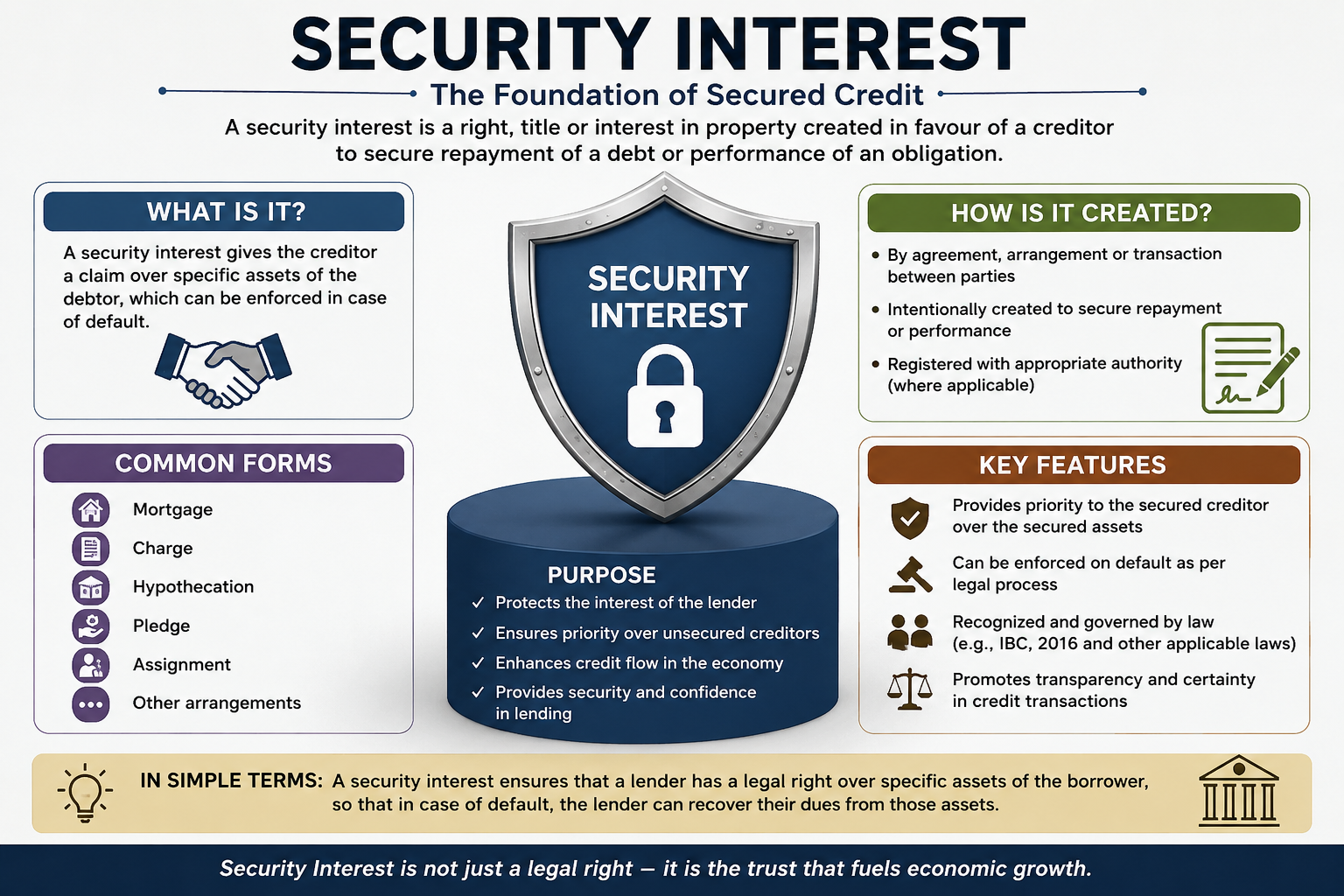
Section 3(31) of the Insolvency and Bankruptcy Code, 2016 originally defined “security interest” as a right, title, interest, or claim created in property in favour of a secured creditor by a transaction securing payment or performance of an obligation.
The definition covered various forms of security, including:
• Mortgage
• Charge
• Hypothecation
• Assignment
• Pledge
• Encumbrance
• Other arrangements securing repayment of a debt or performance of an obligation
The underlying principle was that security interests were generally created through commercial arrangements between parties.
Why Was a Clarification Considered Necessary?
As the IBC evolved through practical application, certain questions arose regarding the treatment of claims where a charge or right existed under a statute rather than under a contractual arrangement.
Different interpretations emerged regarding:
• Classification of claims as secured or unsecured;
• Verification of claims by Resolution Professionals;
• Priority of claims during insolvency and liquidation;
• Treatment of rights arising under various statutory provisions.
These issues led to uncertainty and, in some cases, litigation regarding the scope of the term “security interest”.
To promote consistency and reduce ambiguity, lawmakers considered it necessary to clarify the legislative intent behind the definition.
The Amendment Introduced by the IBC (Amendment) Act, 2026
The Amendment Act, 2026 clarifies the scope of Section 3(31) by emphasizing that a security interest must arise from an agreement, arrangement, or transaction creating such security.
In simple terms, the amendment reinforces that a security interest under the IBC is based on a consensual commercial arrangement between parties.
The amendment distinguishes between:
• Security interests created through contractual arrangements such as mortgages, pledges, hypothecation, or charges; and
• Rights or charges that may arise automatically under a statute without any specific security agreement between the parties.
The objective of the clarification appears to be to provide a clearer framework for determining the status of claims during insolvency proceedings.
Purpose of the Clarification
The clarification is intended to address uncertainty that developed over time regarding the interpretation of security interests.
By clearly identifying the basis on which a security interest may be recognized under the IBC, the amendment seeks to:
• Improve certainty in insolvency proceedings;
• Facilitate consistent treatment of claims;
• Reduce interpretational disputes;
• Promote smoother conduct of CIRP and liquidation processes.
The amendment may also help stakeholders better understand their respective rights and obligations under the insolvency framework.
Significance of the Amendment
1. Greater Clarity in Claim Verification
Resolution Professionals and Liquidators may find it easier to classify and verify claims under a clearer statutory framework.
2. Improved Predictability
Creditors, investors, and resolution applicants generally prefer certainty regarding the treatment and priority of claims. The amendment contributes to greater predictability.
3. Reduction in Litigation
A clearer definition can help reduce disputes arising from differing interpretations of the term “security interest”.
4. Efficient Insolvency Resolution
Reduced uncertainty can support faster decision-making and more efficient insolvency proceedings.
5. Strengthening Commercial Confidence
Financial institutions and lenders frequently rely on security created through documented transactions. The amendment reinforces the significance of such arrangements within the insolvency framework.
Impact on Stakeholders
Banks and Financial Institutions
The amendment provides greater clarity regarding security rights arising from lending transactions and security documentation.
Resolution Professionals
A clearer statutory framework may assist in claim verification, preparation of information memoranda, and conduct of CIRP.
Resolution Applicants
Greater certainty regarding creditor positions may facilitate evaluation of distressed assets and formulation of resolution plans.
Corporate Debtors
The clarification contributes to a more predictable insolvency environment.
Investors
A transparent and predictable insolvency regime supports confidence in the credit and investment ecosystem.
Part of the Broader IBC Reform Process
The clarification regarding security interest forms part of the wider Insolvency and Bankruptcy Code (Amendment) Act, 2026, which seeks to improve the effectiveness of India’s insolvency framework.
The broader reforms are aimed at:
• Enhancing efficiency of insolvency proceedings;
• Reducing delays;
• Improving value maximization;
• Strengthening creditor confidence;
• Promoting a more predictable insolvency ecosystem.
Conclusion
The clarification of “security interest” under Section 3(31) through the Insolvency and Bankruptcy Code (Amendment) Act, 2026 represents an important development in the evolution of India’s insolvency regime.
By emphasizing that a security interest must arise from an agreement, arrangement, or transaction creating such security, the amendment seeks to provide greater clarity regarding the classification and treatment of claims during insolvency proceedings.
While the practical impact will continue to evolve through implementation and future judicial interpretation, the amendment is expected to contribute towards greater certainty, reduced disputes, and improved efficiency in the Corporate Insolvency Resolution Process.
Disclaimer
This article is intended solely for educational and awareness purposes. It provides a general overview of the provisions relating to security interest under the Insolvency and Bankruptcy Code and the amendments introduced in 2026. The article does not constitute legal, financial, or professional advice. Readers should refer to the relevant statutory provisions, notifications, regulations, and professional advisors before taking any action based on the contents of this article.
Author: Ashok Kakkar
Advocate | Insolvency Professional | Former Banker
#IBC #IBCAmendment2026 #SecurityInterest #InsolvencyLaw #CIRP #BankingLaw #ResolutionProfessional #CorporateInsolvency