
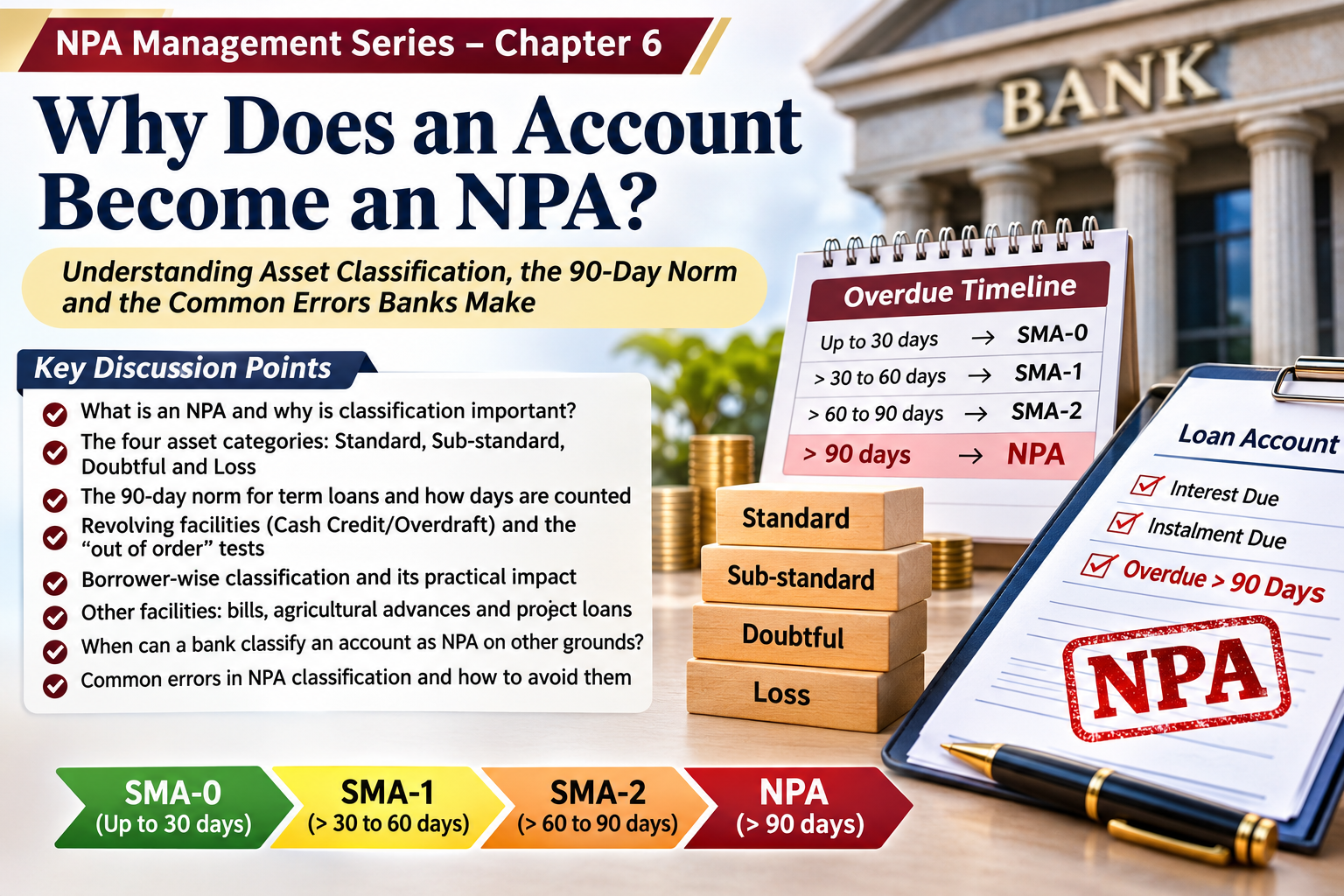
Why an Account Becomes an NPA
NPA Management Series – Chapter 6
Understanding Asset Classification, the 90-Day Norm and the Common Errors Banks Make
By Ashok Kakkar — Former Banker | Advocate | Insolvency Professional
NPA Management in Banking – From Early Warning to Final Recovery | Legal Wisdom Hub
1. Introduction
In the previous chapter we examined Special Mention Accounts (SMA), the early-warning stage that sits between a regular account and a Non-Performing Asset. SMA classification tells the bank that stress has begun. NPA classification is the formal recognition that the stress has crossed a defined line.
There is a common belief, even among some junior bank staff and many borrowers, that an account becomes an NPA because the branch manager has lost patience, or because the borrower has become “difficult”, or because the relationship has soured. That is not how it works. An account does not become an NPA because a banker decides it has. It becomes an NPA when a prescribed, objective test is met.
In most cases that test is simply arithmetic: a period of non-payment counted in calendar days. In my years in banking, I saw very few cases where the classification itself was a surprise. What caused trouble was the delay, the wrong counting of days, or the hope that a promise of payment could somehow stop the clock.
This chapter explains what an NPA is, the four asset categories, the 90-day norm and how days are counted, the position of cash credit and overdraft accounts, borrower-level classification, the limited role of judgement, and the errors that still appear in practice. The detailed consequences of NPA status, such as income recognition, provisioning and upgradation, are the subject of the next chapter.
2. What Is an NPA?
In plain language, a Non-Performing Asset is a loan or advance that has stopped producing income for the bank because the borrower has stopped servicing it as agreed. The Reserve Bank of India’s prudential norms turn this idea into a clear test. In broad terms:
- Term loans: interest or an instalment of principal remains overdue for more than 90 days.
- Cash credit and overdraft accounts: the account remains “out of order”.
- Bills purchased and discounted: the bill remains overdue for more than 90 days.
- Agricultural advances: the instalment of principal or interest remains overdue for two crop seasons in the case of short-duration crops, or one crop season in the case of long-duration crops.
Why does the system insist on a mechanical test? Because the consequences are serious. Classification decides whether the bank may continue to book interest as income, how much it must set aside as provision, and how its financial position is reported to the public and the regulator. If classification depended on personal judgement or on the strength of a relationship, there would be constant pressure to delay it. An objective rule protects the bank, the depositors and, in the long run, the borrower as well.
3. The Four Asset Categories
Under the prudential framework, a bank’s advances fall into four broad categories:
- Standard assets: accounts that are not NPAs. A standard account may still carry an SMA tag if early stress has been identified, but it remains a performing asset.
- Sub-standard assets: an NPA that has remained non-performing for a period not exceeding 12 months.
- Doubtful assets: an asset that has remained in the sub-standard category for 12 months. Doubtful assets are further graded by age, because the longer the account stays doubtful, the weaker the prospect of full recovery.
- Loss assets: assets where the bank, its auditors or the RBI have identified a loss, but the amount has not been written off wholly. Such an asset is regarded as uncollectible, even if some salvage value may remain.
When an account first becomes an NPA, it ordinarily enters the sub-standard category. Movement from sub-standard to doubtful is mainly a matter of time. Movement to loss depends on the assessment of recoverability. The financial consequences of each category, particularly provisioning, belong to the next chapter.
4. The 90-Day Norm for Term Loans
For a term loan, the rule is simple: if interest or any instalment of principal remains overdue for more than 90 days, the account is classified as an NPA.
How days are counted. The contractual due date is the starting point. If the amount remains unpaid at the close of the due date, it is treated as overdue from that date. The account crosses the “more than 90 days” threshold on Day 91, and the bank’s day-end process records the classification in accordance with the applicable RBI directions and system treatment. The precise date and treatment should be verified against the facility terms, transaction records and current regulatory instructions.
Even a small overdue counts. I have seen accounts classified as NPA because of a shortfall of a few thousand rupees in interest, while the rest of the loan was perfectly regular. The rule does not ask how large the overdue is. It asks only whether an amount due has remained unpaid for more than 90 days.
Part-payments. How a payment is appropriated between principal, interest and charges depends on the loan terms and the bank’s policy. But the principle is clear: a part-payment that leaves an amount overdue for more than 90 days does not prevent classification. The test is whether the overdue that has aged beyond the threshold has actually been cleared, not whether the borrower has paid “something”.
5. A Practical Timeline: From Due Date to NPA
Let us follow the account used in Chapter 5. A term-loan instalment falls due on 10 January and the borrower does not pay. The dates below are illustrative and assume a non-leap year.
- 10 January (Day 1): The instalment is due. If it remains unpaid at day-end, the account is overdue and enters SMA-0.
- 9 February (Day 31): The overdue has crossed 30 days. The account moves into SMA-1.
- 11 March (Day 61): The overdue has crossed 60 days. The account moves into SMA-2.
- 10 April (Day 91): The overdue has crossed 90 days. At the day-end process, the account is classified as an NPA in the sub-standard category.
The movement from SMA-0 to SMA-1, SMA-2 and NPA is continuous. There is no discretionary grace period after the applicable threshold. A meeting, assurance or internal note cannot by itself stop the classification process. Actual payment must be received, correctly appropriated and credited; even then, the overdue position must be checked in full.
Notice also what the timeline says about the banker’s opportunity. Between Day 1 and Day 91 the bank has three months in which to understand the cause of the default and act. An account that reaches Day 91 without any real attempt at resolution is a failure of monitoring, not just of the borrower.
6. Revolving Facilities: Cash Credit and Overdraft
A cash credit or overdraft account has no fixed instalment. The borrower draws and repays within a limit, so there is no single due date to count from. The regulatory test therefore looks at how the account is behaving, and the key concept is “out of order”.
Broadly, a CC/OD account is treated as “out of order” where any one of the following conditions is met for the period prescribed under the current RBI directions:
- the outstanding balance remains continuously in excess of the sanctioned limit or drawing power, whichever is lower;
- there are no credits in the account during the relevant continuous period; or
- credits during the relevant period are insufficient to cover the interest debited during that period.
The stock-statement trap. Drawing power is normally computed from stock and book-debt statements submitted by the borrower. Where drawing power is based on stock statements that are more than three months old, the account may be treated as irregular; if the irregularity continues for the prescribed period, NPA classification may follow even though the balance appears to be within the sanctioned limit. This is an important operational risk: delayed statements, stale drawing-power figures and weak follow-up can conceal deterioration.
Ad hoc and temporary excess. Ad hoc limits, “temporary” overdrawings and one-time permissions are meant for genuine and short-lived needs. They do not suspend the out-of-order test. If the account remains out of order for the prescribed period, classification follows, whatever internal approvals may have been given for the excess.
The precise tests and periods should always be checked against the current RBI directions.
7. Other Facilities in Brief
Some facilities follow their own rules, and the banker must not default to the term-loan test.
- Bills purchased and discounted become NPA when they remain overdue for more than 90 days.
- Agricultural advances are linked to crop seasons rather than to a fixed number of days, in recognition of the seasonal nature of farm income.
- Project loans have special treatment where the project does not begin commercial operations within the stipulated period and the permitted extensions.
The detailed rules are set out in the current RBI directions. The point for the practising banker is that special norms exist, and that a facility must be classified under the norm that actually applies to it.
8. Borrower-Level Classification
One of the most important, and most often misunderstood, principles is that classification is generally done borrower-wise, not facility-wise. If one facility of a borrower becomes an NPA, the other facilities of that borrower with the same bank are, as a rule, also classified as NPA, regardless of how well they are being serviced.
In practice, this means that a perfectly regular term loan can be classified as NPA because the borrower’s cash credit account has been out of order. The logic is straightforward. Credit risk lies in the borrower, not in a single ledger. If the borrower cannot service one facility, it is unrealistic to treat the others as fully safe. A bank that keeps the “good” account as standard while the other account is an NPA is understating risk and overstating income.
Two practical cautions follow. First, the rule depends on the bank’s records identifying the borrower correctly. I have seen cases where facilities of the same borrower were held under separate customer IDs and one of them escaped classification simply because the system did not link them. Second, the directions contain specific provisions and exceptions for particular categories of loans, so the current text should always be checked.
In consortium and multiple-banking arrangements, each bank classifies the facilities on its own books, according to the conduct of the account with that bank. One lender’s classification does not automatically bind another, although information sharing means that a default with one bank is quickly known to the others.
9. Classification Based on Other Factors
The day-count rule is the principal test, but the applicable prudential directions also contain provisions for exceptional circumstances involving serious impairment of recoverability or security. Facts such as substantial erosion in security value, fraud-related findings, diversion of funds or grave irregularities may have classification consequences under the specific rules that apply. These circumstances should not be presented as an automatic, free-standing substitute for the normal classification tests.
Any exceptional classification decision must be supported by the applicable RBI provision, the facts on record and a reasoned decision by the competent authority. It must never be used to postpone classification after the normal threshold has been crossed, nor should it be invoked casually without evidence. Auditors should examine the basis and documentation closely.
10. Common Errors in NPA Classification
The rules are clear, yet the same mistakes keep appearing in audits and inspections.
- Delaying classification because the borrower has promised to pay. A promise, a post-dated cheque or an uncollected instrument does not stop the clock. Only cleared funds do.
- Window-dressing and evergreening. Funds are credited near month-end or quarter-end only to keep the account from crossing 90 days, and are withdrawn soon afterwards. The pattern of “regularise, then stress again” is a classic warning sign, and it invites serious supervisory attention.
- System and data errors. A wrong due date, a wrong repayment schedule, delayed posting of credits or unlinked customer IDs can make automated classification unreliable. The loan documents, the sanction terms and the CBS records must agree.
- Treating restructuring or in-principle approval as regularisation. A restructuring proposal, or an in-principle approval from a higher authority, does not by itself change the classification of the account. It remains subject to the normal norms until the arrangement is actually implemented and the applicable conditions are met.
- Ignoring the borrower-level rule. Holding one facility as standard while another facility of the same borrower is an NPA.
- Poor documentation. Classification decisions, especially discretionary ones, need a clear record of the facts and the authority behind them.
11. The Role of the Auditor and the Controlling Office
Asset classification is among the most closely examined areas in a bank. Concurrent auditors, internal inspectors, statutory auditors and the supervisor all test it, and the same questions come up each time.
Typical audit checks include whether any SMA-2 accounts have crossed the 90-day mark without being classified; whether the facilities of the same borrower are linked and treated alike; whether drawing power is based on current stock statements; whether classification dates are correct; and whether interest on identified NPAs has been treated as the norms require. This links directly with Chapter 1, which looked at how a bank auditor reviews an advance.
The controlling office and the credit monitoring function carry the same responsibility in real time. Under-reporting of NPAs can attract regulatory observations, financial penalties and, where it is material, public disclosure of the difference between the bank’s reported position and the supervisor’s assessment. In my experience, the cost of timely and correct classification is almost always lower than the cost of discovery by someone else.
12. A Short Forward-Looking Note
The RBI has announced a move towards an expected-credit-loss (ECL) provisioning framework, with implementation scheduled in stages from 1 April 2027, subject to the applicable directions and transition arrangements. The approach is intended to make provisioning more forward-looking by considering stages of credit deterioration, rather than relying only on the performing/non-performing distinction.
For bankers, the practical message is that the identification and classification rules discussed in this chapter remain important. Early stress—already visible through SMA monitoring—will also be relevant to the transition. Banks should apply the rules currently in force and prepare systems, data and processes in line with the framework applicable to them.
Conclusion
An account becomes an NPA when an objective, largely mechanical test is met: most commonly, an amount overdue for more than 90 days, or the equivalent out-of-order conditions for revolving facilities. Classification is not an act of punishment against the borrower, nor a matter of the banker’s mood. It is a discipline that keeps the bank’s reported position honest.
The lessons for the banker are simple. Count days correctly. Apply the right test to the right facility. Remember that classification is generally borrower-wise. Do not let promises, ad hoc arrangements or in-principle approvals substitute for actual payment. And, above all, use the three months between the first default and Day 91 for real action rather than for waiting.
What Comes Next?
Once an account has been classified as an NPA, what changes? In the next chapter we will examine the consequences that follow: how interest is treated, how the financial impact is measured, when an account can return to standard status, and what the bank should do in the days immediately after classification.
Series navigation: ← Previous: Chapter 5 – Special Mention Accounts (SMA): Classification, Monitoring and the Road to NPA | Back to NPA Management Series | Next: Chapter 7 – What Happens After an Account Becomes an NPA? →
Message to the Reader
Have you come across an account where a promise of payment, a stale drawing-power statement or an incorrect system entry affected timely NPA classification? Share your practical observations and learning in the comments. The discussion can help other banking professionals recognise and avoid similar errors.
Disclaimer: This chapter is intended for general educational purposes and is based on practical banking experience. It summarises key principles of the Reserve Bank of India’s prudential norms on income recognition, asset classification and provisioning, which apply primarily to commercial banks. Readers should refer to the latest RBI master circulars and directions, the facility-specific instructions and their own bank’s approved policies for operative guidance. Nothing in this series constitutes legal or regulatory advice.