
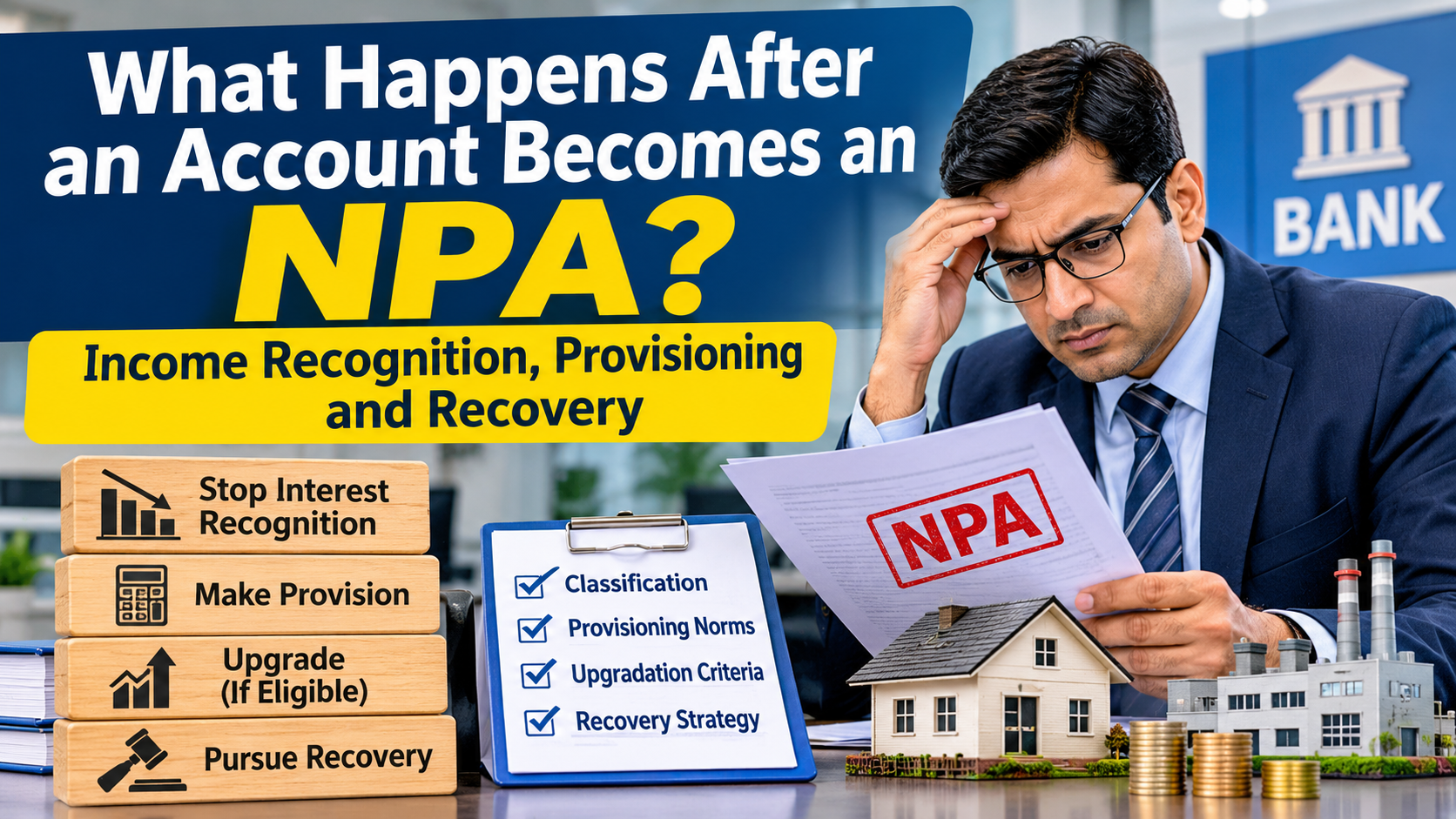
What Happens After an Account Becomes an NPA?
Understanding Income Recognition, Provisioning, Upgradation and Immediate Actions by Banks
NPA Management in Banking – From Early Warning to Final Recovery | Chapter 7
Ashok Kakkar
Advocate | Insolvency Professional | Banking Consultant | M.Com | LL.B. | LL.M. | CAIIB
Introduction
During my years in banking, I have seen an account being classified as a Non-Performing Asset (NPA) in the day-end process of the banking system within a matter of seconds. However, the consequences of that single classification continue to affect the bank’s books, the branch’s workload and its relationship with the borrower for months and sometimes years.
Chapter 6 of this series explained why an account becomes an NPA, the applicable classification criteria and the circumstances leading to deterioration in asset quality. This chapter takes the discussion forward and examines what actually changes once an account is classified as an NPA.
The consequences are significant. The bank has to stop recognising unrealised interest as income, reverse income already recognised but not received, make appropriate provisions, reassess its security and documentation, and formulate a suitable recovery strategy.
NPA classification is therefore not merely an accounting entry or a change in the system-generated status of an account. It marks the beginning of a more intensive phase of credit monitoring, risk management and recovery.
The discussion is intended primarily for branch managers, credit officers, auditors and banking professionals, while also being useful to borrowers, students and other readers interested in understanding the practical aspects of NPA management.
1. What Changes When an Account Becomes an NPA?
Three important changes take place when an account is classified as an NPA.
First, the asset classification changes. The account moves from the standard category to the appropriate NPA category, namely substandard, doubtful or loss, depending upon the period for which it has remained non-performing and the applicable prudential norms.
Asset classification is generally borrower-wise and not facility-wise. Therefore, where one credit facility of a borrower becomes NPA, the other credit facilities granted to the same borrower by the same bank are also ordinarily classified as NPA, subject to specific regulatory exceptions.
Second, the financial position of the bank is affected. Unrealised interest and other income already recognised but not received have to be reversed in accordance with applicable directions. The bank must also make provisions against the risk of non-recovery. These provisions affect the Profit and Loss Account and, consequently, the bank’s profitability and financial position.
Third, the approach towards the borrower changes. A standard account is generally managed through routine credit monitoring, whereas an NPA requires closer examination of the borrower’s financial position, the security available, the enforceability of documents and the prospects of recovery.
In simple terms, an NPA is no longer treated as an ordinary performing credit relationship. It becomes an account requiring focused attention, corrective measures and a well-considered recovery strategy.
2. Income Recognition – Why Banks Stop Recognising Interest as Income
One important distinction that banking professionals and borrowers should understand is that charging interest under a loan agreement and recognising that interest as income in the bank’s books are two different matters.
In a standard account, interest is generally recognised on an accrual basis because regular recovery is expected. Once the account becomes an NPA, the bank cannot continue recognising unrealised interest as income merely because it is contractually due.
Under the prudential norms, income from an NPA is generally recognised only when actually received. This principle applies irrespective of the availability of security or the existence of a guarantee, subject to specific regulatory provisions governing particular categories of exposure.
The underlying principle is that a bank should not report income which has not actually been realised. Otherwise, its financial statements may reflect profits that have not been earned in cash.
The same prudential approach applies to fees, commission and similar income to the extent prescribed under the applicable income-recognition directions.
3. Reversal of Interest and the Memorandum Account
When an account becomes an NPA, the bank has to ensure that unrealised interest is not retained as recognised income.
Interest already charged to the account and credited to the Profit and Loss Account, but not actually recovered, has to be reversed in accordance with the applicable RBI directions. Interest accruing thereafter must not be recognised as income merely on an accrual basis.
Banks may continue to maintain a record of contractual interest in a memorandum or other appropriate record as prescribed by their accounting systems and policies. This enables the bank to keep track of its contractual claim without treating unrealised interest as realised income.
Illustration:
Suppose interest of ₹3 lakh was charged to a cash-credit account during the previous quarter and credited to the bank’s income account, but the borrower did not pay it. When the account becomes NPA, the unrealised interest is reversed from income in accordance with the applicable accounting treatment.
Interest accruing subsequently is also dealt with under the prescribed NPA accounting mechanism and is not recognised as income until actually received.
If the borrower subsequently pays interest in cash, the amount actually recovered may be recognised as income, subject to the applicable conditions.
An important safeguard is that such recovery should not be funded through a fresh or additional credit facility sanctioned by the same bank to the borrower. A bank cannot treat money advanced by itself to meet its own interest dues as genuine recovery.
A common operational mistake is to continue recognising interest as income merely because the system continues to calculate or debit interest. Banks must ensure that the system-generated accounting treatment is consistent with the applicable prudential norms.
4. Provisioning – Setting Aside Funds Against Expected Losses
Provisioning is the process through which a bank recognises the potential loss arising from advances that may not be fully recovered.
It is an accounting charge to the Profit and Loss Account. It does not mean that an equivalent amount of money is physically transferred to a separate account.
When an advance becomes non-performing, the bank can no longer assume that the entire outstanding amount will be recovered. The borrower may be unable to repay, the security may have deteriorated in value, or the recovery process may take considerable time.
Provisioning ensures that the financial statements reflect the risk associated with such advances and that profits are not overstated.
It is important to distinguish between classification and provisioning. Classification determines the category of the asset, whereas provisioning determines the amount to be recognised against the potential loss.
The provision depends upon the category of the NPA, the period for which it has remained in that category, the realisable value of eligible security and other applicable regulatory requirements.
For general understanding, the principal provisioning norms under the applicable IRACP framework are explained below.
A. Substandard Assets
A substandard asset is generally one that has remained an NPA for a period up to twelve months.
The general provisioning requirement is 15% of the total outstanding amount, without reducing it for the value of security.
Where the exposure is unsecured, an additional provision of 10% is generally applicable, taking the total provision to 25%.
An exposure is treated as unsecured for this purpose where the realisable value of eligible security, as assessed from the beginning, is not more than 10% of the outstanding exposure.
Certain specified categories, including eligible infrastructure exposures with prescribed escrow arrangements, may attract different provisioning treatment.
B. Doubtful Assets
An asset becomes doubtful when it has remained in the substandard category for twelve months.
Provisioning is required on both the secured and unsecured portions of the outstanding amount.
The unsecured portion is generally provided for at 100%.
For the secured portion, the general provisioning rates are:
- Up to one year in the doubtful category: 25%.
- More than one year and up to three years: 40%.
- More than three years: 100%.
The value of security considered for this purpose should be its realistic realisable value, determined in accordance with the applicable regulatory requirements.
C. Loss Assets
A loss asset is one where the loss has been identified by the bank, its internal or external auditors, or an RBI inspection, but the amount has not been fully written off.
Such assets should ordinarily be written off. If they continue to remain in the books, a provision of 100% is generally required.
These are the broad provisioning norms. Special categories of advances, eligible credit guarantee arrangements, restructuring provisions and other specific regulatory requirements may result in different or additional treatment.
It is also important to remember that guarantees, comfort letters and other intangible support are not ordinarily treated as tangible security for calculating the secured portion. However, specific regulatory provisions relating to eligible credit guarantee schemes must be examined separately.
5. A Numerical Illustration of Provisioning
Consider a term loan with an outstanding balance of ₹100 lakh. The realisable value of eligible security is assessed at ₹70 lakh. The portion not covered by security is therefore ₹30 lakh.
When the account is substandard:
The general provision is 15% of the total outstanding of ₹100 lakh.
Provision required = ₹100 lakh × 15% = ₹15 lakh.
Since the security value is more than 10% of the outstanding exposure, the additional 10% provision for an unsecured exposure does not apply in this illustration.
Had the realisable value of security been ₹10 lakh or less, the exposure would generally have been treated as unsecured and the provision would have been 25%, amounting to ₹25 lakh.
When the account becomes doubtful:
Assuming the security value remains ₹70 lakh:
- Secured portion: ₹70 lakh.
- Unsecured portion: ₹30 lakh.
For the first year in the doubtful category:
Provision on secured portion = ₹70 lakh × 25% = ₹17.50 lakh.
Provision on unsecured portion = ₹30 lakh × 100% = ₹30 lakh.
Total provision = ₹47.50 lakh.
If the account remains doubtful for more than one year but not more than three years:
Provision on secured portion = ₹70 lakh × 40% = ₹28 lakh.
Provision on unsecured portion = ₹30 lakh.
Total provision = ₹58 lakh.
Thus, the provision increases from ₹15 lakh at the substandard stage to ₹58 lakh during the later doubtful stage, without any fresh lending by the bank.
This illustrates why timely recovery efforts and realistic security valuation are important in NPA management.
6. Upgradation of an NPA Account – When Can It Become Standard Again?
An NPA does not necessarily remain an NPA permanently. An account can be upgraded to standard when the prescribed conditions for regularisation are fully satisfied.
The general rule is that the borrower should pay the entire arrears of interest and principal in respect of all credit facilities availed from the bank.
A part payment, token deposit or temporary credit does not by itself satisfy this requirement.
Where a borrower enjoys more than one credit facility from the same bank, the condition applies to all such facilities. Since classification is generally borrower-wise, clearing the overdue amount in one facility while arrears continue in another will not ordinarily justify upgradation.
In cash-credit and overdraft accounts, the bank must also satisfy itself that the account has genuinely become regular. The outstanding should be within the sanctioned limit and drawing power, and the credits should be adequate to cover the interest debited during the relevant period.
The source of repayment is also important. The bank should ensure that regularisation is genuine and not achieved through fresh or additional credit facilities or artificial fund movements designed merely to obtain an upgrade.
Regularisation is not the same as upgradation.
A solitary credit near the quarter-end or balance-sheet date does not establish that the account has recovered. Where the account continues to show inherent weakness, the bank must examine its actual conduct and recovery position before considering upgradation.
In cases involving restructuring, project-related conditions or other special circumstances, the specific RBI directions applicable to those accounts must also be considered.
7. Immediate Steps to Be Taken by the Bank After NPA Classification
The first few weeks following NPA classification are important. Prompt and coordinated action can help preserve the value of security and improve the prospects of recovery.
The following steps deserve particular attention.
1. Verify the classification
The branch should verify the overdue position, out-of-order status, system records and relevant dates to ensure that classification has been carried out correctly under the applicable norms.
2. Reconcile the outstanding amount
The outstanding should be properly examined and reconciled, including principal, interest, charges and other dues. The accounting treatment of unrealised interest should also be verified.
3. Identify and examine securities
All primary and collateral securities should be identified and verified. Their existence, condition, ownership, charge creation and enforceability should be examined. Fresh valuation should be obtained wherever required.
4. Examine loan documents and charges
The branch should verify the completeness and validity of loan and security documents, execution of necessary agreements, registration of charges, continuity of guarantees and limitation-related requirements.
5. Review stock, drawing power and insurance
In working-capital accounts, stock statements, book debts, drawing power and the value of current assets require particular attention. Insurance coverage on stocks, machinery and buildings should be checked for validity and adequacy.
For NPAs with an outstanding balance of ₹5 crore and above, the RBI directions provide for annual stock audits by external agencies and valuation of charged immovable collateral once in three years.
6. Communicate with the borrower and guarantors
The borrower and guarantors should be appropriately informed about the account status and outstanding dues. The bank may also explore the possibility of regularisation, a viable repayment arrangement or settlement, depending upon the circumstances.
7. Decide the recovery strategy
The bank should assess the borrower’s repayment capacity, available security, legal position and likely recovery prospects. Depending on the facts, suitable measures may include negotiation, compromise settlement, restructuring where permissible, enforcement under applicable laws, proceedings before the Debt Recovery Tribunal or assignment to an asset reconstruction company.
The recovery strategy should be properly documented and periodically reviewed.
These steps convert NPA classification from an accounting event into a structured recovery and resolution process.
8. Role of the Branch Manager, Credit Department and Auditor
Effective NPA management requires coordination between the operating branch, the controlling office and the audit function.
Branch Manager
The Branch Manager is responsible for ensuring correct classification, proper accounting of interest, review of securities and documentation, communication with the borrower and timely initiation of recovery measures.
The branch should maintain complete records of recovery efforts and ensure that the account receives continuous attention.
Credit Department or Controlling Office
The Credit Department or Controlling Office reviews the classification and provisioning, examines the adequacy of security and documentation, and guides the branch in deciding the recovery strategy.
Large NPA accounts require closer monitoring and appropriate reporting under the bank’s internal policies.
Concurrent or Internal Auditor
The auditor independently examines whether NPA classification has been correctly carried out, unrealised income has been reversed, provisions are adequate and recoveries have been properly accounted for.
The auditor should also examine whether security valuations are current, documentation is complete and any upgradation has been allowed only after satisfying the prescribed conditions.
Timely audit observations help banks correct deficiencies before they develop into larger supervisory or financial issues.
9. Common Mistakes in Handling NPA Accounts
Certain errors can weaken NPA management and result in avoidable audit observations.
Some of the commonly noticed mistakes are:
- Continuing to recognise unrealised interest as income after NPA classification.
- Incomplete reversal of interest already recognised but not recovered.
- Incorrect accounting of interest accruing after classification.
- Recognising interest recovery funded through fresh lending to the same borrower.
- Under-provisioning because of outdated or inflated security valuations.
- Treating guarantees or comfort letters as ordinary tangible security.
- Upgrading an account without clearing arrears across all applicable facilities.
- Treating temporary credits near the balance-sheet date as genuine regularisation.
- Delaying examination of documents, securities and recovery options.
- Failing to maintain proper records of recovery efforts and important decisions.
Avoiding these mistakes requires sound systems, proper documentation, continuous monitoring and coordination between the branch and controlling office.
10. A Practical Case Study – From NPA Classification to Provisioning
Consider a manufacturing company enjoying the following facilities from the same bank:
- Cash-credit limit: ₹80 lakh.
- Term loan: ₹40 lakh.
The cash-credit account has remained irregular for several months. Credits are inadequate, stock statements are not being submitted regularly and the drawing power position requires review.
After satisfying the applicable regulatory conditions, the cash-credit account is classified as NPA. Since classification is generally borrower-wise, the term loan is also classified as NPA.
For this illustration, both facilities fall in the substandard category.
Step 1 – Reversal of interest
Interest of ₹4.50 lakh, which had earlier been credited to the bank’s income account but remained unrealised, is reversed in accordance with the applicable norms. Subsequent interest is dealt with under the prescribed NPA accounting mechanism.
Step 2 – Assessment of security
The bank reviews the available stock, book debts, plant and machinery and other eligible securities.
The realisable value of eligible security is assessed at ₹75 lakh.
The total outstanding in both facilities, excluding unrealised interest separately recorded for accounting purposes, is ₹118 lakh.
Therefore:
- Total outstanding: ₹118 lakh.
- Eligible secured portion: ₹75 lakh.
- Portion not covered by security: ₹43 lakh.
Step 3 – Provisioning
Since the accounts are substandard, the general provision is calculated at 15% of the total outstanding.
₹118 lakh × 15% = ₹17.70 lakh.
For this illustration, the additional unsecured exposure provision does not apply because the eligible security value is more than 10% of the total exposure.
Step 4 – Action by the bank
The branch verifies the loan documents, examines the securities, obtains updated stock statements and insurance details, and reviews the borrower’s financial position.
It also initiates discussions with the borrower regarding repayment, regularisation or an appropriate settlement proposal.
Step 5 – Two possible outcomes
Situation A – The borrower regularises the accounts.
The borrower clears the entire arrears of principal and interest on both facilities from genuine resources.
The bank verifies that the cash-credit account has actually become regular and that all other prescribed conditions are fulfilled.
If the conditions for upgradation are satisfied, the accounts may be upgraded to standard. The provision held can then be reviewed for reversal in accordance with the applicable norms, and income recognition will follow the treatment applicable to standard accounts.
Situation B – The borrower fails to regularise the accounts.
After remaining in the substandard category for twelve months, the accounts become doubtful.
Assuming the security value remains ₹75 lakh:
Provision on secured portion = ₹75 lakh × 25% = ₹18.75 lakh.
Provision on unsecured portion = ₹43 lakh × 100% = ₹43 lakh.
Total provision = ₹61.75 lakh.
The provision has increased from ₹17.70 lakh to ₹61.75 lakh. The bank has also lost valuable recovery time.
The figures are illustrative. Actual provisioning must be determined after considering the applicable regulatory requirements, eligible security, guarantee-related provisions and the bank’s accounting policies.
11. Key Lessons for Bankers, Auditors and Borrowers
The discussion brings out some important practical lessons:
- NPA classification is both an accounting event and a credit-risk event. It changes income recognition, provisioning and the bank’s approach towards recovery.
- Unrealised interest must not be treated as income merely because it is contractually due.
- Provisioning depends on the classification category, the period of non-performance and the realisable value of eligible security.
- Upgradation requires genuine regularisation and satisfaction of the prescribed conditions across the borrower’s facilities.
- Timely examination of documents, security and recovery prospects can help prevent further deterioration.
- Automation ensures consistency in NPA identification, but professional judgment remains essential in evaluating security, repayment capacity and recovery options.
- Borrowers should not ignore early signs of financial stress. Timely communication with the bank and a realistic repayment proposal may help avoid further deterioration.
Conclusion
When an account becomes an NPA, the real work of the bank begins. It must recognise income realistically, make adequate provisions, protect its securities, examine the legal position and initiate appropriate recovery measures.
Correct classification and adequate provisioning provide a realistic picture of the bank’s financial position. Equally important are the decisions taken by the branch and controlling office to preserve the value of security and improve the prospects of recovery.
From a banker’s perspective, the objective should not merely be to identify and report NPAs but to manage them effectively and recover the bank’s dues through appropriate, timely and legally sustainable measures.
The Road Ahead – Expected Credit Loss Framework
An important regulatory development is the introduction of the Expected Credit Loss (ECL) framework by the RBI under its 2026 Directions, effective from April 1, 2027. The framework introduces a more forward-looking approach to provisioning while retaining the existing NPA classification framework. Banks will need to strengthen their credit-risk assessment, data management and provisioning systems. The principles of timely recognition of stress, realistic assessment of recoverability and adequate provisioning will, however, remain central to sound banking.
Having examined what changes in the bank’s books after NPA classification, the next chapter will focus on what happens on the ground.
Chapter 8 – Recovery of NPAs: From Follow-up to Legal Action and Resolution will examine the practical recovery process, including follow-up measures, compromise settlements, enforcement under the SARFAESI Act, proceedings before the Debt Recovery Tribunal and other available legal remedies.
Message to Readers
Dear Reader,
If you are a banker, treat every NPA classification as the beginning of a disciplined recovery process and not merely the completion of a reporting exercise.
If you are a borrower, remember that early communication with your bank and a realistic approach towards repayment are always preferable to silence and continued default.
If you are a student or professional, I hope this chapter has helped you understand how a single classification in the banking system affects income recognition, provisioning, credit administration and recovery.
I welcome your observations, questions and suggestions and look forward to your company in the next chapter.
References
- RBI (Commercial Banks – Income Recognition, Asset Classification and Provisioning) Directions, 2025, as amended and applicable.
- RBI (Commercial Banks – Resolution of Stressed Assets) Directions, 2025, as amended and applicable.
- RBI (Commercial Banks – Asset Classification, Provisioning and Income Recognition) Directions, 2026, effective April 1, 2027.
- Banking Regulation Act, 1949.
- Also to refer Relevant Board-approved policies of banks.
- Author’s practical experience in banking, credit administration and recovery.
Disclaimer
This article is intended for general educational and professional awareness and reflects the author’s understanding and practical experience. Regulatory provisions and provisioning requirements are subject to amendments and special conditions. Readers should refer to the latest RBI directions and applicable bank policies before taking decisions in individual cases. This article does not constitute legal, financial or professional advice.
Ashok Kakkaraa