
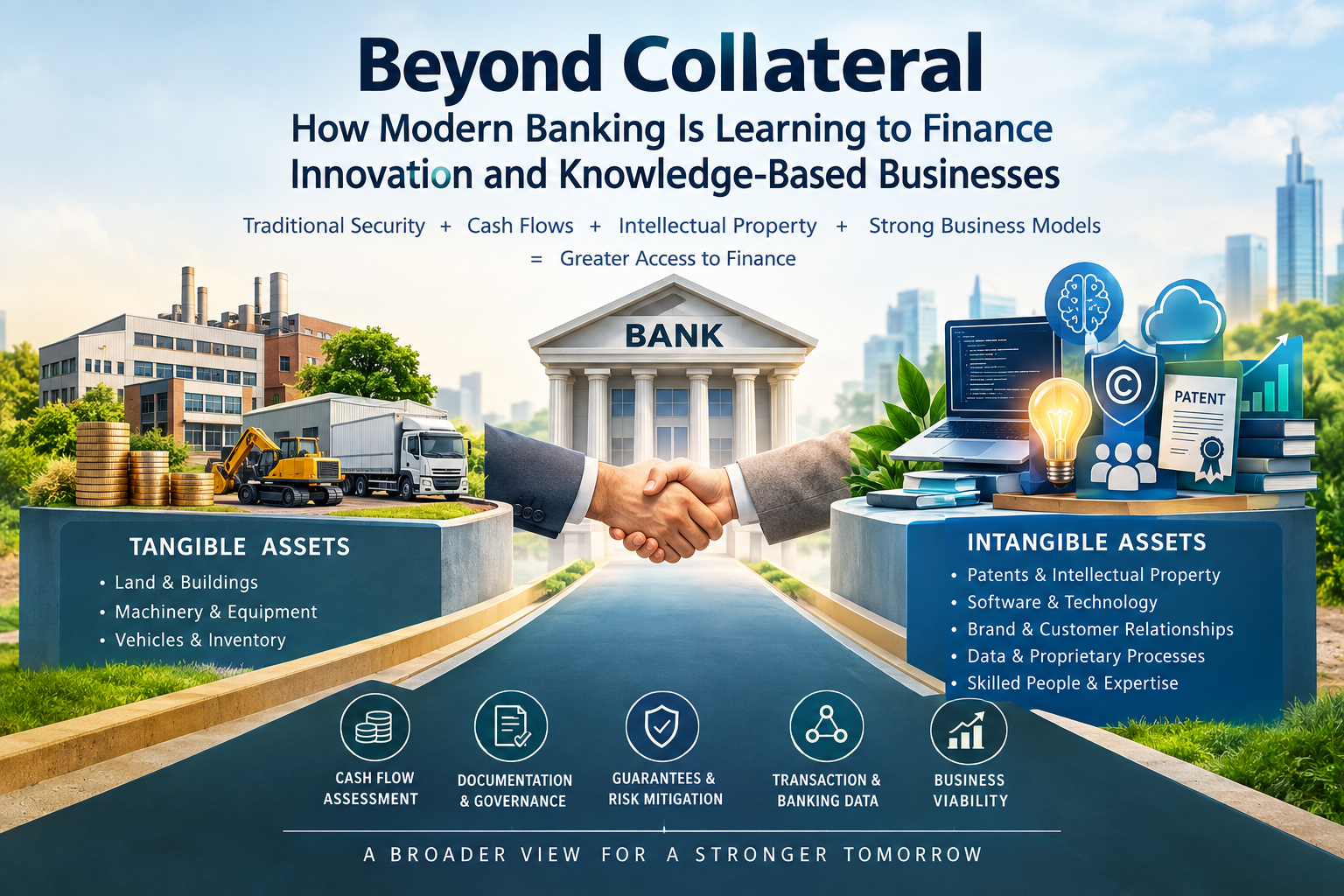
Beyond Collateral: How Modern Banking Is Learning to Finance Innovation and Knowledge-Based Businesses
What Startups, Software Firms and Research-Driven Enterprises with Few Physical Assets Should Know About Bank Finance
By Ashok Kakkar
Former Banker | Advocate | Insolvency Professional
Introduction: Trust, Security and a Changing Economy
Banks play a central role in economic development. Every loan sanctioned by a bank involves funds entrusted by depositors and, therefore, lending decisions necessarily require prudent assessment of risk, repayment capacity and recoverability.
For generations, physical assets have provided an important source of comfort in lending. Land, buildings, plant and machinery, vehicles and stock are generally visible, measurable and capable of being inspected. Where circumstances require recovery action, such assets may also provide identifiable security for enforcement and realisation. This approach has served agriculture, manufacturing, trading and other asset-intensive businesses well.
As the economy has evolved, however, the nature of many businesses and their underlying sources of value have also changed.
A modern enterprise may operate from a relatively small office—or even through a largely digital infrastructure—with its principal strengths lying in software, data, patents, research, brands, customer relationships and specialised human skills.
This raises an important question:
How can established principles of prudent lending also be applied effectively to knowledge-driven businesses whose principal value may not be represented by traditional physical assets?
The answer is not to choose between traditional collateral and innovation. Rather, traditional security can continue to play its important role while being complemented, where appropriate, by other reliable indicators of business strength and repayment capacity.
This article examines why tangible security remains important, why intangible assets require somewhat different assessment, how various financing approaches can complement traditional lending, and what entrepreneurs can do to make their businesses more bankable.
PART A – UNDERSTANDING THE TRADITIONAL SYSTEM
1. Why Banks Have Traditionally Preferred Physical Assets
Physical security has an established place in credit appraisal because it provides lenders with several practical advantages.
i. Easier valuation
Land, buildings, machinery and other tangible assets generally have identifiable characteristics, market references and established valuation practices.
ii. Legal and documentation framework
Charges over tangible assets are supported by well-established documentation, registration and enforcement mechanisms. Depending upon the nature of the security and transaction, laws such as the SARFAESI Act also provide important enforcement mechanisms.
iii. Recoverability
Many tangible assets have recognised markets through which they can potentially be realised if recovery action becomes necessary.
iv. Physical verification
A lender can ordinarily inspect physical assets before and after sanction and monitor their existence and condition during the currency of a facility.
v. Insurance
Many physical assets can be insured against specified risks, providing an additional layer of protection.
vi. Relative predictability
Although the value of every asset can fluctuate, established physical assets may generally be easier to understand and monitor than rapidly changing technologies or commercially untested intellectual property.
The preference for tangible security should therefore not be viewed as a weakness in the traditional banking model. It is an important part of prudent risk management and provides lenders with identifiable forms of security alongside assessment of the borrower’s business and repayment capacity.
2. How the Source of Business Value Has Evolved
Modern enterprises increasingly create value through software platforms, patents and trademarks, research and development, proprietary data, artificial intelligence solutions, customer networks, brand reputation and specialised professional skills.
A software company may serve thousands of customers from a modest office. A research-oriented enterprise may possess valuable intellectual property while having relatively limited physical infrastructure.
In such businesses, the balance sheet may not always fully reflect the commercial potential of the enterprise.
The important point, however, is that commercial potential by itself cannot substitute for prudent credit assessment. The lender still needs to understand ownership, sustainability, cash generation, repayment capacity and the risks associated with the business model.
The challenge, therefore, is not to move away from established credit discipline, but to apply that discipline appropriately to different types of businesses.
3. Why Intangible Assets Require Different Credit Assessment
Intangible assets can be commercially valuable. The practical challenge lies in establishing, securing, monitoring and realising that value.
i. Valuation uncertainty
The value of a patent, software product or technology may depend significantly on future commercial success. Different assumptions about future revenues, competition and technology can result in different valuations.
ii. Limited marketability
Unlike many tangible assets, some intellectual assets may not have a ready secondary market if enforcement and realisation become necessary.
iii. Technological change
Technology can change rapidly. An asset that is commercially valuable today may face competition or obsolescence as new technologies emerge.
iv. Ownership and documentation
A lender needs clarity regarding ownership of intellectual property, registration where applicable, licensing arrangements, contractual restrictions and the rights assigned by employees, consultants or developers.
v. Monitoring
A bank can physically inspect machinery, buildings or stock. Assessing software, algorithms, databases and other specialised assets may require different forms of technical and commercial evaluation.
vi. Dependence on key people
The value of a technology or knowledge-based business may be closely connected with its founders, scientists, engineers and other key personnel. From a business continuity, insolvency and recovery perspective, the retention of such expertise can therefore be significant.
These characteristics do not reduce the importance of innovation or intellectual property. They simply mean that such businesses may require a broader and more specialised assessment of risk.
4. What This Means for Startups
A new venture may have a promising product, proprietary technology, a capable team and early customers while having limited land, buildings or machinery.
For such a business, financing may involve greater reliance on the strength of the business model, cash flows, contracts, promoters, intellectual property and other available forms of risk mitigation.
A business may consequently explore a combination of sources such as promoter contribution, equity investment, specialised finance, working-capital facilities, receivables financing or eligible guarantee-supported lending.
There is also an important difference in perspective.
The entrepreneur may reasonably think:
“I have a valuable product and a large market.”
The banker, equally reasonably, needs to ask:
“How will this business generate sufficient and predictable cash to repay the loan?”
Both questions are legitimate.
The objective is to bridge the gap between the commercial potential of the enterprise and the evidence required for prudent lending.
5. The Banker’s Side: Balancing Opportunity and Risk
Collateral is an important component of credit assessment, but it is not the only consideration.
Lenders also examine business viability, repayment capacity, cash-flow generation, management capability, financial discipline, industry conditions, market position and overall sustainability.
Every lending decision involves balancing several considerations:
- business opportunity and associated risk;
- growth and financial discipline;
- innovation and repayment capacity;
- entrepreneurship and responsible borrowing; and
- availability of appropriate risk mitigation and protection of depositors’ funds.
The evolution of business models therefore does not require a departure from sound lending principles. It calls for applying those principles carefully to different forms of economic activity.
PART B – COMPLEMENTING TRADITIONAL LENDING APPROACHES
6. Emerging Approaches to Financing Knowledge-Based Businesses
Several financing approaches can complement traditional security-based lending, depending upon the nature of the business, the lender’s policy and applicable eligibility conditions.
i. Cash-flow-based assessment
Greater attention can be given to actual and projected earnings, recurring revenues, customer contracts and demonstrated repayment capacity. Collateral can continue to provide supporting comfort wherever available.
ii. Receivables financing
Businesses with genuine commercial receivables may explore financing against eligible invoices and receivables. Platforms such as TReDS can also facilitate receivables financing for eligible MSMEs.
iii. Supply-chain finance
Established relationships with reliable buyers and suppliers can provide opportunities for structured working-capital finance based on identifiable transactions and payment flows.
iv. Venture debt
Specialised lenders may provide debt financing to certain high-growth businesses that have limited physical security. Such facilities are generally subject to specialised assessment and commercial terms.
v. Intellectual-property assessment
Patents, trademarks, copyrights and other intellectual property may, where appropriate, form part of the overall assessment of a business. Professional valuation and clear documentation can assist in understanding their commercial significance.
However, the treatment of intellectual property as security depends on the nature of the asset, ownership, documentation, valuation, enforceability, marketability and the applicable policy of the concerned lender.
vi. Data-supported assessment
GST records, banking transactions and other business information, where available through appropriate consent-based mechanisms such as the Account Aggregator framework, can help lenders obtain a clearer picture of actual business activity and cash flows.
vii. Credit guarantee support
Government-backed credit guarantee schemes, including schemes such as CGTMSE and other applicable programmes, can provide risk-sharing support for eligible borrowers and facilities.
The availability, eligibility conditions, limits, coverage and terms of such schemes may change from time to time. Businesses should therefore verify the current position from the concerned lender or official scheme source before making financial decisions.
7. The Legal Framework and Intangible Assets
The legal framework in India recognises various forms of intangible property. The SARFAESI Act, for example, contains a broad definition of “property” that includes certain intangible assets such as know-how, patents, copyrights, trademarks, licences and franchises.
Legal recognition, however, does not by itself determine whether a particular intangible asset will be suitable or sufficient as lending security.
A lender may still need to consider:
- whether the asset can be clearly identified;
- whether the borrower has valid and transferable rights;
- whether ownership and documentation are satisfactory;
- whether its value can be independently assessed;
- whether an effective security interest can be created and monitored;
- whether applicable registrations or filings are required; and
- whether there is a realistic possibility of realisation if recovery becomes necessary.
These practical considerations explain why intangible assets may require a different approach from conventional physical security.
8. What Can Further Strengthen the Ecosystem
The development of knowledge-based businesses may benefit from:
- credible and consistent approaches to valuation of intangible assets;
- deeper and more transparent secondary markets for suitable intellectual property;
- greater understanding of technology and research-sector risks among professionals involved in credit assessment;
- appropriate use of guarantees and risk-sharing mechanisms;
- better documentation and protection of intellectual property by businesses; and
- appropriate insolvency and recovery preparedness for IP-intensive enterprises.
The objective should not be to make lending easier merely because a business is innovative.
The objective should be to enable better-informed credit assessment, so that genuine business strength can be properly understood wherever that strength resides, while maintaining appropriate standards of prudence and risk management.
PART C – WHAT ENTREPRENEURS CAN DO NOW
9. Building a Bankable Profile Without Significant Property
Limited physical assets do not necessarily mean that a business cannot establish bankability.
A startup or knowledge-based enterprise can strengthen its credit profile by creating credible and verifiable evidence of its business strength.
1. Maintain proper financial records
Accounts should be accurate, current and properly supported. Statutory filings, including GST and income-tax returns where applicable, should be maintained in an orderly manner and within prescribed timelines.
2. Build a visible banking track record
Genuine business receipts and payments should be routed through appropriate banking channels. A clear transaction history helps demonstrate actual business activity and cash-flow patterns.
3. Protect and document intellectual property
Identify the intellectual property owned or used by the business and ensure that appropriate registration, protection and documentation are undertaken wherever applicable.
4. Make ownership clear
Employee, consultant and developer agreements should clearly address ownership and assignment of intellectual-property rights wherever relevant.
5. Develop recurring revenue
Long-term customer relationships, subscriptions and recurring contractual revenues can provide useful evidence of business continuity and repayment capacity.
6. Prepare realistic projections
A business plan should clearly answer four basic questions:
- How much finance is required?
- Why is it required?
- How will the finance contribute to income generation?
- How will the borrowing be repaid?
7. Build a repayment track record
Where appropriate, businesses can begin with appropriately structured facilities within their repayment capacity. Timely repayment can help establish a credit history and demonstrate financial discipline.
8. Explore eligible guarantee-supported or collateral-light options
Businesses may examine guarantee-backed or other suitable financing options applicable to their size, sector and circumstances, subject to eligibility and the terms of the concerned lender or scheme.
9. Use debt and equity appropriately
Debt and equity can serve different purposes. Borrowing should be undertaken with careful consideration of the business’s ability to service the debt from sustainable cash flows.
10. Where Professionals Can Help
Chartered accountants, company secretaries, lawyers, valuers, insolvency professionals and other specialised advisers can assist businesses in presenting their financial information, contracts, intellectual property and business models in a clear and organised manner.
The purpose of professional assistance should not be to make a business appear less risky than it actually is.
Rather, it should be to help the lender understand the business accurately, including its strengths, risks, obligations and repayment capacity.
MESSAGE TO READERS
To Entrepreneurs and Startups
If you own limited physical property, do not assume that you have nothing to offer a lender.
At the same time, a good idea by itself is not sufficient for prudent borrowing.
Business strength needs to be demonstrated through disciplined financial records, visible cash flows, sound contracts, clearly documented intellectual property, credible business activity and a realistic repayment plan.
To Bankers
Prudence and innovation are not opposites.
Tangible security will continue to have an important place in banking. At the same time, understanding newer business models and the different forms in which business value is created can assist in making a more complete assessment of the credit proposition, wherever the lender’s policy and applicable framework permit.
To Professionals
The knowledge economy requires professionals who can understand both conventional financial statements and businesses whose value is substantially based on intellectual capital, technology, contracts and specialised human resources.
To Students
The banking, legal and insolvency practice of tomorrow will require an understanding of collateral and cash flows as well as technology, intellectual property, business models and intangible value.
Conclusion
Physical collateral has an important and well-established place in banking for sound and practical reasons. It provides lenders with relatively clear methods of identification, valuation, documentation, monitoring and, where necessary, recovery. It will therefore continue to remain an important component of prudent lending.
At the same time, the nature of business value is evolving. In many modern enterprises, significant value may lie not only in land, buildings or machinery, but also in patents, software platforms, research and technology, customer contracts, recurring revenues, proprietary processes and specialised knowledge.
The way forward, therefore, is not to replace traditional security, but to complement it, where appropriate, with broader methods of assessing business strength and repayment capacity. Cash-flow assessment, appropriate evaluation of intellectual property, receivables financing, credit guarantees, transaction and banking data, and other risk-mitigation mechanisms can provide additional support, subject to the applicable regulatory framework and the credit policy of the concerned lender.
It is also important to recognise that the legal recognition of an intangible asset does not, by itself, mean that a bank is required to accept that asset as security or assign it a particular lending value. Its acceptability as security will depend upon factors such as ownership, documentation, enforceability, valuation, marketability, the nature of the asset, applicable regulations and the lender’s credit policy.
For banks, the emerging approach is therefore one of understanding newer business models while maintaining established principles of credit discipline, risk assessment and responsible lending.
For entrepreneurs, the message is equally important. A business seeking finance must demonstrate genuine business activity, sound financial records, appropriate documentation, sustainable cash flows, effective risk mitigation and a credible capacity to repay. Where traditional collateral is limited, these aspects can become particularly important in establishing the overall bankability of the business.
The future of lending, therefore, need not be a world without collateral. Rather, it can be a lending environment in which collateral remains one important component of a broader understanding of value, risk, cash flows and repayment capacity.
That is the practical meaning of going “Beyond Collateral”—not moving away from prudent banking, but broadening the way business strength and creditworthiness are understood in an evolving economy.
Disclaimer
This article is intended for educational and general public-awareness purposes only. It does not constitute legal, financial, investment, regulatory or credit advice. Lending decisions and applicable requirements may vary depending on the lender, borrower, business circumstances and prevailing laws and regulations. Readers should verify the current position from official sources and seek professional advice where necessary.
Ashok Kakkar
#Banking, #Start up Finance, #Intellectual Property, #Innovation Economy, #Credit Risk Management, #Business Finance, #Financial Inclusion, #Future Of Lending,