
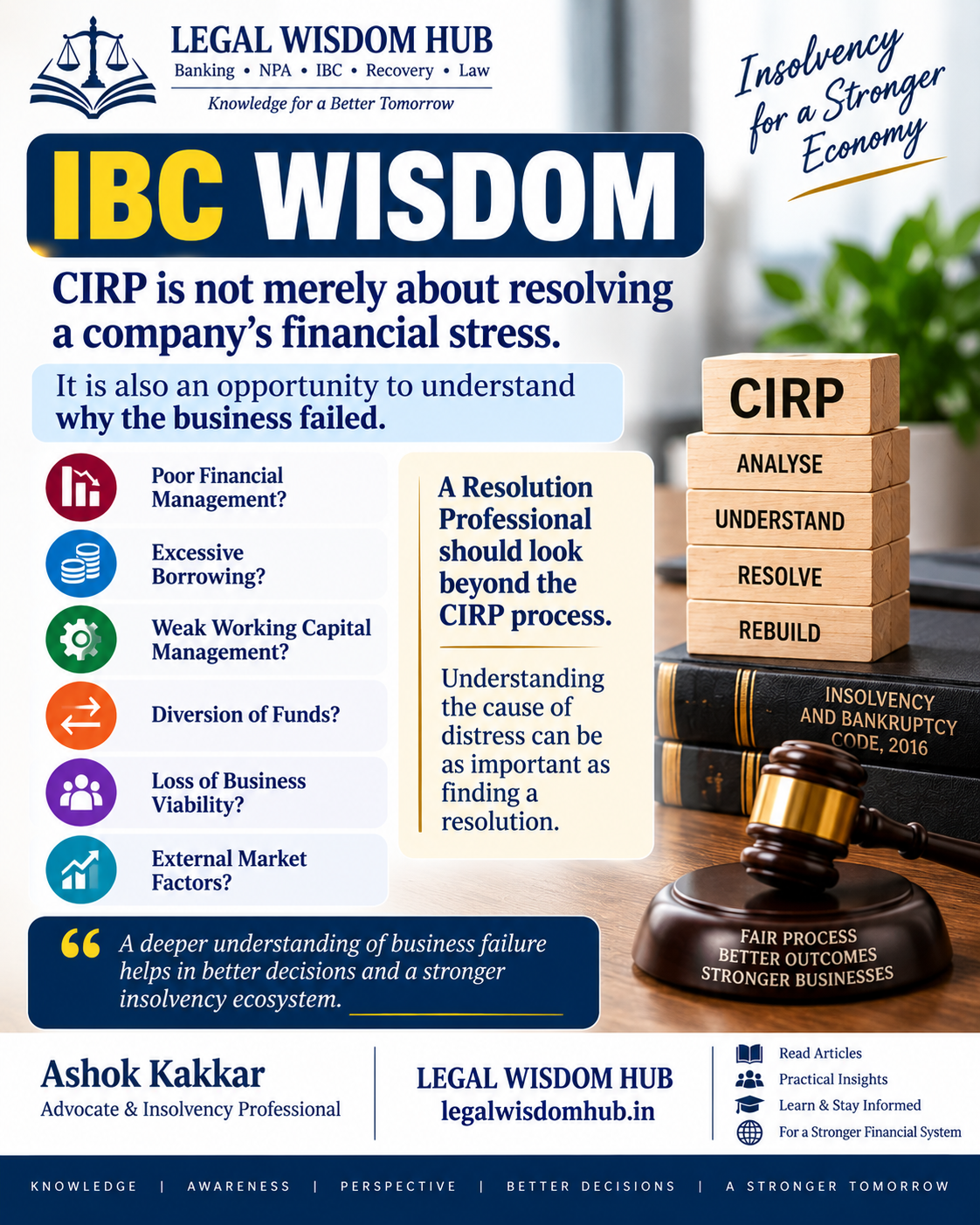
Beyond Resolution: Understanding the Causes of Business Failure in CIRP
Why Understanding the Business Before Evaluating Resolution Options Matters
Ashok Kakkar — Advocate & Insolvency Professional
Introduction
The Insolvency and Bankruptcy Code, 2016 (“IBC”) was enacted to consolidate and amend the laws relating to the reorganisation and insolvency resolution of corporate persons in a time-bound manner. The Corporate Insolvency Resolution Process (“CIRP”) under the Code is the mechanism through which a financially distressed corporate debtor is placed before its creditors, with the object of finding a viable resolution rather than allowing the company to simply be wound up.
Because CIRP operates under a strict statutory timeline, there is a common perception — even among some professionals — that once CIRP is admitted, the Resolution Professional (“RP”) must move as quickly as possible towards inviting and evaluating resolution plans. The urgency of the timeline, however, should not result in important preliminary steps being overlooked or compressed unnecessarily.
Admission of CIRP does not mean that the RP moves immediately to a resolution proposal. The Code and the applicable regulations contemplate a structured process between admission and the eventual consideration of resolution plans. An important professional consideration within that process is developing an informed understanding of why the business failed, what caused its financial distress, and whether and how it can potentially be moved back towards viability.
This understanding is not merely a peripheral exercise. It can inform the approach of the Committee of Creditors (“CoC”) and help prospective resolution applicants assess whether the underlying business can realistically be revived.
The Sequence of Steps After Admission — Why Understanding the Business Matters
On admission of CIRP, a defined framework of activities follows, each contributing to the foundation for a sound resolution process. The following broad steps illustrate why understanding the corporate debtor should remain an important focus:
1. Public Announcement and Moratorium — The commencement of CIRP is publicly announced, and a moratorium is imposed in accordance with the Code to provide the statutory protection contemplated during the process.
2. Appointment of the RP and Cooperation of the Suspended Board — The Interim Resolution Professional is appointed and, subject to the statutory process, is later confirmed as RP. The erstwhile management is required to provide records and extend cooperation as required under the Code.
3. Collection, Verification and Admission of Claims — Claims are invited from financial creditors, operational creditors and other stakeholders and are examined on the basis of available supporting records.
4. Constitution of the Committee of Creditors — The CoC is constituted in accordance with the Code on the basis of admitted financial debt and becomes the principal decision-making body for matters within its statutory remit.
5. Taking Control and Custody of Assets — The RP takes control and custody of the assets of the corporate debtor as required by the Code, arranges for their valuation where applicable, and works to preserve and protect them.
6. Examination of the Corporate Debtor’s Financial and Operational History — Information available to the RP — including financial statements, bank transactions, books of account, statutory records, borrowing patterns and related-party dealings — can be examined to develop an informed understanding of how and why the corporate debtor reached its present state of distress.
7. Preparation of the Information Memorandum — The understanding gathered during the process contributes to the Information Memorandum, which is intended to provide the CoC and prospective resolution applicants with relevant information concerning the corporate debtor and its affairs.
8. Invitation, Evaluation and Approval of Resolution Plans — The information and understanding developed during the CIRP provide an important foundation for inviting, evaluating and approving resolution plans in accordance with the applicable statutory and regulatory framework.
The key point is that understanding the causes of business failure should inform the resolution process. A resolution plan that addresses only the financial structure, while leaving the underlying commercial problem untouched, may face significant challenges in achieving sustainable revival.
CIRP Should Also Encourage an Understanding of the Business
The RP is required to conduct the CIRP within the statutory framework of the IBC. At the same time, the information that becomes available during the process — financial statements, bank transactions, books of account, statutory records, receivables, inventory, borrowing patterns, related-party transactions and other relevant material — can provide a much broader picture of the corporate debtor’s financial and operational history.
A company does not, as a rule, become financially distressed overnight. In many cases, the distress visible at the time CIRP commences is the cumulative result of problems that developed over a considerable period. The objective of examining this history is not to assign blame merely because a company has failed. Rather, understanding the reasons for failure can help the CoC, resolution applicants and other stakeholders make better-informed decisions about the future of the business.
What May Have Contributed to the Distress
Some common areas that deserve close attention while examining the corporate debtor’s history include the following.
1. Poor Financial Management — Inadequate financial planning, weak control over expenditure, poor cash-flow management, or failure to respond to financial stress at an early stage can gradually weaken a business.
2. Excessive Borrowing — Debt can support business growth when appropriately structured and serviced. However, excessive borrowing without a corresponding growth in cash flows can place significant pressure on the business.
3. Weak Working-Capital Management — A business may show turnover, and even accounting profits, while facing serious cash-flow problems. Delayed receivables, excessive inventory, inadequate working capital and a mismatch between inflows and outflows can create financial stress.
4. Diversion or Misapplication of Funds — Where borrowed funds are not utilised for the purposes for which they were sanctioned, the financial position of the business may deteriorate further. Examination of fund movements can therefore be an important part of understanding the financial history.
5. Loss of Business Viability — Changing customer preferences, technological developments, increased competition, declining margins or an unsustainable business model may affect the long-term viability of a company.
6. External Market Factors — Not every business failure is the result of poor management. Economic downturns, regulatory changes, supply-chain disruptions, market shocks and other external factors can also materially affect a business.
Looking Beyond the Balance Sheet
A balance sheet tells us about the financial position at a particular point in time. Understanding business failure, however, often requires looking at the story behind the numbers. Some questions worth asking include:
- Why did sales decline?
- Why did receivables increase?
- Why was additional borrowing required?
- Why did working capital remain under pressure?
- Why did the business lose customers or margins?
- Were borrowed funds used for the intended business purpose?
- Were there significant changes in the business model?
- Were early warning signs visible but not addressed?
These questions may help stakeholders develop a more complete understanding of the corporate debtor — an understanding that a set of financial statements alone rarely provides.
Understanding Failure Can Help in Resolution
For a prospective resolution applicant, understanding the reasons for past failure can be particularly important. If the underlying problem was temporary and capable of being corrected, the business may have a realistic opportunity for revival. If, however, the business model itself has become commercially unviable, simply restructuring its financial liabilities may not be sufficient.
A successful resolution should ideally address not only the financial structure but also the commercial realities of the business.
A Broader Perspective for the Resolution Professional and the CoC
The RP need not become a business consultant or a management strategist. However, identifying significant financial and operational patterns can help present a clearer picture of the corporate debtor to the CoC and other stakeholders. This should remain a continuing focus during the process rather than a box to be ticked once and set aside.
Where circumstances warrant, issues requiring further examination should be appropriately identified and dealt with in accordance with the applicable legal and regulatory framework.
From Distress to Learning
1. For Lenders — The case may highlight weaknesses in credit appraisal or post-sanction monitoring.
2. For Management — It may reveal shortcomings in financial discipline, governance or business strategy.
3. For Prospective Resolution Applicants — It may identify the changes required to make the business viable again.
4. For Insolvency Professionals — It reinforces the importance of examining the corporate debtor’s affairs carefully and understanding the commercial context behind the financial data.
Conclusion — A Message to the Reader
CIRP should not be viewed merely as a process for dealing with a company’s financial stress, nor should admission of CIRP be treated as a signal for the RP to move mechanically towards a resolution proposal. Between admission and resolution lies a structured process, and an important part of that process is developing an informed understanding of the journey that led the business to distress.
The question before the RP, the CoC and every resolution applicant is not simply “How can this company be resolved?” but also “Why did this business fail, and what needs to change for it to become viable again?” Keeping this second question in focus throughout the process can contribute to better-informed decisions, more realistic resolution strategies and, ultimately, a stronger insolvency ecosystem.
Understand the failure. Analyse the causes. Find the resolution. Rebuild where viable.
— Ashok Kakkar
Advocate & Insolvency Professional | Legal Wisdom Hub
Disclaimer
This article is for general awareness and professional discussion only and does not constitute legal, financial or professional advice. Readers are advised to seek specific professional guidance and to refer to the applicable provisions of the Insolvency and Bankruptcy Code, 2016 and the regulations made thereunder before acting on any matter discussed above.
IBC | CIRP | Insolvency Resolution | Resolution Professional | Committee of Creditors | Corporate Insolvency | Business Failure | Business Viability | Resolution Plans | Financial Distress | Business Revival,