
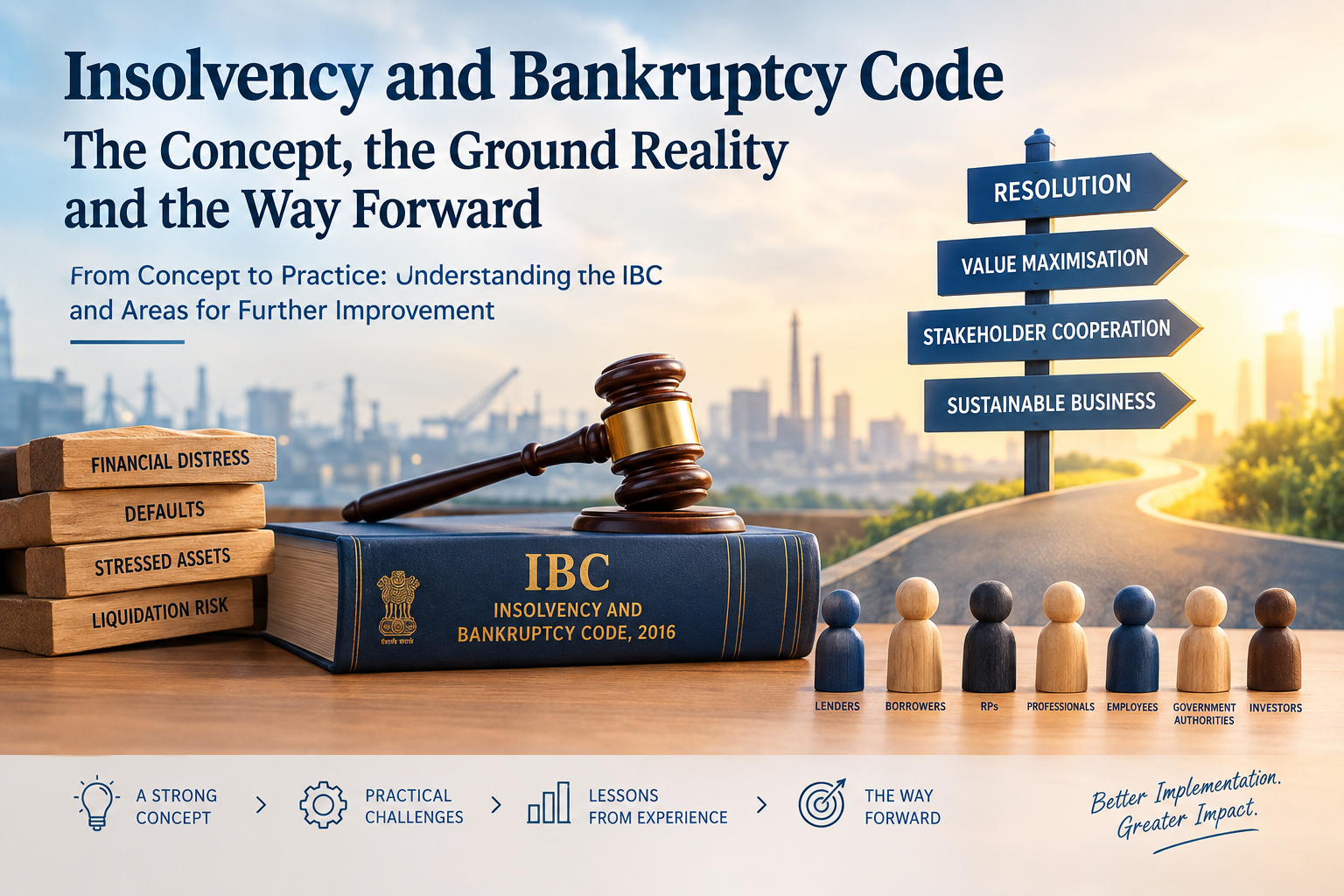
Insolvency and Bankruptcy Code: The Concept, the Ground Reality and the Way Forward
From Concept to Practice: Understanding the IBC and Areas for Further Improvement
A good concept becomes a great system when law, people and processes move together.
Ashok Kakkar, Advocate, Insolvency Professional, Former Banker, M.Com, LLB, LLM, CAIIB
Background
Every business passes through good times and difficult times. Financial stress is a normal part of economic life, and the way a country handles it decides whether jobs, supplier networks and productive assets are preserved or lost.
The Insolvency and Bankruptcy Code, 2016 (IBC) was introduced to bring a clear, unified and time-bound approach to such situations. Its core idea is a change in thinking: from merely recovering dues to attempting the resolution of viable businesses, with liquidation as the last option.
Nearly a decade later, the concept has become an important part of India’s financial and business environment. It has influenced how borrowers borrow, how lenders lend and how professionals work. At the same time, day-to-day experience shows that there is a natural gap between how a concept is designed and how it works on the ground.
This article explains the concept in simple language, describes the practical realities that arise in its working, and discusses how the framework can be strengthened further. It is meant for general awareness of business owners, bankers, professionals and students. It does not refer to any specific provision, authority, decision or case, and it is not intended to criticise any policy, institution or individual.
Part I: The Concept
1. From Recovery to Resolution
The central idea behind the Insolvency and Bankruptcy Code is a change in the question that is asked when a business falls into financial difficulty. The approach increasingly shifts the focus from asking only, “How can dues be recovered?” to also asking, “Can this business be saved, and if so, how?”
Where a viable resolution is possible, the emphasis is on resolution and preservation of value, while liquidation remains an important part of the overall insolvency framework where resolution is not achieved or is not commercially viable.
2. Why a Going Concern Matters
A factory that is running, with its machinery, workers, suppliers, customers and brand intact, is usually worth far more than the same assets sold piece by piece. This is the idea of a “going concern”.
Protecting a going concern protects livelihoods, supplier networks and market confidence. That is why the concept speaks of preserving and maximising value, and not merely of collecting dues.
3. One Collective and Time-Bound Process
Before the present framework, recovery and restructuring mechanisms operated through different laws and forums. The IBC brought a more integrated and collective approach to corporate insolvency resolution.
Time matters because value erodes quickly in distress. Machines become idle, customers move away and skilled people leave. A time-bound process aims to reach a decision while the business still has something worth saving.
4. A Positive Change in Credit Behaviour
One of the most visible benefits has been the change in behaviour of borrowers and lenders. Borrowers are more conscious that continued default can affect their position in the business. Lenders pay closer attention to early signs of stress and to regular monitoring.
As a result, many businesses settle dues or restructure in time, without the formal process ever being needed. In that sense, the concept works even in cases that never reach it.
Part II: The Ground Reality
5. Design on Paper, Diversity in Practice
On paper, the process looks orderly and sequential: commencement, appointment of a professional, invitation of claims, formation of the creditors’ committee, receipt of plans and a final decision. In practice, every case brings its own facts, its own people and its own commercial circumstances.
The gap between design and day-to-day execution is not a weakness of the concept. It is the natural result of applying a new and ambitious framework to a wide variety of real businesses, and recognising it is the first step towards improving how the framework works.
6. Many Participants, Many Perspectives
A typical case involves lenders, suppliers, the existing management, employees and workmen, valuers, auditors, legal and financial professionals, government departments, prospective investors and the adjudicating forum. Each has a defined role, yet each has different interests, different information and different pressures.
Bringing all of them towards a common goal needs communication, patience and mutual understanding. Rules provide the structure, but people make the process move.
7. The Resolution Professional: A Central Coordinator
The resolution professional sits at the centre of the practical process. Within a short time of appointment, the professional is expected to take charge of the business, protect its assets, verify claims, convene meetings, coordinate with authorities and facilitate the preparation of plans.
Each of these expectations meets a practical reality. Taking custody of assets may mean locating and securing assets that are scattered or in dispute. Verifying claims may mean working with incomplete or older records. Managing the creditors’ committee may mean balancing differing commercial interests and waiting for timely decisions. Regular reporting adds to the workload, and running the business may have to be done with very limited immediate funds.
This is why the role is far more than administrative. It combines the work of a manager, a coordinator and an independent fiduciary, and it calls for impartiality, sound commercial judgement and the ability to handle many tasks together.
8. Availability of Records and Information
A business that has been under stress for long may not have complete, updated or well-organised records. Accounts, asset registers, contracts and statutory filings may be scattered or delayed.
Reconstructing the true position, verifying transactions and understanding assets and liabilities takes time, and the time available is limited. Reliable information at the start is one of the biggest enablers of a good outcome.
9. Keeping the Business Running
A business in distress often already faces shortage of working capital, hesitant suppliers, anxious employees and concerned customers. If operations slow down or stop, value can fall quickly and the interest of prospective investors may reduce.
Preserving operations wherever commercially feasible is therefore not just an administrative matter. It protects the very value that the process is trying to maximise.
10. Funding in the Early Days
Even a process designed to rescue a business has costs. Security of premises, preservation of assets, valuation, professional assistance, public notices and essential operating expenses all need funds, and often right at the beginning.
When support is available in time, the professional can act without hesitation. When it takes longer, essential activities may have to wait. Expenditure that protects assets and keeps the business alive is best seen as an investment in preserving value for all stakeholders, and not merely as a cost.
11. Commercial Decision-Making by Creditors
The creditors’ committee is the main decision-making body, and its strength lies in commercial wisdom. Its decisions are never easy: they involve weighing immediate recovery against long-term value, the sacrifice creditors may have to accept against the chance of keeping a business alive, and the interests of different classes of stakeholders.
Institutional approvals, risk considerations and the need for careful evaluation naturally take time. Even so, the sooner well-informed decisions are taken, the more value there is left to protect.
12. Cooperation among Stakeholders
No single person or institution can make the process succeed alone. The existing management can provide information and records. Employees can share operational knowledge. Creditors can extend support and take timely decisions. Professionals and authorities contribute expertise and perform their respective functions.
Where each participant contributes constructively, many practical difficulties resolve quickly. In simple words, compliance provides the framework, but cooperation makes the process workable. It must also be remembered that resolution is not only a legal exercise. It is a blend of law, finance, accounting, valuation, management and negotiation, and its success depends on the commercial viability of the business as much as on the paperwork.
Part III: Making a Good Concept Even Better
13. Better Availability of Reliable Digital Records
Greater availability of authenticated digital records of debts and defaults, together with orderly digital storage of business information, can reduce disputes, shorten the time needed to verify claims and make reliable information available from the beginning of the process. The earlier such records are in place, the easier it becomes to take informed decisions in the limited time available.
14. Predictable Support for Essential Expenses
Since the first weeks of the process are particularly sensitive, simple and clearly understood arrangements for meeting essential costs can help prevent disruption in operations. A standard and predictable approach to early funding gives the professional the confidence to protect assets and keep the business running.
15. Strengthening Institutional and Professional Capacity
Cases are becoming larger and more complex, involving forensic accounting, valuation, turnaround management and sector-specific knowledge. Continuous training of professionals, bankers, advocates, accountants and valuers, along with steady strengthening of institutional capacity and resources, will help the system handle growing volume and complexity with confidence.
16. Timely and Practical Decisions
Prompt decisions, guided by the long-term productivity and viability of the business, help ensure that feasible plans are considered while the enterprise still retains its value. A practical, value-oriented outlook among all participants can make a decisive difference to outcomes.
17. Early Action by Promoters and Lenders
The best time to address stress is early, long before it becomes a crisis. Open communication between borrower and lender, honest assessment and timely corrective steps usually create far more options than waiting for the situation to deteriorate. The concept works best when it is used as a tool for revival and not as a last resort.
18. A Framework That Keeps Evolving
Like every major reform, the framework continues to develop through experience, amendments, regulatory guidance and judicial understanding. This continuous improvement is a sign of a healthy and responsive system, and the experience of those working in it will continue to guide the next steps.
Conclusion
The concept behind the Insolvency and Bankruptcy Code is sound and forward-looking. It recognises that a viable business is a valuable asset for the economy, and that timely, collective and professional handling of financial distress benefits creditors, employees, investors and society at large.
Practical experience shows that every case is different. The condition of the records, the state of the business, the availability of funds, the cooperation of stakeholders and the commercial viability of the enterprise all influence how a case unfolds. These are not defects of the concept; they are the realities of applying any good idea in the real world.
The lesson is clear: resolution is not achieved by legal provisions alone. It needs timely action, professional competence, commercial understanding and stakeholder cooperation. With continued learning, better use of technology, capacity building and a cooperative spirit, the framework can deliver its promise of timely, transparent and value-oriented resolution even more effectively.
Message to Readers
For business owners and promoters: Financial difficulty need not mean the end of a business. Speak to your lenders early, keep your records in order and take corrective steps in time. Early and honest engagement creates more options than delay.
For bankers and lenders: Early recognition of stress, regular monitoring and a practical, value-oriented outlook can protect both the account and the business. Timely support and timely decisions often make the difference.
For professionals: Technical knowledge must go hand in hand with commercial understanding, coordination skills, documentation and professional integrity. Continuous learning is the key to handling complex situations.
For students and the general public: Understand the idea behind the framework. It is not only about debt and default; it is about saving viable businesses, protecting livelihoods and strengthening the economy.
For all stakeholders: Compliance gives structure, but cooperation gives results. A system works best when everyone in it works together.
Disclaimer
This article is intended solely for educational and general awareness purposes. It presents a broad and simplified understanding of the insolvency framework based on practical experience and does not refer to or comment upon any particular case, authority, institution, individual or situation. It should not be treated as legal, financial, regulatory, insolvency or professional advice, and the views expressed are general in nature. Laws, regulations, procedures and judicial interpretations may change from time to time. Readers are advised to refer to the current applicable laws, regulations and guidelines and to obtain appropriate professional advice before acting on any specific matter.
#IBC #Insolvency And Bankruptcy Code #CIRP #Insolvency Resolution #Resolution Professional #IBBI #NCLT #Corporate Insolvency #Banking And Insolvency #Debt Resolution