
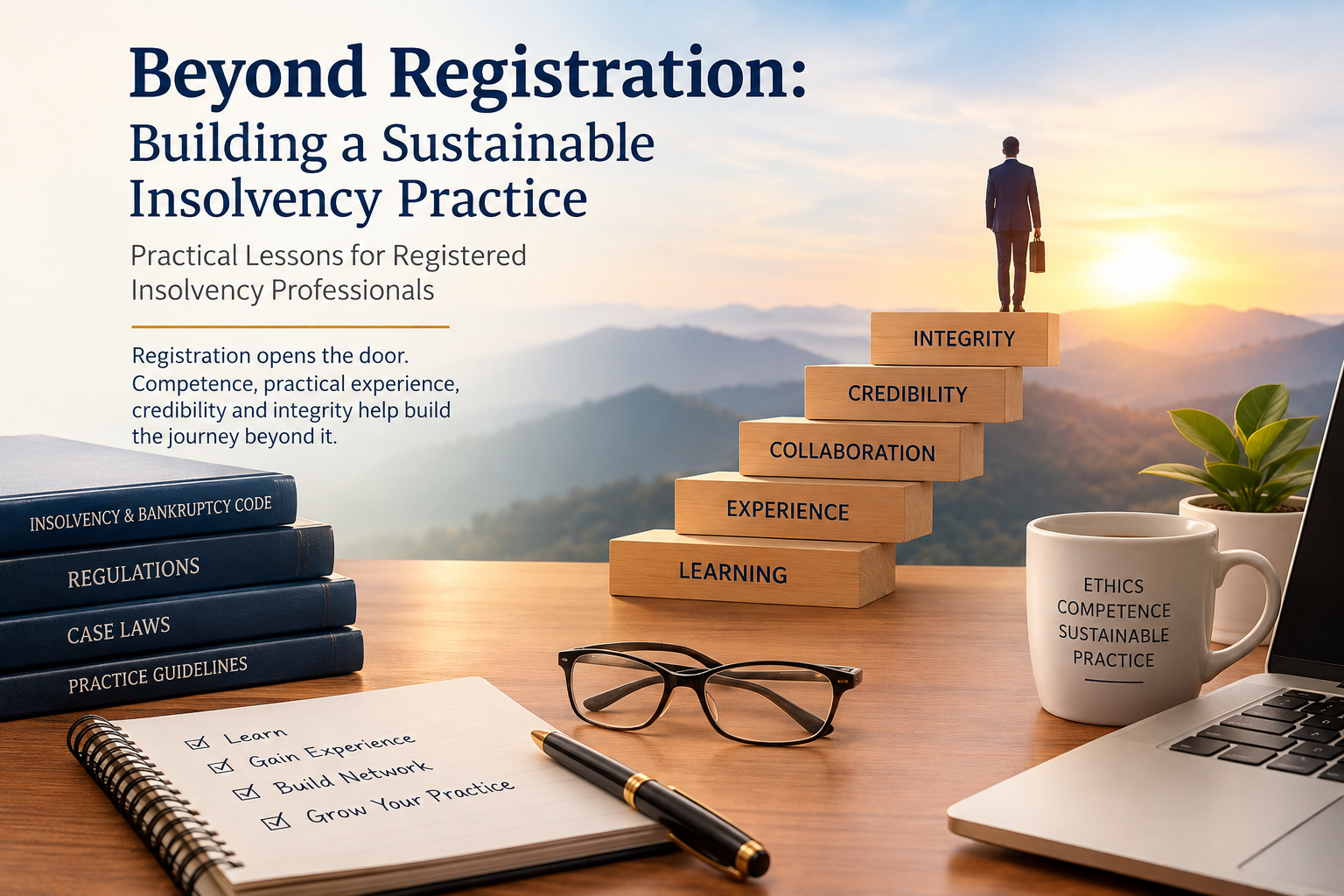
Beyond Registration Building a Sustainable Insolvency Practice
Practical Lessons for Registered Insolvency Professionals
Registration opens the door. Competence, practical experience, credibility and integrity help build the journey beyond it.
Ashok Kakkar
Advocate, Insolvency Professional and Banking Consultant
M.Com, LL.B., LL.M. and CAIIB
Background
The Insolvency and Bankruptcy Code, 2016 created a specialised professional role for Insolvency Professionals (IPs). It brought together professionals from different disciplines who meet the prescribed eligibility requirements and register with the Insolvency and Bankruptcy Board of India (IBBI).
Registration is an important milestone. It establishes eligibility to undertake assignments under the insolvency framework. But registration, by itself, does not create a professional practice. The real professional journey begins after registration, and it develops through continuous learning, practical exposure, operational competence, professional relationships, specialised knowledge and ethical conduct.
For some professionals, the period immediately after registration may not bring regular independent assignments. Rather than viewing such a period as inactivity, it can be used constructively to strengthen knowledge, gain practical exposure, develop a professional identity and prepare for future responsibilities. This article discusses practical approaches that registered Insolvency Professionals may consider while building a sustainable practice.
1. Registration Is the Beginning, Not the Destination
Insolvency assignments involve much more than knowing the provisions of the Code. An IP may have to deal with creditors, employees, management, statutory authorities, valuers, auditors and legal professionals, while simultaneously managing strict statutory timelines. There is a real difference between knowing the law and being ready to manage an insolvency assignment.
The period after registration can be used to bridge that gap. Instead of asking only, “When will I get my first assignment?”, a professional may also ask, “What should I learn, and what practical capabilities should I develop, so that I am ready when an assignment comes?” This change in perspective makes the early years far more purposeful.
2. Look Beyond the Traditional CIRP Assignment
Insolvency practice is wider than an appointment as Interim Resolution Professional or Resolution Professional. Depending upon eligibility, applicable regulations and professional competence, opportunities may arise in:
- corporate insolvency resolution and liquidation;
- voluntary liquidation;
- personal guarantor insolvency;
- Authorised Representative assignments for classes of creditors such as homebuyers or deposit holders;
- restructuring and turnaround-related work; and
- pre-insolvency preparedness and other activities connected with stressed assets.
Understanding these areas gives an IP a broader professional perspective. The objective is not to pursue every possible activity, but to identify the areas that genuinely match one’s qualifications, experience and competence.
3. Stay Alert to Regulatory and Professional Developments
The insolvency framework continues to evolve. The IBBI, the Insolvency Professional Agencies and other institutions issue notifications, guidelines, training opportunities and professional communications from time to time. A registered IP should develop a regular habit of following these, including empanelment and Expression of Interest invitations, Authorised Representative opportunities, training programmes, relevant judicial developments and the requirements relating to one’s own registration and profile.
Opportunities sometimes arise with relatively little notice. Being prepared is therefore part of professional practice.
4. Learn by Working Alongside Experienced Professionals
One of the most effective ways of developing practical competence is to work alongside professionals who are already handling live assignments. Association with an experienced Resolution Professional or an appropriate Insolvency Professional Entity gives exposure to matters that books and classroom programmes cannot fully convey, such as:
- verification and collation of claims;
- preparation for Committee of Creditors (CoC) meetings;
- monitoring the corporate debtor as a going concern;
- monitoring cash flows and process expenses;
- coordination with valuers, auditors and legal counsel;
- preparation of reports and applications; and
- statutory and regulatory filings.
Such experience also shows how experienced professionals deal with competing interests, incomplete information, time pressure and difficult commercial situations. The aim should not merely be to associate with a senior professional, but to learn how an insolvency assignment is actually managed.
5. Develop Operational Competence
An effective Insolvency Professional combines legal understanding, financial knowledge and practical management ability. Some of the most important operational areas are the following.
Claims management. Claims form the foundation of the process. Proper receipt, verification, classification, documentation and reporting require a systematic approach.
Going-concern management. The business may need to keep operating. Understanding operations, cash flows, employees, vendors and essential services is therefore important.
Committee of Creditors processes. An IP should understand how CoC meetings are prepared, conducted and documented, and how decisions are communicated to stakeholders.
Cash-flow and expense monitoring. Financial discipline preserves value and ensures transparency.
Coordination with other professionals. Valuers, auditors, advocates, accountants and other specialists may become part of an assignment, and their work must be coordinated effectively.
Documentation and compliance. Timelines and records matter. A sound system for maintaining correspondence, reports, approvals and filings improves the quality of administration.
These are practical skills, and they develop through repeated exposure and disciplined working methods.
6. Develop an Area of Focus
An IP may hold a broad understanding of insolvency law while developing deeper expertise in one or two areas. Possible areas include banking and stressed-asset resolution, real estate insolvency, MSME restructuring and pre-packaged insolvency, personal guarantor insolvency, avoidance transactions, liquidation, and restructuring and turnaround.
Specialisation does not mean restricting one’s practice. It provides a professional identity around which broader capabilities can be developed. The important point is to build on existing strengths rather than start from zero.
7. Use Earlier Professional Experience as an Asset
Many Insolvency Professionals enter the profession after years in another field. That experience is not separate from insolvency practice; it can become one of the professional’s strongest assets.
A former banker brings experience in credit appraisal, loan documentation, stressed assets, recovery, monitoring and lender relationships. A legal professional brings drafting skills, statutory interpretation, litigation experience and an understanding of judicial processes. A finance professional brings financial analysis, cash-flow assessment, audit and due diligence experience. A Company Secretary brings corporate governance, statutory compliance and regulatory reporting experience.
The strongest professional identity often emerges at the intersection of the earlier background and insolvency knowledge.
8. Consider Building an Advisory Capability
An Insolvency Professional need not depend entirely on formal proceedings. Subject to applicable laws, regulations and professional requirements, relevant advisory areas may include debt restructuring, business revival planning, stressed-asset and recovery-related advisory, insolvency preparedness, MSME turnaround support, financial due diligence, cash-flow assessment, and corporate governance and compliance guidance.
The purpose of such work is not simply to generate assignments. Advisory work helps an IP understand financial distress at an earlier stage, gain practical knowledge of restructuring and revival, and build constructive relationships with businesses, lenders and other professionals. Care should always be taken to ensure that any advisory engagement is consistent with applicable law, professional standards and independence requirements.
9. Build Visibility Through Knowledge Sharing
Professional visibility does not require aggressive promotion. For a professional, useful knowledge is often the best form of visibility. An IP can contribute through educational articles, analysis of important judgments, professional journals, seminars, lectures, webinars, training programmes and a credible website or digital knowledge platform.
The objective should be to explain, educate and contribute rather than merely advertise. Regular writing has another benefit: it compels the professional to study a subject carefully, examine different viewpoints and explain the issue in simple language. Over time, this strengthens both knowledge and credibility.
10. Build Relationships Across the Insolvency Ecosystem
Insolvency work is multidisciplinary. An IP may interact with banks and financial institutions, Asset Reconstruction Companies, advocates and law firms, Chartered Accountants, Company Secretaries, Cost Accountants, registered valuers, forensic and transaction auditors, management consultants, fellow Insolvency Professionals and Insolvency Professional Entities.
Relationships are best built through mutual learning, professional courtesy and contribution. A useful discussion on a recent judgment, a knowledge-sharing session, help on a technical issue, or simply staying in touch can gradually build trust. Relationships developed in this way become valuable sources of knowledge, collaboration and professional support.
11. Keep Learning Beyond the Code
Insolvency practice does not operate in isolation. An IP dealing with a distressed business may need an understanding of banking, finance, valuation, corporate law, taxation, securities regulation, commercial contracts, recovery laws, negotiation and business operations.
A useful routine includes regularly reviewing important decisions of the Supreme Court, NCLAT and NCLT, following IBBI notifications and regulatory developments, and studying subjects connected with one’s chosen area of practice. The aim is not to know everything. It is to remain professionally current and practically useful.
12. Use Technology to Improve Professional Practice
Technology supports both external visibility and internal working systems. A simple professional website, networking profile or knowledge repository makes useful work accessible to a wider audience. Within the practice, technology assists with document management, case tracking, calendar and deadline management, digital records, virtual meetings, structured databases and secure communication.
Technology does not replace professional judgement. Its real value lies in helping the professional remain organised, responsive and better prepared.
13. Use Periods Without Assignments Wisely
This may be the most important practical question for a newly registered or relatively inactive professional. A period without an assignment need not be regarded as wasted time. It can be used to:
- study recent judgments;
- improve drafting and documentation skills;
- understand claims and CoC processes in depth;
- work with experienced professionals;
- develop checklists and templates;
- study a specialised area;
- write articles or case notes;
- attend professional programmes;
- build professional relationships; and
- organise the systems required for future assignments.
Professional growth often follows a natural sequence: registration, learning, practical exposure, specialisation, visibility, wider relationships, advisory capability and, in due course, independent practice. This is not a rigid formula, and every professional follows a different path. But it illustrates a useful principle: independent practice is easier to handle when it is supported by knowledge, experience and preparation.
Waiting for an appointment and preparing for an appointment are two very different approaches. The objective is to ensure that when an opportunity comes, the professional is better prepared than before.
14. Ethics, Independence and Patience Matter
Insolvency is a profession in which credibility is particularly important. An IP balances the interests of multiple stakeholders while exercising independent professional judgement. Integrity, independence, objectivity, confidentiality, diligence and proper documentation are therefore not merely formal requirements; they are the foundation of professional reputation.
Professional growth also takes time. There may be periods of opportunity and periods of limited activity, and a sustainable practice is rarely built overnight. Patience, however, should not mean inactivity. Patience should be accompanied by preparation.
A Practical Checklist for Registered Insolvency Professionals
A professional may periodically ask:
- Am I keeping myself updated with important regulatory developments?
- Am I gaining practical exposure to live insolvency work?
- Do I understand the operational side of resolution and liquidation processes?
- Have I identified an area in which I can develop deeper expertise?
- Am I making effective use of my earlier professional experience?
- Am I building relationships across the insolvency ecosystem?
- Am I sharing useful professional knowledge?
- Are my records, systems and templates organised?
- Am I maintaining appropriate professional standards and independence?
- What have I learnt during the last six months, and what capability should I develop next?
These questions are simple, but they help convert professional uncertainty into a structured development plan.
Conclusion
Registration as an Insolvency Professional is an important achievement, but it is the beginning of a professional journey rather than its conclusion. A sustainable practice is built gradually through technical knowledge, practical exposure, operational competence, professional relationships, focused expertise, continuous learning and ethical conduct.
There may be periods when independent assignments are limited. Such periods can nevertheless be productive when used for learning, collaboration, research, writing and preparation. The profession offers several avenues for learning and contribution, including formal assignments, liquidation, representation of creditor classes, restructuring, advisory work, teaching, research and knowledge sharing, always subject to applicable legal and professional requirements.
Ultimately, professional reputation is not created only by the number of assignments handled. It is built through the quality of work, depth of knowledge, reliability, integrity and the value contributed to the profession.
Message to Readers
If assignments are not coming immediately, do not allow the waiting period to become a period of professional inactivity. Keep learning. Gain practical exposure. Build your strengths. Share knowledge. Develop relationships. Stay prepared.
Registration may open the door, but it is competence, credibility and integrity that help build the journey beyond registration.
Disclaimer: This article is intended solely for educational awareness and professional discussion. It is general in nature and should not be construed as legal, regulatory, professional or financial advice. The availability and scope of any assignment or professional activity are subject to the applicable law, regulations, professional standards and requirements in force from time to time. Readers should refer to the applicable laws, regulations, notifications and official guidelines, and obtain appropriate professional advice, before taking any decision or action.
Keywords: Insolvency Professionals, Insolvency Practice, IBC, Insolvency and Bankruptcy Code, IBBI, Insolvency Resolution, Liquidation, Banking Consultancy, Stressed Assets, Restructuring, Professional Development, Insolvency Advisory, Banking and Insolvency, Legal Practice