
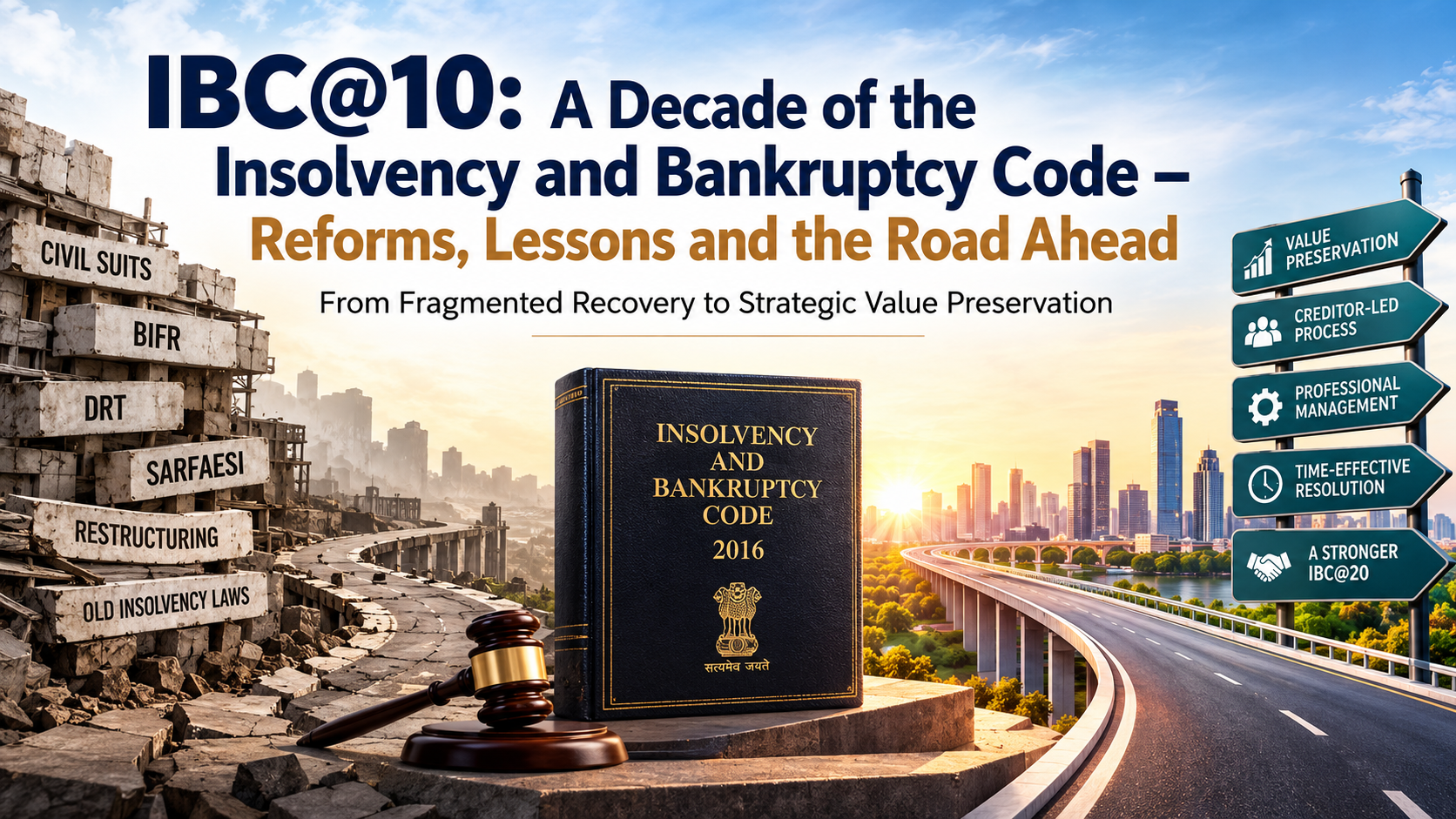
IBC@10: A Decade of the Insolvency and Bankruptcy Code – Reforms, Lessons and the Road Ahead
From Fragmented Recovery to Strategic Value Preservation
A general awareness article on how India’s insolvency framework began, what ten years have taught, and where it is heading
Ashok Kakkar | Advocate | Insolvency Professional | Former Banker | M.Com | LL.B. | LL.M. | CAIIB
Background
The Insolvency and Bankruptcy Code, 2016 (IBC) completed ten years in 2026. A decade is long enough to ask three simple questions: why was the Code needed, how has it worked, and what must change now? This article answers them in plain language, for students, professionals, entrepreneurs and bankers.
The Code changed the central question of distress. The earlier question was, “How do we recover our dues from the borrower?” The IBC added another: “Can the business be saved, and who is best placed to run it?”
1. Before the IBC – Why a New Framework Was Needed
Before 2016, India did not lack laws on recovery, restructuring and winding up. What it lacked was one coordinated, time-bound system. The main mechanisms were these:
(i) Civil suits and winding up. Lenders could sue for recovery, and creditors could seek winding up of a company through the High Court. Both routes were slow, and by the time a liquidator was appointed much of the business value had often disappeared.
(ii) BIFR. The law on sick industrial companies created a forum for revival, but protection under it was sometimes prolonged while the unit continued to decline.
(iii) Debt Recovery Tribunals and SARFAESI. These gave banks faster tools for recovery and enforcement of security. They focused on the debt and the asset, not on the survival of the enterprise, and did not bring all creditors to one table.
(iv) Out-of-court restructuring. Corporate debt restructuring and regulatory schemes helped lenders rework loans, but depended on consent, carried no legal moratorium and sometimes postponed the problem.
(v) Old insolvency statutes. Insolvency of individuals and firms was governed by colonial-era laws not designed for modern credit.
The larger concern was value. A business under prolonged stress loses customers, skilled employees, working-capital support and market relationships. By the time a process ended, the enterprise could be worth far less than when distress first appeared. India needed a framework that acted earlier, brought stakeholders into one organised process, and provided either revival or orderly exit.
2. How the IBC Came into Being
Step 1 – Study and recommendation. Earlier committees and amendments had improved parts of the system, but not created a single framework. In 2014 the Government constituted the Bankruptcy Law Reforms Committee under Dr. T. K. Viswanathan.
Step 2 – Report and draft Code. In November 2015 the Committee submitted its report and a draft Code, built on a clear moratorium, creditor-led decisions, professional management, strict timelines and an independent regulator.
Step 3 – Parliament. The Bill was introduced in December 2015, examined by a Joint Parliamentary Committee, passed in May 2016, and received assent on 28 May 2016.
Step 4 – Institutions and commencement. The Insolvency and Bankruptcy Board of India (IBBI) was established in October 2016. Corporate insolvency provisions came into force in December 2016, with other parts following in stages.
3. What the IBC Changed
The Code consolidated the law on insolvency, liquidation and related matters. Its aims include maximising the value of assets, promoting entrepreneurship, improving availability of credit and balancing stakeholder interests. Revival as a going concern comes first; liquidation is the last resort. Control of the company during the process moves from the suspended management to the resolution framework, with the Committee of Creditors (CoC) taking key commercial decisions.
The framework works through defined functionaries. The National Company Law Tribunal (NCLT) is the adjudicating authority for companies, admitting applications, declaring the moratorium and approving plans; appeals go to the National Company Law Appellate Tribunal (NCLAT) and then the Supreme Court. IBBI is the regulator of insolvency professionals, agencies and information utilities. Insolvency Professional Agencies enrol and discipline professionals. The Insolvency Professional manages the affairs of the company during the process, subject to the framework of the Code and the oversight of the Committee of Creditors. Registered valuers assess value, and Information Utilities store verified records of debt.
4. How Corporate Insolvency Resolution Works
A simplified outline, for general understanding only:
Step 1 – Default. A company fails to pay a debt that is due.
Step 2 – Application. A financial creditor, operational creditor or the company itself applies to the NCLT.
Step 3 – Admission and moratorium. On being satisfied that default exists, the Tribunal admits the application. A moratorium then bars suits and recovery actions, protecting assets while a solution is sought.
Step 4 – Interim Resolution Professional. A professional takes over management, the board’s powers are suspended, and a public announcement invites claims.
Step 5 – Claims. Creditors submit claims; the professional verifies them and prepares the list of creditors.
Step 6 – Committee of Creditors. Financial creditors form the CoC, which guides the process and may confirm or replace the professional.
Step 7 – Running the business. The company continues as a going concern under CoC oversight so that value does not erode.
Step 8 – Information and valuation. An information memorandum is prepared and registered valuers assess the business.
Step 9 – Resolution plans. Eligible investors, called resolution applicants, submit plans for revival, takeover or restructuring.
Step 10 – CoC decision. The CoC evaluates the plans and votes on the one it considers best.
Step 11 – Tribunal approval. The NCLT checks that the plan meets legal requirements. Once approved, it binds the stakeholders as the Code provides.
Step 12 – Implementation or liquidation. The plan is implemented under monitoring. If no plan is approved within the time allowed, the company goes into liquidation, the last resort.
The Code provides an overall framework of statutory timelines, including an outer limit of 330 days in the circumstances specified under the Code
5. The Early Challenges
A new law, new institutions and a new profession had to be built together, so teething troubles were natural. The main practical hurdles were these:
(i) New roles and institutions. Insolvency professionals, registered valuers and information utilities were unfamiliar concepts, and capacity, standards and acceptance took time to build.
(ii) Delay at admission. Applications sometimes took longer to admit than intended, and value kept eroding in the meantime.
(iii) Litigation. Disputes on eligibility, claims, creditor classes and valuation extended many cases beyond the expected timelines.
(iv) Limited tribunal capacity. The volume of cases was large compared with the number of benches and supporting infrastructure.
(v) Legal uncertainty. Questions on the position of operational creditors, homebuyers, statutory dues and personal guarantors needed judicial clarification, which over time gave the Code a more stable foundation.
(vi) Information gaps. Records were often incomplete at the start and suspended management did not always cooperate.
(vii) Valuation, cost and misuse. Differences in valuation, the cost of running the process, and misuse of the process or gaps in the law led to repeated amendments.
6. Ten Years of Experience – Achievements and Lessons
Despite the hurdles, the first decade has been one of real progress:
1. A recognised ecosystem. The Code has established a professional class in insolvency, valuation and distressed-asset management.
2. Stronger credit discipline. The prospect of losing control has become a serious consideration for borrowers, and lenders pay more attention to early-warning signals, documentation and security.
3. Creditor-led decisions. The fate of a stressed company is now decided by the Committee of Creditors and not by the defaulting management alone.
4. Revival and restructuring. The IBC has become an important mechanism for dealing with stressed assets in the banking system, and many businesses have been revived, taken over or restructured.
5. Judicial and regulatory refinement. Amendments, regulations and court decisions have steadily refined the framework, including a pre-packaged route for small enterprises.
The decade also showed that a good statute does not by itself guarantee speedy resolution. Delays, information gaps, litigation and cost continued to affect outcomes. In many cases timelines were “time-bound on paper” but not always “time-effective in practice.”
7. IBC 2.0 – The 2026 Amendments
The Insolvency and Bankruptcy Code (Amendment) Act, 2026 received Presidential assent on 6 April 2026, and key provisions were brought into force from 26 May 2026. IBBI regulatory amendments followed at different dates during 2026. These changes were needed because delay before admission, poor early information, valuation disputes, rising costs and value-diverting transactions were weakening the benefits of the Code. In broad terms the reforms move in five directions:
1. Disciplined commencement. Greater emphasis on deciding admission applications within the prescribed fourteen days, so delay does not itself destroy value.
2. Better information at the start. Fuller disclosures at filing and wider powers to obtain records, so the professional can move from collecting data to stabilising the business within the first weeks.
3. Enterprise value. Valuation looks at the business as a whole, including synergies between assets, rather than a mere total of individual assets.
4. Accountability and cost discipline. A formal assessment of whether continuing the business preserves value, closer control of costs, reasons for decisions on claims, and documented grounds for creditor decisions.
5. Cleaner exits and special situations. Quicker closure of empty shells, a last window to restore resolution before liquidation, better treatment of identifiable homebuyers, and smoother use of guarantor assets in a plan.
These are directions of change, not a checklist of rules. The practical message for readers is that the process is being front-loaded: more work, more information and more discipline at the beginning, so that there is more time and value left for genuine resolution.
The Act also contains enabling provisions for a creditor-initiated, out-of-court resolution process for notified creditors and companies, and for group and cross-border insolvency. Much of this depends on further rules and notifications. Readers should distinguish between a provision that has been enacted, one that has been brought into force, one that is operational, and one that is still to come, and should verify current status on official sources before relying on it.
8. From Time-Bound to Time-Effective Resolution
The central shift of IBC 2.0 is from deadlines on paper to results in practice. The question is no longer only whether proceedings are legally time-bound, but whether they actually protect enterprise value while remaining fair and transparent to all stakeholders. Early attention to transactions made before insolvency is part of this. Financial distress often develops long before admission, and value can be diverted in the gap between filing and admission. Forensic findings, however, are an input and not a substitute for the professional’s own independent judgment.
A professional examining such transactions may ask where the company’s assets went, whether dealings with related parties were at arm’s length, whether value was transferred out, and whether the evidence is strong enough to withstand scrutiny. Good outcomes in this area also depend on what lenders did before insolvency, such as perfecting security and monitoring accounts.
9. The Changing Role of the Insolvency Professional
The Resolution Professional is increasingly a manager of a business in distress, not merely an administrator of procedure. The role calls for understanding of banking and credit, corporate finance, valuation, forensic review, legal proceedings, negotiation and technology. No individual need perform every function, but the professional must be able to integrate the work of specialists. Documentation matters too, since a decision may later be examined by the Tribunal or an appellate forum. The Insolvency Professional manages the affairs of the company during the process, subject to the framework of the Code and the oversight of the Committee of Creditors.”
For banks the lesson is equally clear: the IBC starts before Section 7 is filed. Early recognition of stress, regular monitoring, proper documentation and perfection of security shape the outcome of any later process. For resolution applicants, the clean-slate principle developed by the courts offers certainty, but careful due diligence remains essential.
10. Technology, Group Insolvency and Cross-Border Insolvency
Modern businesses often operate through interconnected group companies and may have assets or creditors in several countries. Group and cross-border frameworks are therefore the next frontier, and their detailed operational rules continue to evolve. Technology will also play a larger role: claim reconciliation, transaction mapping, related-party identification and digital due diligence can save time and highlight anomalies. But technology remains an enabler, not a substitute for professional judgment. An automated finding must still be verified against primary records and be capable of defence in law.
11. Looking Towards IBC@20
The next decade may bring earlier intervention in stress, wider use of pre-insolvency and pre-packaged routes, creditor-initiated mechanisms, coordinated group resolution, better monitoring of approved plans and professional management of distressed assets. The aim is not to increase the number of proceedings, but to resolve distress before value is needlessly destroyed.
IBC@10 in Brief
Before 2016, recovery was fragmented. In 2016 the Code created one framework with creditor-led decisions, professional management and statutory timelines. The first decade built institutions, produced judicial guidance and exposed practical delays. In 2026 the Amendment Act began a second phase aimed at time-effective resolution, with some provisions already in force and others awaiting operationalisation.
Conclusion
The first decade turned a fragmented recovery system into a creditor-led, time-bound and market-oriented resolution framework, produced a new profession and a body of judicial guidance, and made revival of distressed businesses a practical possibility. It also showed where the system needs strengthening.
The real measure of success in the second decade will not be the number of cases admitted, but the ability of the system to resolve distress before the economic value of the business disappears. The first ten years established the framework. The next ten must strengthen its execution.
Message to Readers
To bankers: good insolvency outcomes begin with sound credit administration and early recognition of stress. To business owners: treat early financial stress seriously, keep clean records and engage creditors transparently, since delay narrows everyone’s options. To insolvency professionals: combine legal compliance with commercial understanding and independent judgment. To investors: distressed assets offer opportunity, but only with rigorous due diligence. To students: this is a growing field combining law, finance, valuation and technology. IBC@10 is not an end point; it is the beginning of the next stage of India’s insolvency journey.
Disclaimer: This article is intended for general educational and professional awareness. It is not legal, financial or professional advice. Insolvency laws, regulations, notifications and their status of implementation may change from time to time. Readers should refer to the latest applicable provisions and official notifications and obtain professional advice for specific matters.
Keywords: Insolvency and Bankruptcy Code, IBC 2016, IBC@10, IBC 2026 , CIRP, Resolution Professional, CoC, NCLT, NCLAT, IBBI, Debt Resolution, Value Preservation, IBC 2.0, Group Insolvency, Cross Border Insolvency,